Subversive Chinese Brush-Up at the Met

Yang Jiechang’s Crying Landscape (2003) shares the Gallery for Art of Ancient China with a sandstone stele from the Northern Wei dynasty (489-495) and the 1319 Buddha of Medicine.

Yang Jiechang’s Crying Landscape (2003) shares the Gallery for Art of Ancient China with a sandstone stele from the Northern Wei dynasty (489-495) and the 1319 Buddha of Medicine.

Normally, the galleries for Asian Art at the Metropolitan Museum of Art are pretty tranquil. But through April 6, you’ll find them buzzing with contemporary art lovers reveling in the hunt to find the most famous, subversive, subtle works by Chinese painters, sculptors, and digital artists residing amidst centuries-old treasures in the widely popular exhibition, Ink Art: Past as Present in Contemporary China.

The Met gave the Chinese art curators free reign to pluck sly works from the in-house contemporary collections created by Chinese artists over the last 20 years, grab monumental works from private collectors, and mount a tribute to how post-Cultural Revolution innovators parse the traditions associated with centuries-old art making in their ancestral country.

How do the hottest artists on the planet turn calligraphy and inked woodblocks into biting social commentary? Take a stroll through the second floor Asian art wing.

Inspired by Cultural Revolution posters, the letters in Wu Shanzhuan’s Character Image of Black Character Font (1989) have no meaning.

Inspired by Cultural Revolution posters, the letters in Wu Shanzhuan’s Character Image of Black Character Font (1989) have no meaning. Courtesy: Private collector, the artist.

Just past the balcony-bar area, the monumental 1319 Buddha of Medicine mural from Shanxi Province, China, casts a benign presence over the Gallery for Art of Ancient China. But just stage right, two larger-than-life works on paper preview how Chinese artists twist the “then” into the “now”.

Yang Jiechang’s Crying Landscape panels are painted in the beautiful, colorful “old school” flat Asian style but depict decidedly unbeautiful industrial and political subjects. Similarly, Qiu Zhirie’s Nanjing Yangzi River Bridge ink triptych features masterful, large-scale ink-brush technique but uses art-world icons to relay a disturbing story. It’s an installation triumph that will haunt you every time you pass through that room again.

Large-scale calligraphy by many of the artists makes ink-pot-and-brush tradition echo with gestures as large as Rothko’s. In the galleries with meticulously crafted “landscape” drawings and images, you’ll ask how this modern crew managed to produce scrolls with such heft and detail. Take a walk-through of the show through our Flickr site.

In 1995, Ai Weiwei corporatized a Han Dynasty (206 B.C. – 9 A.D.) earthenware jar.

In 1995, Ai Weiwei corporatized a Han Dynasty (206 B.C. – 9 A.D.) earthenware jar. Courtesy: M + Sigg, the artist

Along the way to back of the wing, the curators play hide-and-seek, putting Ai Weiwei’s “enhanced” Han Dynasty jar right in the aisle with the “unmodernized” earthenware vessels, and mounting Hong Hoo’s subtly colored, hilarious historical “atlas” silkscreens in a case that practically dares unfocused visitors to pass them by as they drift toward the Astor Court.

Hopefully by the time they get to the rock garden they will notice Zhang Jianjun’s crazy pink silicone rubber “scholar rock” right next to the real ones. Zhan Wang’s stainless steel scholar rock and Shou Fan’s side chairs are beautifully arranged in the Ming Dynasty room just off the Court, along with more of Ai Weiwei’s furniture hijinx.

After you’re done getting a feel for how the galleries have been transformed, go back into the Met’s exhibition web site to study the brushwork and details and get to know some of the artists.
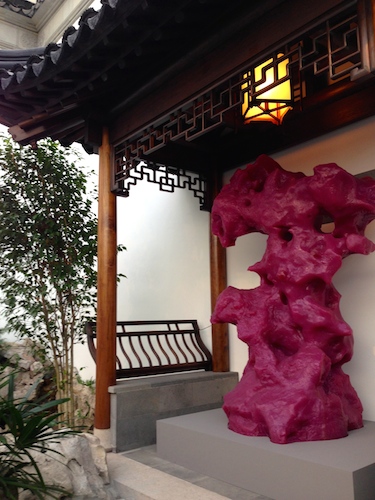
Zhang Jianjun’s 2008 silicone rubber Scholar Rock (The Mirage Garden) sits in a 17th-century pagoda in the Met’s Astor Court

Zhang Jianjun’s 2008 silicone rubber Scholar Rock (The Mirage Garden) sits under a 17th-century pagoda in the Met’s Astor Court. Courtesy: Sigg Collection, the atist

Although the web site appears to be more plain-vanilla than jazzy, you’ll be surprised to see that the digital back-end of the Met archives lets you zoom into each of the paintings to see the handsome handwork of each of these wunderkinds from each thematic section of the show. You can even peruse the gigantic scrolls up close, section by section.

The video room, where art lovers can relax and watch a rotating collection of work, is a nice touch. The modern digital sign to the side tells you exactly where you are in the rotation.

Here’s a link to one of the featured videos: Get to know the constantly transforming cityscape of Beijing through Chen Shaoxiong’s 2005  Ink City, and see what happens when a contemporary artist paints daily life in Beijing with traditional tools and ports his day-to-night experience to video.
Berlin Artist Loves NYC and MoMA Loves Her Back

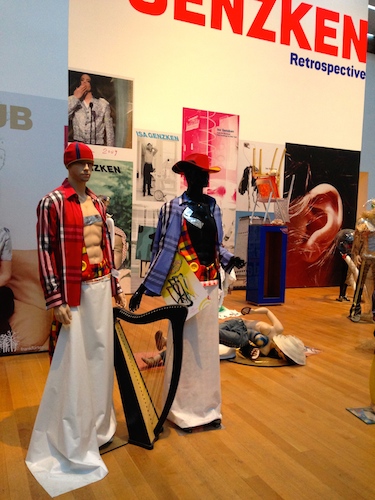
Schauspieler (Actors) (2012-2013) welcome visitors to Isa’s show.

Isa’s Schauspieler (Actors) (2012-2013) welcome visitors.

Early in her art career, she zigged and zagged and eventually found inspiration in New York, but  then who hasn’t? Take a ride at MoMA through the career of an “artist’s artist”, Isa Genzken Retrospective, through March 10.

On a weekend with the bit-of-everything Biennial debut, why not also see work a sculptor who’s done it all herself — tried a little bit of everything on a career-long journey through computerized wood, concrete and electronics, resin, subversive architectural models with ready-mades, and mannequin-and-outfit art. Hey, she’s a one-woman Armory Show!

We have highlights on our Flickr feed, but MoMA’s digital interactive team has done an outstanding chronology of this Berlin artist’s invention over the past 40 years. Click through the show on the web, read the label copy, and enjoy the audio tour.

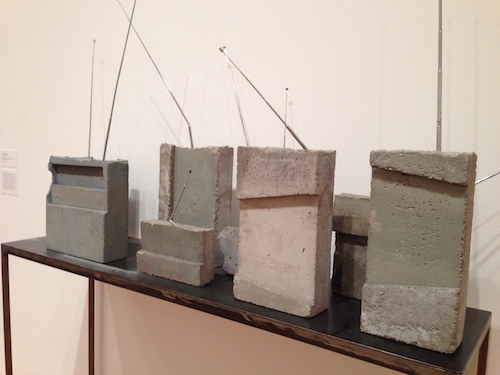
Weltempfänger (World Receiver) (1987–89) mimic the real thing in concrete

Weltempfänger (World Receiver) (1987–89) mimic the real thing in concrete

What we found interesting: Back in the late 1970s, she wondered what it would be like to design sculptures on computers and ended up making huge wooden sculptures that took collaboration with physicists and carpenters. To put her achievement in perspective, her 1980 sculptures were displayed at a time when the Mac was still essentially a garage project. Good going, girl!

Around the same time, she became captivated by electronics and began experimenting with collages, sculptures, and ready-mades with hi-fi equipment and wideband radio receivers.

Fenster (Window) (1992) installed under a MoMA skylight from which you can see the buildings outside.

Fenster (Window) (1992) installed under a MoMA skylight from which you can see the buildings outside.

MoMA’s installed a spectacular gallery populated with large, high, dramatic, airy structures that she made in the 1990s. Are they windows? Empty stretchers for paintings? Look closely and you’ll see that they are made of see-through resin. It’s all the more mysterious because their tops are reaching up to Midtown’s rectangle skyscrapers visible through MoMA’s own window. (You’ll feel like you’re in Stacy and Clinton’s 360, except it’s reflecting Modern architecture.)

It’s a nice gateway to what lies beyond – a room filled with work inspired by her first trips to New York in 1995-1996. She loved what she saw.  She collected mementos of her Downtown travels – invites to clubs, flyers, posters, gallery notices, calling cards – and made them into bright, colorful scrapbooks.

In 2000, she went on another collecting trip from her flat near Wall Street to pay tribute to the City’s world-class skyscraper architecture that so inspired her.

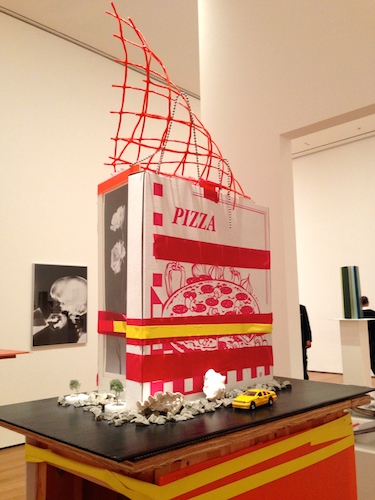
Genzken’s 2000 series that paid tribute to NYC's modernist architecture. A sly Tatlin touch.

Genzken’s 2000 series that paid tribute to NYC’s modernist architecture. A sly Tatlin touch.

But rather than rely on “substantial” materials to interpret hard-edge Modernist design, she cobbled together vignettes of toy cars, pizza boxes, and other ready-mades holding it all together with brightly colored adhesive tape. (As you walk through her tall plywood stands perusing her cityscapes, watch out for the tiny Hula-Hair-Barbie-wannabe toy standing along the narrow pathway facing the gallery wall.)

And be sure to look up. On the ceiling above, she’s showing a film shot on the noisy city streets, interspersed with tranquil river views of the Hudson.

There’s much more to the exhibit – commentaries on corporate America (featuring Scrooge McDuck) and her phenomenal we-are-all-actors-in-this-crazy-life installation at the entrance. You can’t really describe it.

And don’t worry if you’ve never heard of Isa before, as this MoMA YouTube attests. If you have 20 minutes, take a tour of Berlin, New York, and the Venice Biennale through the eyes of Isa’s fans — Lawrence Weiner, Wolfgang Tilmans, Dan Graham, and a host of German gallery owners, collectors, and curators:

Take a stroll through Isa’s work in person at the Museum of Contemporary Art Chicago (April 12-August 3) and the Dallas Museum of Art (September 14 – January 4).

Oldest Painted Theater Curtain in America on View in NC

The original 1858 William Russell Smith drop curtain, displayed in Thalian Hall’s Parquet Hall

The original 1858 William Russell Smith drop curtain, displayed in Thalian Hall’s Parquet Hall

Lincoln was prepping for his sixth debate with Douglas in Illinois when the curtain went up on October 12, 1858 at Thalian Hall in Wilmington, North Carolina – the same curtain, still on display, that is considered to be the oldest existing theater drop in America, painted by Philadelphia-trained landscape artist William Russell Smith.

Back in the 1850s, major theaters up and down the East Coast were in pursuit of the classically trained Smith to create romantic, ethereal landscape images on the gigantic canvas curtains that audiences saw when they entered opera houses. Typically framed by an ornate proscenium, the drop transported theatergoers to the work of make-believe, Moliere, and Macbeth – staples of the touring companies and troupes of the time.

Detail of original drop curtain, done in distemper on 30-foot canvas

Detail of 1858 curtain, distemper on a 30-foot canvas

Today, except for Wilmington’s Thalian Hall treasure, those grand masterpieces are gone, victims of time, decay, and impermanence like the superstars of yesteryear. It’s quite a miracle that Thalian’s original curtain has still survived, considering that it’s not painted in oil, but distemper – a less permanent, water-soluable medium, essentially colors ground into glue. When an artist applies the wet pigment, he sees the opposite color, which gradually turns into the “true” color when the paint dries. It’s a process that could only be executed by a skilled master, particularly on a 30-foot wide canvas. The surface of the curtain holds the granules (like a piece of paper holds pastel fragments).

Wilmington, NC’s Thalian Hall, built 1855-1858, one of the oldest continuously operating theaters in the South

Wilmington, NC’s Thalian Hall, built 1855-1858, one of the oldest continuously operating theaters in the South

No wonder Smith purpose-built a huge studio in his home with poles that could be raised and lowered as he worked on a gigantic scale first with a charcoal sketch, then with distemper (move over, Chuck Close!). When Smith finished painting his commission, he carefully folded the canvas, rolled it on a long pole, and had it delivered to the opera house.

Thalian Hall received its long-distance delivery this way, because Smith never set foot in North Carolina. The new opera house was designed by New York architect John Trimble, who built Barnum’s Museum and many New York theaters of the mid-1800s, including the New Bowery. Smith’s curtain was the finishing touch, depicting an Aegean sailing ship arriving at classical islands filled with temples dedicated to Apollo, evoking commencement of the ancient Olympiad.

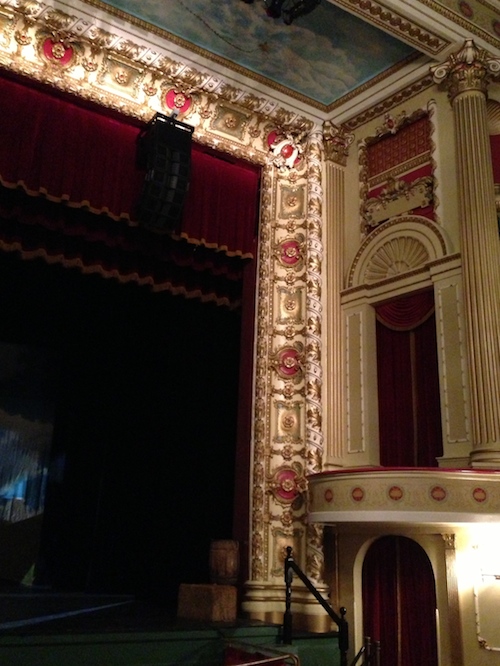
Detail of Thalian Hall's beautifully restored proscenium and box

Detail of Thalian Hall’s beautifully restored proscenium and box

The curtain was in service from 1858 until 1909, when a restoration was planned. Historians know it was hung again by 1938 (see the photo in our Flickr feed). It got hurt a little in the 1940 WPA renovations, and was known to be back in place in 1947, but disappeared after 1963. It was rediscovered in 1979, when Mrs. Juanita Menick, the president of the board, told the new Thalian director that she might still have an old curtain that she took years ago to her home for safekeeping. Thank goodness for those large, Southern homes.

Although only 15 feet of the original 30-foot drop remained, tribute was paid to the historic artwork. The fragile canvas was used as part of the set for Thanlian Hall’s 125th anniversary celebration, and now hangs, ready for its closeup, in the luxurious entry to the theater’s orchestra section.

Hear how executive director Tony Rivenbark rediscovered it, and watch historian David Rowland’s talk about the life of William Russell Smith (at 4:20), whose romantic landscapes of New England somewhat predated the Hudson River School; the imagery used in the magnificent theater curtains (at 30:22); and the astonishing discovery recently made in Smith’s grand studio (at 35:30) in this YouTube video.

Thalian Hall's balconies and orchestra

Thalian Hall’s balconies and orchestra

You can read more about the historic theater on its website (and check out the video on Thalian’s “thunder roll” device, another “only remaining in America” theatrical wonder). Glimpse more of this theater’s grandeur and photos of the illustrious performers who have trod its boards on our Flickr feed.

In Wilmington, you can view this remarkable piece of theater history any time during box office hours.

History Twist in Brooklyn’s Period Rooms

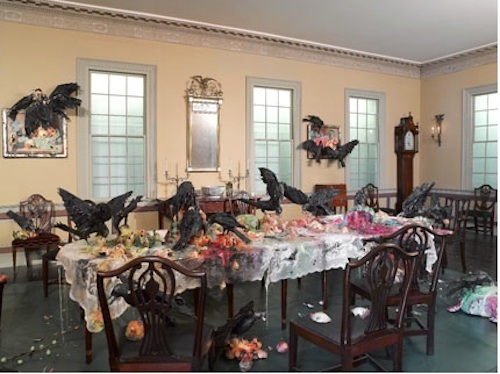
Hegarty’s “activation” of the Cane Acres Plantation dining room: Still Life with Peaches, Pear, Grapes and Crows; Still Life with Watermelon, Peaches and Crows; and Table Cloth with Fruit and Crows. Photo: Brooklyn Museum

Hegarty’s “activation” of the Cane Acres Plantation dining room including Still Life with Watermelon, Peaches and Crows. Photo: Brooklyn Museum

The Brooklyn Museum’s Period Rooms are again the focus of a rip-roaring, history-tearing, upside-down interpretation by an installation artist. Go before December 1 to see what’s happened to three rooms up on the museum’s Fourth Floor in Valerie Hegarty: Alternative Histories.

The dining room from the South Carolina’s Cane Acres Plantation is alive with dozen or so papier-mâché crows that are chowing down on the faux watermelons and peaches that you imagine to have been so beautifully arranged on the long, grand table.

Peering into either of the two plantation doorways, it’s disconcerting to see how the delicacies are being ripped apart and strewn about. The fruit literally pops out of the frames in this cross-referenced mash-up of Hitchcock terror, racial segregation issues, and classic still life painting.

Hegarty’s Pendleton carpet in the Cupola House parlor.

Hegarty’s Pendleton carpet is growing in the Cupola House parlor.

See how Hegarty created it all out of wire, glue, foil, foam, and everything else you can purchase at Michael’s on the Brooklyn Museum’s Flickr feed.

She was equally ambitious in two other rooms from the Cupola House, originally built in Edenton, North Carolina: The 1725 parlor room focuses on a visual “conversation” between General George Washington and Pawnee Chief Sharitarish, featuring a Native American-style Pendleton parlor rug that is “growing” grass, flowers, and roots to make you think about what happened to the native culture over the last few centuries.

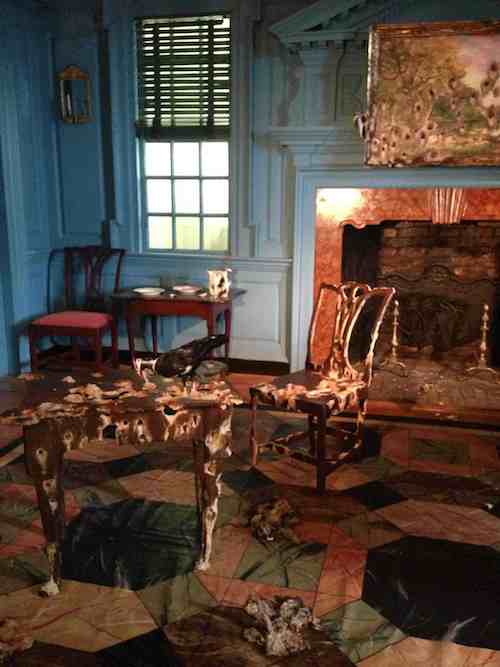
She kicks the Manifest Destiny discussion right where it hurts in the Cupola House “hall” (where guests socialized) by letting two Pileated and Downy Woodpeckers have their way with everything valuable in the room, including (a reproduction of) Thomas Cole’s 1846 painting The Pic-Nic. Nature is getting out of hand.

The Downey Woodpeckers take over the Cupola House hall. Photo: Brooklyn Museum

The Downey Woodpeckers take over the Cupola House hall. Photo: Brooklyn Museum

Get over to Brooklyn and encounter a new twist on what you were taught in grade school history, but watch out for Hegarty’s flying bullets and birds.

Rich & Famous at Green-Wood’s 175th Anniversary

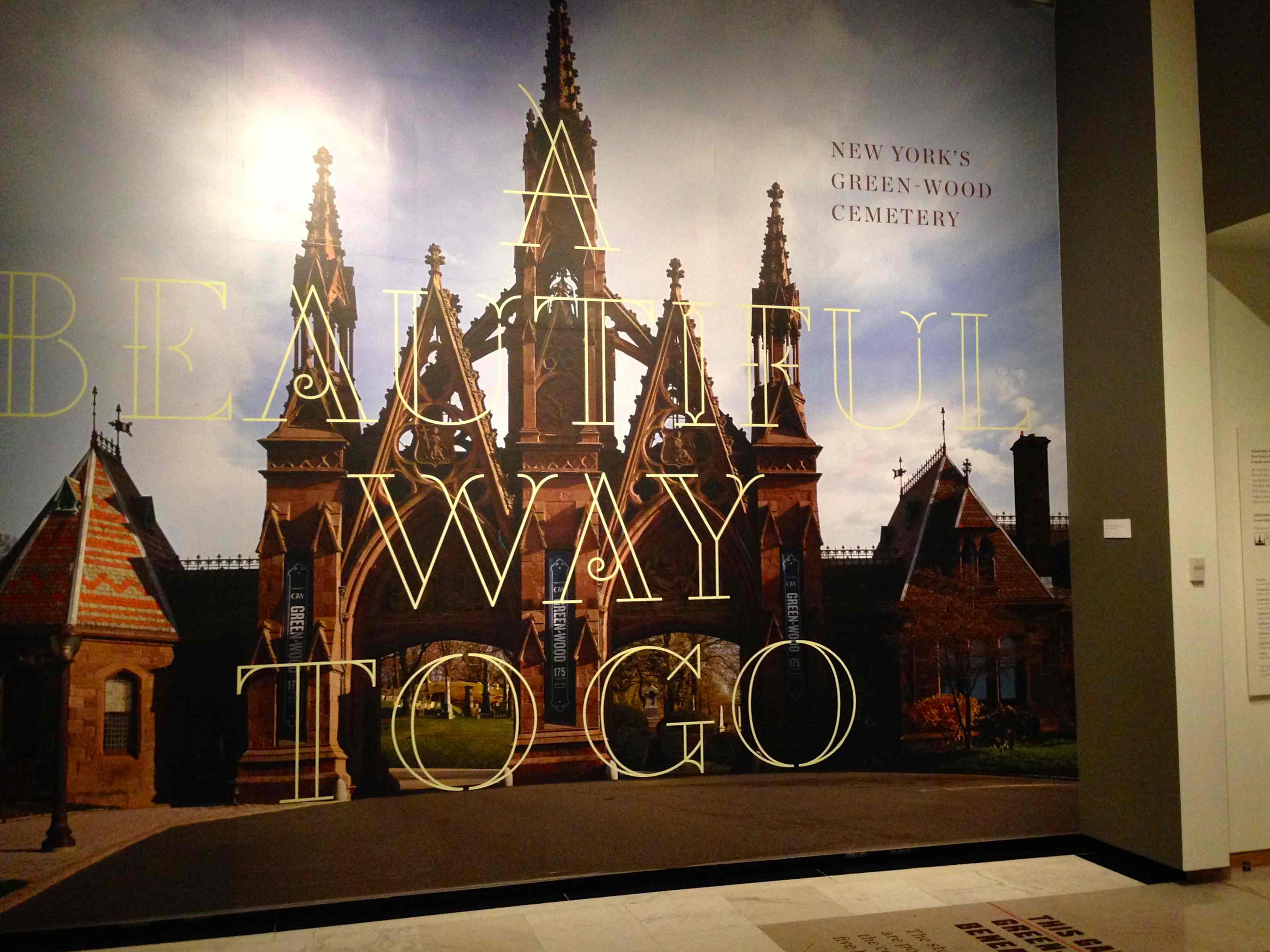
Show entrance featuring Green-Wood’s spectacular Gothic architecture.

Show entrance featuring Green-Wood’s spectacular Gothic architecture.

It’s big, green, historic, beautiful, and has more celebrities inside than you could ever imagine possible in an out-of-the-way spot in Brooklyn. Any day of the week, you can take a trip out to the lush woodlands, hills, and statuary gardens of Green-Wood Cemetery (and you should!), but every NYC history geek needs to visit the Museum of the City of New York’s A Beautiful Way to Go: New York’s Green-Wood Cemetery before October 13 to plumb the riches that have been assembled to celebrate its 175-year history.

We’re providing a walk-through on our Flickr feed, but the virtual experience is no match for the first-hand encounters with objects associated with the New York titans that are interred within the 478 acres of hills and countryside of Green-Wood itself – Tiffany, Duncan Phyfe, Boss Tweed, and even The Little Drummer Boy.

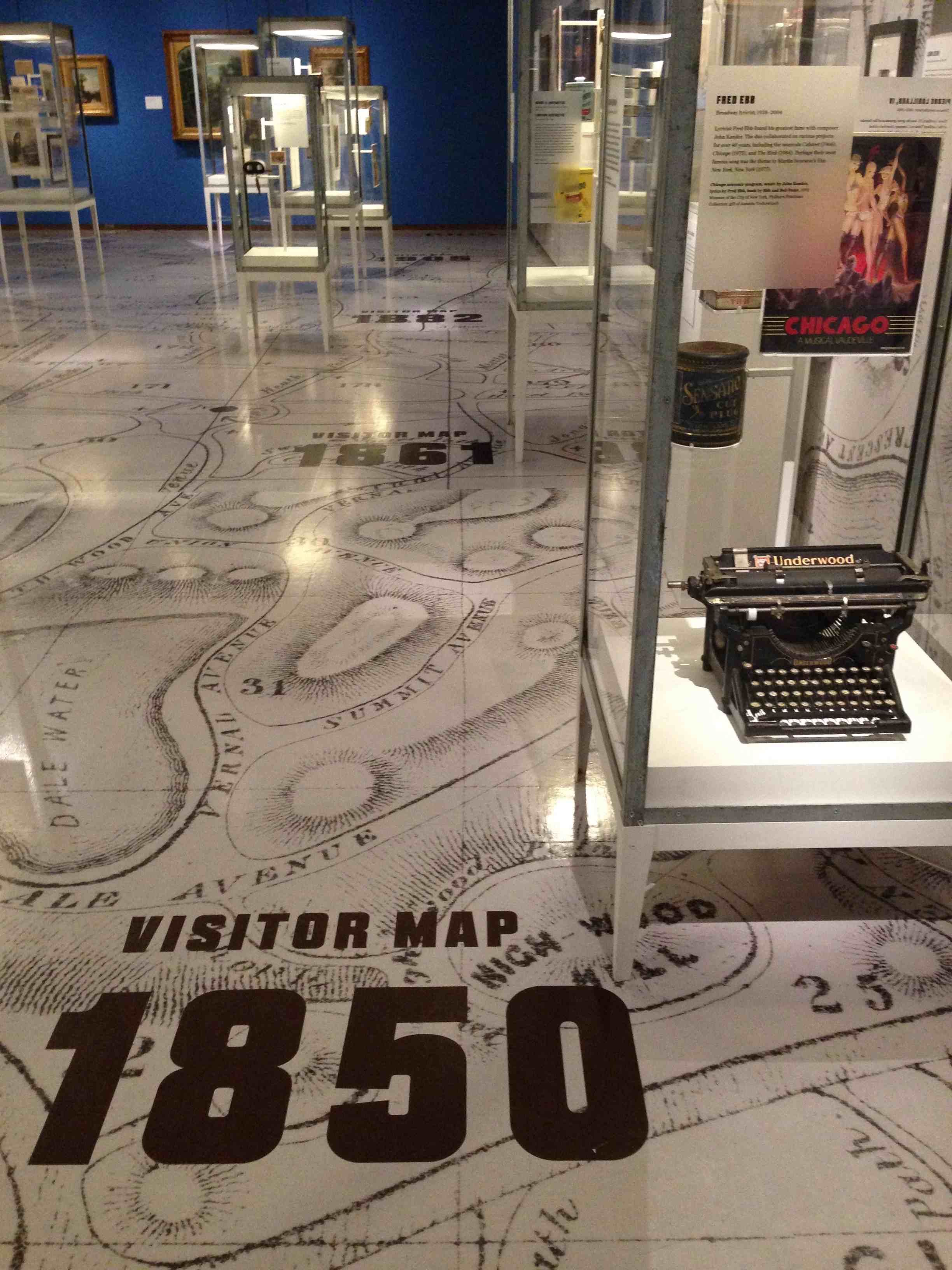
The floor map and vitrines with items associated with Green-wood’s most famous

The floor map and vitrines with items associated with Green-wood’s most famous

Consider the retail giants and brands: All five Brooks Brothers (who invented ready-made suits in 1849), the six Steinways who made pianos in Queens, Ebhard Faber (remember pencils?), the Domino Sugar owners (who once had 98% of the entire US market and who gave most of their vast art collection to the Met), the creator of Chiclets, the founder of Pan Am, and even F.A.O. Schwartz (yes, it’s a person).

MCNY has put the map of Green-wood on the floor of the gallery and has placed vitrines with objects associated with the rich and famous sort-of where they would be in the actual cemetery. Walking through the show is like random-access memory. You don’t know what or who you’ll stumble upon.

The tribute includes artists (from Currier & Ives and Asher Durand to Leon Golub, Nancy Spero, and Jean-Michel Basquiat); composers (Frank Ebb, Mr. Bernstein, and disco legend Paul Jibara); and inventors of things like the safety razor, the sewing machine, soda fountains, and the safety pin (think about that). Yes, it all happened in New York.

Spanish-language poster for "The Wizard of Oz" as a tribute to Frank Morgan, who played The Wizard

Spanish-language poster for “The Wizard of Oz” as a tribute to Frank Morgan, who played The Wizard

Green-wood is New York’s equivalent of the Pere Lachaise Cemetery in Paris, full of vistas, trees, paths, lakes, works by celebrity sculptors, military memorials, and elaborate, ornate above-ground tombs. Lachaise spawned an international mania for sylvan-glade cemeteries when it opened in 1804, and when Mr. Pierrepont was laying out the Brooklyn street system in the early 1800s, he left a big, open green spot in the plan, where Green-Wood is today. It opened in 1838, predating Central Park, and grew into the No. 2 tourist attraction in the United States (after Niagara) by the 1850s.

An 1875 Howe Sewing Machine by the inventor of the sewing machine, Elias Howe.

An 1875 Howe Sewing Machine by the inventor of the sewing machine, Elias Howe.

The show’s front hall has spectacular landscape photos taken last year by Jeff Chien-Hsing Liao, serving as luring calling cards to take the actual expedition to Green-Wood and its celebrated trolley tours led by uber-historian Jeff Richman.

See New York Through Hopper’s Eyes

Hopper’s easel holds his painting, Early Sunday Morning (1930) at the Whitney.

Hopper’s easel holds his painting, Early Sunday Morning (1930) at the Whitney.

If you thought you knew about Edward Hopper, think again. The Whitney’s show, Hopper Drawing, provides surprises galore from curator Carter Foster, who has presented the museum’s trove of Hopper drawings in a fresh, new context. The Whitney has more Hopper drawings (made for his private use) than any other museum in America, and about half are up on the walls. Go before October 6.

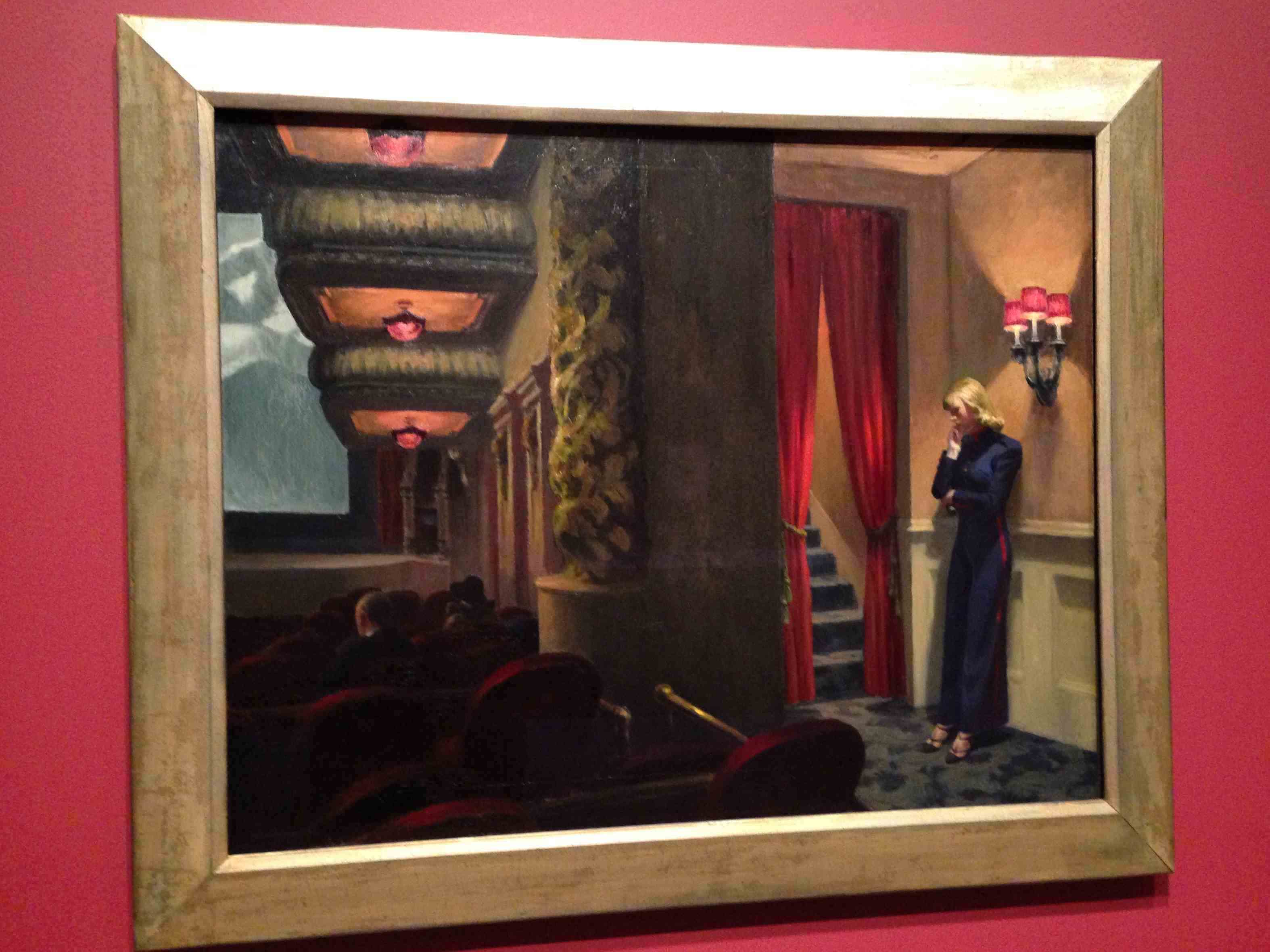
Although Hopper’s representational work is considered by his fans to signify “realism”, Foster has unearthed and organized zillions of preparatory drawings that demonstrate that this is hardly the case. Hopper, as he often said, worked “from fact” but added improvisational touches that pretty much made the canvases perfect. A case in point is New York Movie, where one side of the canvas is “real”, and the other side is completely imaginary. His sketchbook from the Palace Theater proves it.

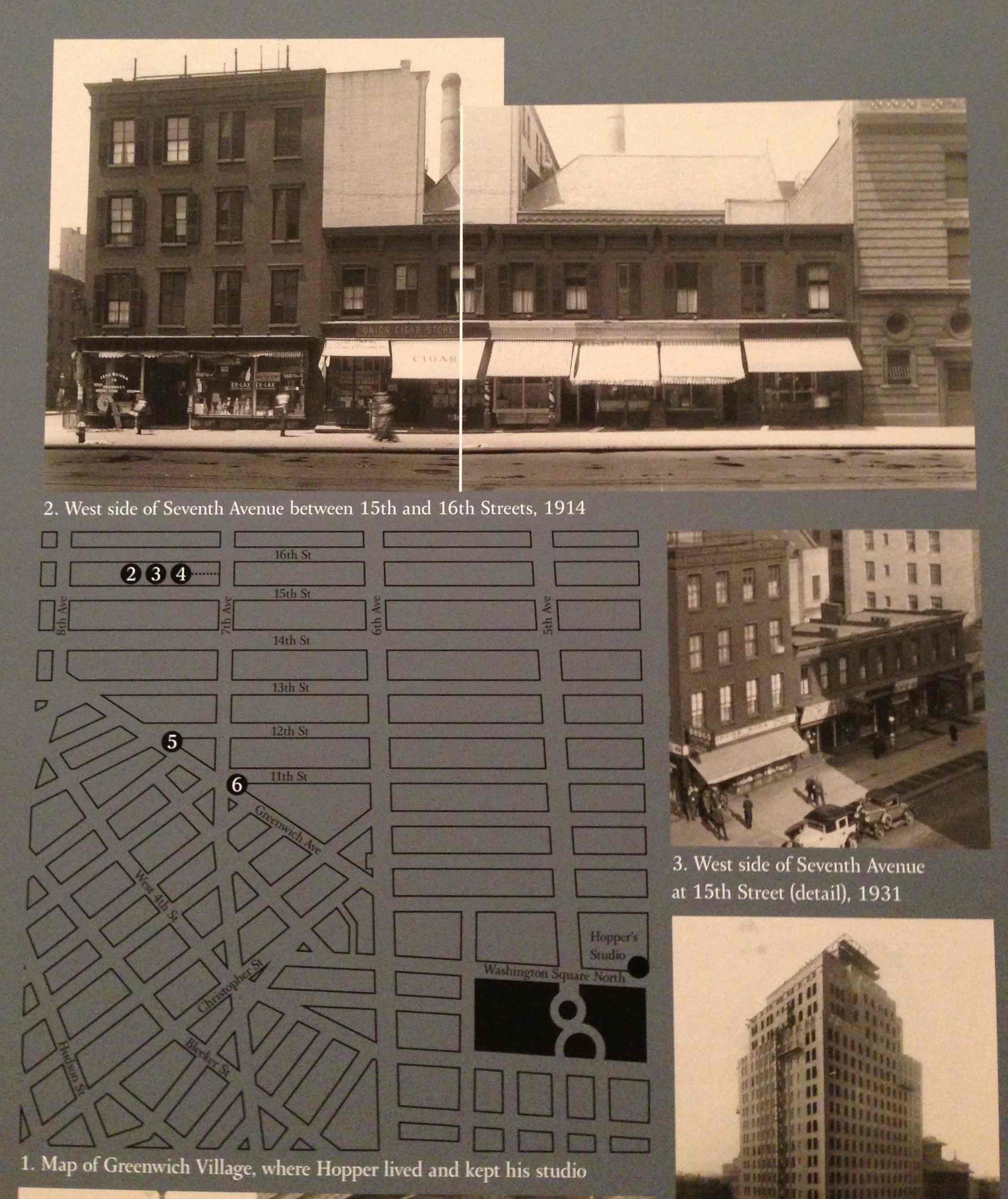
Whitney exhibition card showing map and 1914 photograph of the West Village storefronts depicted in the above oil painting

Whitney exhibition card showing map and 1914 photograph of the West Village storefronts depicted in the above oil painting

To prove this point, you’ll see the most famous Hopper paintings right alongside his preparatory sketches and sketchbooks to see his meticulous decision making process. Go to the exhibition web site (or our Flickr feed) and flip through images of Hopper’s iconic oils (such as New York Movie  and Chicago’s Nighthawks), followed by sketches and studies where Hopper worked out all the compositional kinks.

Hopper lived and worked right inside the row of gorgeous 1830s townhouses along Washington Square North. It’s a complete surprise to find that NYU still preserves Hopper’s studio intact, complete with his print press and easel.

Foster convinced NYU to loan it to the show, and it’s an electrifying reminder that artists once walked the streets of the Village and then came back to paint. You’ll stand face-to-face with the working easel that Hopper used to paint every one of his great works. Early Sunday Morning is perched, right where it sat in 1930, facing the Hopper’s other icon Nighthawks, on loan from Chicago’s Art Institute. The width of those canvases precisely matches the width of the easel.

Installation view of Hopper’s New York Movie (1939), on loan from MoMA

Installation view of Hopper’s New York Movie (1939), on loan from MoMA

So, that left a question: Where these real places, or fictions made up entirely in Hopper’s mind? Foster spent time trying to figuring it out, and thankfully the Whitney recorded the answers on its YouTube video. Take a walk with him and see the Village and the Flatiron through Hopper’s eyes back in the 1930s. You’ll never look at Nighthawks the same way again. Genius.

For theater fans: It’s not in the video, but Hopper’s sketchbooks are also filled with drawings of Times Square theaters — the Palace, the Globe (now the Lunt-Fontanne), the Republic (now the New Victory; formerly Minsky’s Burlesque),  and the Strand (where Morgan Stanley now sits).

Thousands Flock to the Light

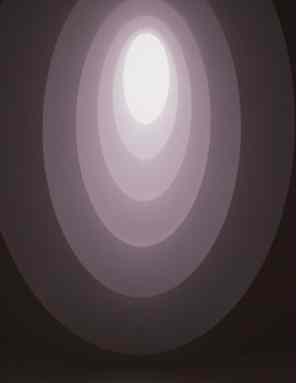
Imagine you are laying on the floor of the Guggenheim rotunda and that you are looking up at James Turrell’s new work. This is what you’d see.

James Turrell’s Aten Reign. Source: Guggenheim

The colors slowly, slowly morph for the next hour, changing from pink to green to yellow until they work through the entire color cycle. As yellow fades, you see the white, glowing sun…or is it the moon?

Aten Reign moment in the Guggenheim atrium, James Turrell’s site-specific spectacular. Source: Guggenheim

Aten Reign moment in the Guggenheim atrium, James Turrell’s site-specific spectacular. Source: Guggenheim

You need to get there to experience the spectacular light before September 25, when James Turrell takes his leave of New York, the end of his first major show here. The museum’s exhibition site is wonderful, but it’s no match for the out-of-this-world, cosmic experience of his masterful Aten Reign.

The Guggenheim has blocked off the famous skylight and any view of the atrium from its gallery spiral. Viewing the light show from the ground floor, all viewers see are these rings of slowly changing light with an oval center – a natural shape that Mr. Turrell loves.

Out-of-towners expecting to have the fun of walking up the ramp and looking down on ever-tinier ground-floor visitors will be disappointed. But other magical Turrell encounters await.

On Level 2, we found celebrated security guard, Jeffrey Martinez (see this week’s New York Times profile on him) holding throngs in rapt attention explaining the magic wrought by Mr. Turrell with his corner floor-to-ceiling strip of light. Martinez told us that although it appeared to be a vertical “light”, we were actually seeing an illumination emanating from behind the false wall. The New York Times was right to single him out for a story, because it felt like we were meeting a celebrity with art-world smarts, gently cautioning people against trying to touch and asking them to “stand back” to give the piece some space.

Afrum I (White), 1967, one of Mr. Turrell’s early cross-corner projections. Source: Guggenheim

Afrum I (White), 1967, one of Mr. Turrell’s early cross-corner projections. Source: Guggenheim

Upstairs, the show presents two more light installations that mimic two of the twenty 2D etchings precisely ringing a small gallery. Mr. Turrell creates the illusion, on paper, of light glowing from the white cubes surrounded by the ink. You just have to see them and then turn the corner to see “square” beams of light illuminating two walls. In the second room, Afrum I (White) astounds. You think you’re seeing a levitating white cube of light. Magical.

Hear him talk about his view of Mr. Wright’s philosophy and building and why they are so right for one another:

Enough said. Go see it.

Spoiler alert: The Guggenheim’s YouTube site has several videos about how Turrell and the team created the magic on the spiral.

LA Whimsy Runs Riot at The Met

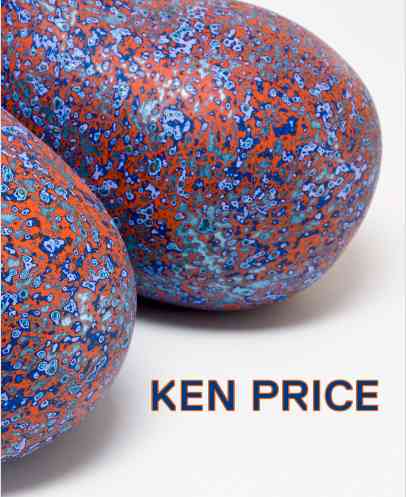
The catalog cover shows a close-up of Price’s finely sanded surface

Catalog cover close-up of Price’s finely sanded ceramic surfaces

If you want to feel happy, step into the Frank Gehry-designed space at the back of the first floor of the Metropolitan Museum of Art before September 22 to see Ken Price Sculpture: A Retrospective. You’ll find colorful abstract ceramic sculptures that absolutely defy you to smile.

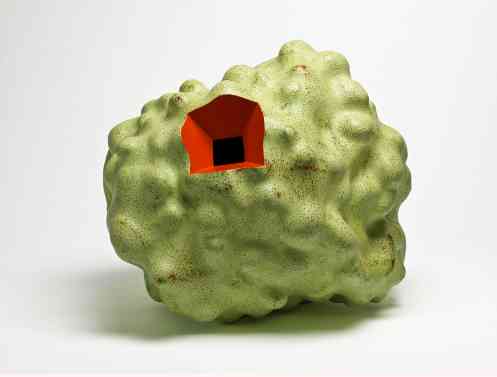
Blobs, twists, eggs with things popping out, and joyful fantasy shapes abound in the clean, white space. It’s impossible to make sense out of any of it, except the feeling that you are let loose inside the mind of a California artist, who claimed to have a “highway to the unconscious.”

Price, a superstar on the West Coast, is fairly unknown here in the East, so it’s nice to get to know him. As a student, he was tutored by legendary ceramic artist Peter Voulkos and then worked mostly around Venice, California (and occasionally Taos) for the next 50 years, producing delightful, collectable pieces, and hanging out with LA greats Rusha, Irwin, Keinholz, Bell, and Bengston.

Pastel, 1995, fired and painted clay. Courtesy: James Corcoran Gallery. © Ken Price. Photo: © Fredrik Nilsen.

Pastel, 1995, Ken Price’s fired and painted clay sculpture, courtesy of the James Corcoran Gallery. © Ken Price. Photo: © Fredrik Nilsen.

The show begins with Price’s most recent work and works back through time, so you’ll encounter some of the larger, crazier, colorful pieces right as you walk in. Some of the ceramic surfaces of look pebbly and coarse, but this is right where Price worked his magic. He painted coat after coat atop his fired pieces, and then meticulously sanded it all down to make a silky smooth surface. You really can’t tell unless you’re eyeball-to-eyeball with the blob sculptures, but the cover of the catalog (top left) gives you a hint.

This experience suggests the type of fun, contemporary shows that The Met will mount when it takes up residence at the Whitney’s building on Madison, once that institution decamps for the High Line in 2015.

Take 3 minutes to let curator Stephanie Barron walk you through LACMA’s installation earlier this year, which is pretty much what you’ll experience on Fifth Avenue. She tells you a little about Gehry’s gallery approach and talks about her relationship with the fun, fabulous Ken Price. Enjoy the spin, and get over to The Met for some real California fun.

Stylish NYC Micro-Housing Showcased at MCNY

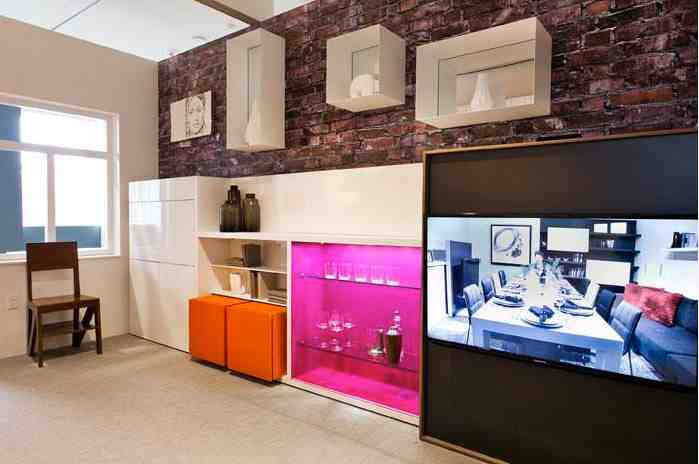
The TV wall slides away to reveal storage shelves

The 325 square-foot solution on display at MCNY: the TV wall slides away to reveal storage shelves. Source: MCNY

With all the single people living in Manhattan and the outer boroughs, it’s kind of shocking to find that building stylish, affordable micro-units is still illegal in most of the City. What’s a renter to do?

Get over to Museum of the City of New York pronto and take a look at the future in the hugely popular show, Making Room: New Models for Housing New Yorkers.

It’s no surprise that the housing stock here doesn’t match the demand. MCNY and the Citizens Housing & Planning Council got together to put on a show that raises the possibility of change, showcases several innovative solutions proposed by design teams, and presents a full-scale, walk-through model apartment: a 325 square-foot micro-space (built and furnished by Clei and Resource Furniture).

The sofa turns into a bed

The sofa turns into a bed. Source: MCNY

Apparently our City’s is due to grow by 600,000 people over the next 20 years, so the question becomes – where is everyone going to live? How can people live affordably? Is there a way to create living spaces that are flexible as families grow? Listen as CHPC’s Jerilyn Perine lays it all out in this fascinating 11-minute presentation at the 2011 kick-off to the project, focusing on housing demand, illegal rentals, and rental history in New York.

Currently, the City regulates things such as occupancy, density, minimum room size, parking areas, lot coverage, the number of dwelling units that can be on a single lot, and the proportion of living vs. working space in some parts of town. And, yes, most neighborhoods prohibit building spaces like the micro-studio at the center of the MCNY show. CHPC’s projects imagined what could be if some of those regulations (well intended) were relaxed.

Read about the background of CHPC’s Making Room project and design competition and find links to related TED talks, sites, and the proposed design solutions – stacks of prefabricated apartments, mini-bungalows for the Bronx, and repurposed industrial spaces in Brooklyn. The CHPC site shows details of each of the five featured plans.

But the star of the MCNY show is the model studio. Here’s a video of what you can experience for a few more days. (The show was held over by popular demand.) Note the transformation of the Cubista (the ottoman-looking piece of furniture that unfolds), and so many other smart small-space design choices.

All Smiles at The Mouse Museum on 53rd St

View of Oldenburg’s Mouse Museum/Ray Gun Wing at MoMA. Photo: Jason Mandella. © 2013 The Museum of Modern Art

View of Oldenburg’s Mouse Museum/Ray Gun Wing at MoMA. Photo: Jason Mandella. © 2013 The Museum of Modern Art

Is it the best museum in the world? One of the happiest places to be in New York right now is Claes Oldenburg’s Mouse Museum and Ray Gun Wing, currently installed in MoMA’s atrium as the scene-stealing companion to the Fifth Floor exhibit, Claes Oldenburg: The Street and The Store, which ends August 5.

You’ll want to take your time contemplating the Pop master’s 1970s curated collection of average, everyday stuff that he showcased inside a geometric mouse-head structure, originally a design he proposed for Chicago’s (then unbuilt) Museum of Contemporary Art.

In the mid-1960s, Oldenburg began collecting souvenirs, rubber toys, and crazy stuff he found on his wanderings and storing them on shelves of his 14th Street studio. An early idea was a display of artificial vegetables and other food with Fluxus genius George Maciunas. It never happened, but luckily some of the 1960s-style replicas repurposed here in the Mouse collection.

Inside view. On loan from the Austrian Ludwig Foundation, since 1991. © 1965–77 Claes Oldenburg. Photo by MoMA Imaging Services Dept. © 2013 The Museum of Modern Art

Inside view. On loan from the Austrian Ludwig Foundation, since 1991. © 1965–77 Claes Oldenburg. Photo by MoMA Imaging Services Dept. © 2013 The Museum of Modern Art

Oldenburg decided to submit his museum to Documenta 5, whose theme was “inquiry into reality—today’s imagery.” He washed off his dusty collection (you can hear the tape of that inside) and he and some friends organized 367 objects into display categories. For Documenta, the little building itself was fabricated in Germany.

What’s really inside? In a riff on the classification systems that were then in vogue by conceptual artists, Oldenburg “classified” all his fun stuff – landscape, human beings, food, body parts, clothing (including makeup), tools, animals, buildings (including monuments and souvenirs), money containers, smoking articles, and studio remnants.

Here’s MoMA’s take on the importance of this little museum and its Ray Gun Wing:

Now, enjoy a virtual walk-through to examine this tiny museum’s treasures, shot by Christian Zurn when it was on display at MUMOK in Vienna last year. Do yourself a favor and go see this spectacularly funny, whimsical collection for yourself.

Want to spend some time with Claes himself? Here’s a YouTube of the master recollecting his life in the Sixties, travels to LA with Warhol, and how his soft sculptures came to be, click here.