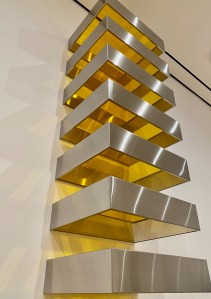
1968 stainless steel and Plexiglass tower (Froehlich Collection)
For anyone lamenting the disappearance of the Monolith and yearning to experience its minimalist magic, walk through MoMA’s Donald Judd retrospective before January 3 to understand how big, gleaming, super-sleek objects create such electrifying force fields.
Initially, journalists speculated that the Utah Monolith was the work of West Coast artist John McCracken. It wasn’t, but Judd was one of McCracken’s art-world heroes – a master who reveled in pure shape, pure color, and (when he wanted to) pure transparency. Judd also built repeating rectangles (seemingly not created by human hands) in remote western landscapes (Marpha, Texas).
On MoMA’s top floor, you’ll encounter wide, open spaces with spare, clean hard-edged objects inhabiting four galleries.
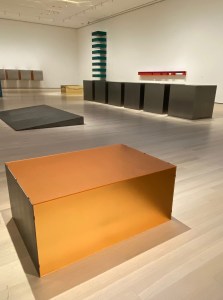
1964 construction of orange pebbled Plexiglass and hot-rolled steel. Private collection.
In the first room, you’ll see cadmium-red shapes from the early Sixties that Judd made in his Soho studio. The idea was to remove any gestures or evidence of craft in the work – just present the pure painted shape.
But to get the perfection he craved, Judd went one step further – engaging industrial fabricators to create large-scale works from his meticulous drawings. Industrial materials like aluminum, iron, and Plexiglass are transformed into magical rectangles, epic towers, and airy channels. See our favorites in our Flickr album.
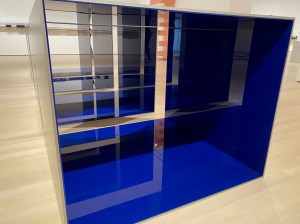
In each gallery, visitors are invited to circumnavigate and explore the monumental works. One orange box seems to glow; another has a transparent surface that lets you peer inside. An enticing series of blue and silver boxes seem to let you peek through to an entirely different dimension.
1969 “channel” of aluminum and Plexiglass units (Saint Louis Art Museum)
Towers emerge from walls in each room – neat stacks of monumental rectangles, separated by exact amounts of space. It’s quite a sensation to approach one, look up, and feel its commanding presence. One silver tower seems to be emitting yellow light. A copper tower gleams a little from a subtle spotlight.
Judd wanted it this way – no interpretation. Just you and the large, beautiful, perfect form, as this short video demonstrates:
MoMA cautions visitors to remain at least six feet away from each of the works, but most admirers are cautious and reverent, taking it all in and giving everything its space.
Here, curator Ann Temkin talks about Judd’s work and the joy of bringing such a monumental exhibition to New York:
Take a trip through the installation on MoMA’s website here, and hear artists describe their experience of the show here.
Entrance with Noguchi’s 1945 Kouros and Rodin’s controversial 1876 sculpture
The Met has pulled out all the stops on its 150th birthday show, Making the Met, 1870-2020, on view at Fifth Avenue through January 3 – incredible installation, intriguing stories, and a phenomenal digital showcase. So even if you can’t come to New York to see it in person, the Met website has it all!
The exhibition tells the story of the Met over the last 150 years – from its first incarnation in a house on 14th Street to its ever-expanding footprint in Central Park – shows the incredible art that benefactors donated, and relays the stories of the men and women who made it happen.
Head of a Hindu god, Bhairava, made by 16th c. Nepalese artists
Walking into the dramatic exhibition entrance, you’re surrounded by figures from different eras and cultures – a little girl from 5th century Greece holding two doves, a gilded mask of a Hindu god beautifully crafted by Nepalese masters of the 16th century, and Avedon’s 1957 portrait of a pensive Marilyn Monroe.
At the press opening, senior researcher associate Laura Corey explained that these were chosen to encourage visitors to think about the people behind the Met – collectors, curators, artists, restoration experts, and other staff. According to Laura, the African power figure from the Republic of Congo was one of the first artworks chosen for the welcome gallery. He’s looking right across to Marilyn, and they are sharing a similar expression and mood.
1906 photo of The Great Hall
At Noguchi’s Kouros sculpture, you can look left or right down a “street” lined with arches – portals that beckon you to step into different chapters of the Museum’s history. Each arch proclaims the decade and the theme. In between, there are huge slideshows from the museum’s past – how the Great Hall used to look, ladies in turn-of-the-century hats taking their art appreciation classes, Fifties moms and kids looking at art.
We’ve included our favorite artworks in our Flickr album, but the Met has produced a spectacular multimedia walk-through (posted on Google Arts & Culture), where you can experience all ten stories through photos, films, and links to blogs. Definitely watch the silent 1928 “Behind the Scenes” film showing museum shops, painters, gilders, and photographers at work. No surprise that the museum was into multimedia way back then!
Houdon’s 1778 bust of Franklin and reflection of Manet’s Young Lady in 1866
Through the first arch titled “The Founding” (the 1870s), you pass a huge Cypriot head (the first director was into archaeology) and the first paintings donated by the founding trustees. Houdon’s spectacular Ben Franklin gazes quietly (and slyly) at Manet’s Young Lady in 1866 – the first contemporary painting in the Met’s collection. It depicts a life-size, modern gal in her dressing gown – an image that shocked early visitors to the Met’s classical galleries! Of course, Ben looks on approvingly.
Next, you’ll see a 15th-century Turkish turban helmet and 17th-century Japanese armor. The story here is that the Met green-lighted Bashford Dean, a zoologist and world traveler working at the AMNH, to begin the arms and armor collection. Other curators began collecting works on paper, textiles, lace, wallpaper, musical instruments, and contemporary designs. In the Twenties, curators headed straight to the UK to scoop up samples from Morris & Company.
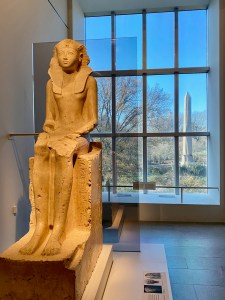
1479-1458 B.C. statue of Hatshepsut, and Cleopatra’s Needle (1450 B.C.) in Central Park
Around the corner is a tribute to the deep-pocketed donors like Morgan and B. Altman, who gave the Met lots of upscale, princely treasures – paintings by Vermeer and Ingres, fancy furniture, and tapestries. A treasure trove gifted by generous benefactors fills a wall – pistols for kings, cosmetic cases for Egyptians, bedazzled tablewear, and Middle Eastern glass.
Back into the main “street,” you’re right next to an imposing, reconstructed sculpture of Egypt’s female pharaoh Hatshepsut with a stunning view of Central Park’s Egyptian obelisk through the window.
These lead to the stories of how the Met collected art via excavations of archaeological sites – the Kharga Oasis (1908), Egypt (1880-1931) with Wah’s tomb stuff, Nimrud (Iraq), and along an ancient trade route (1934). The intrepid Bashford Dean enters the story again – excavating a Crusader castle, but only bringing back “dismal finds,” such as Crusader lamps, melted chain mail, and shards of stained glass, and (our favorite!) a projectile from a Crusades-era catapult (1250).
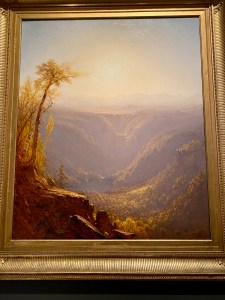
1864 A Gorge in the Mountains by Sanford Robinson Gifford
Apparently, it took a lot for a fancy museum to turn its attention from Europe to collecting art from the Western Hemisphere, but wealthy patrons had the goods. The American room features Sargent’s best-dressed “Madame X” and an enormous 1830 honeycomb quilt by Elizabeth Clarkson, the first quilt to enter the Met’s collection in 1923. There’s also a gorgeous Catskill Mountain landscape by Sanford Robinson Gifford, once owned by AMNH’s long-serving president, Mr. Jessup.
A gallery packed with work by Degas, Monet, Cassatt, Cezanne, and their Japanese masters tells the story of the Havemeyers, the Met patrons who lavished the museum with Tiffany glass (likely picked out by Mr. Tiffany himself), impressionist masters (picked out by Ms. Cassatt herself), and much more.
I Saw the Figure 5 in Gold (1928) by Demuth
At the midpoint of the exhibition, you learn that Stieglitz had a rough time trying to convince the Met to honor contemporary photography. The Met also refused Ms. Whitney’s collection in 1929. Gertrude’s response was to start her own museum, which joined MoMA (which debuted in 1929) in celebrating modernism. The Met finally did accept modern works through Georgia O’Keeffe’s 1949 gift, and proudly displays a Demuth and Kandinsky in the show.
The Monuments Men story looms large, with Met curators playing a major role in discovering and returning art looted during World War II. There’s a 1945 model of an Army helmet prototype designed by the Met’s armor expert, hand-crafted in solid aluminum.
1965 Yves Saint Laurent Mondrian dress and 1966 Balenciaga coat
The largest gallery in the show tells the story of how the Met beefed up its collections and expanded gallery space during what it calls “The Centennial Era” – Islamic art, fashion, Asian and African art, and modern art from the 20th century.
The final story about the Museum’s current focus – adding works by artists and from regions that are underrepresented in its collections – is represented by a large El Anatsui piece, an embellished Tibetan saddle, a wall of art guitars, a large Faith Ringgold story quilt, and other intriguing works.
The museum’s done a tremendous job online telling all the stories via its digital primer. Click here to hear in-depth stories on the Met’s audio guide with Steve Martin, check out this video with his narration, get the backstory on every artwork in the show, and definitely visit the multimedia walk-through .
And check out this exhibition video showing how the museum’s architecture evolved to house these growing collections. In the 1880s, Olmstead and Vaux assigned a spot in Central Park for the Met. It’s interesting that one of the initial designs (which no one liked) was not scheduled for completion until 1990!! It’s a microcosm of 150 years of architecture and history.
Zamora’s wall with southern skyline view from the Met terrace
The rooftop mojito bar is missing, but it doesn’t matter to the art lovers trekking up to the Met’s rooftop. The Roof Garden Commission: Héctor Zamora, Lattice Detour, on view through December 7, invites you to stroll around Héctor’s undulating wall and experience what it feels like to have your ideal, verdant view of Central Park and the soaring skyline partially interrupted.
On a bright, sunny day (and New York as had many recently), Metropolitan Museum visitors are taking the time contemplate this simple, provocative, statement by a Mexican installation artist. Héctor’s wall is only 11 feet high and made of see-through bricks – the kind created to let air and sun pass through courtyard walls in steamy Mediterranean, Middle Eastern, and Latin American climates.
Partial view through blocks made from Mexican earth
For this Met installation, Héctor had the blocks for the wall made from Mexico’s earth and asked a crew of Mexican and Latin American builders to hand-craft it the traditional way. As you circumnavigate Héctor’s wall, you have to position yourself just right to get a good view, and then it’s only a tiny, tiny fraction of what lies beyond.
And you have to be close, which lets you appreciate the artistry of the patterns and tunnels of the lattice, which also casts geometric patterns on the roof.
Héctor’s hope is that his installation enables quiet contemplation on thinking about the world that lies just beyond the walls of the Met. If you free-associate about walls, national borders, or larger societal issues, OK, but Héctor presents his architectural statement in a straightforward manner – basic building blocks that originated in ancient times. You can create the experience what you want.
Take a tour of the installation in our Flickr album, enjoy the spectacular rooftop views in this Met’s video, and hear Héctor Zamora talk about this work with Met curator Iria Candela:
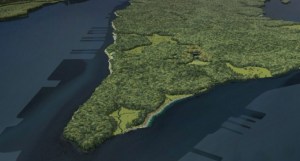
Recreation of Manhatta by the Welikea Project, presenting virtually with NYPL
On Tuesday November 10, New York museums and cultural institutions have packed the digital schedule with events that look to the past to inform our understanding of nature, the history of fake news, and the sometimes-forgotten participants in Veteran’s Day – the millions of WWII home-front workers:
At 1pm, the New York Public Library hosts a session with the ground-breaking Welikia Project, which recreates ecosystems that existed in New York City before Henry Hudson sailed into the harbor 400 years ago. The program will explain how the city’s current built environment syncs with the marshes, ponds, rivers, and hills that the Lenape knew so well.
“A Warning to Libellers”, an 1804 broadside attacking vice-president Burr. Collection: NYPL
At 6pm, the New-York Historical Society is taking the long look at the relationships between presidents and the press, going back to the time of the Founding Fathers, investigating how their surrogates spread fake news, and comparing then and now.
At 6pm, the Brooklyn Historical Society will take you behind the gates of the Brooklyn Navy Yard to present the stories and voices of everyday New Yorkers who kept up the riveting, launching, and maintenance of the Atlantic fleet during WWII.
1942 Brooklyn Navy Yard worker. Collection: Brooklyn Historical Society
Find the links to these and other museum events on our virtual events page here. Poster House is having all sorts of virtual get-togethers this week centered around its Chinese and Swiss poster shows, so look through our list. On other days of the week:
On Wednesday November 11 at 7:00pm, the Museum of the City of New York explores the history of celebrations in the city – parades, marches, and spontaneous outpourings of emotion on the streets.
On Thursday November 12, the Museum at FIT presents a conversation on sustainability in fashion at 6pm, and the International Center of Photography will present the five young photographers it commissioned to make work in response to the COVID crisis at 7pm.
On Friday at 3pm, there’s another chance to go on a virtual tour of the Morgan Library’s David Hockney portrait show.
Take a look and register for as many of the topics and events that you can fit into your schedule. Most of the events are free, but it’s always nice to add a thank-you donation.
Museum Updates
Last week, we dropped into the Metropolitan Museum to see if we could take a quick peek at the “rediscovered” painting in the Jacob Lawrence American Struggle series, but that didn’t happen, since the lines through the 20th-century wing stretched all the way back to the Rockefeller Wing. Anyone needing to get their Lawrence fix can see his historic Migration series on MoMA’s Fifth floor, and his WWII War Series in its own gallery at The Whitney.
Donald Judd installation at MoMA
Anyone needing to chill out in a clean, white space can have the Donald Judd show at MoMA all to themselves weekdays (MoMA is open 7 days a week). We swung by last Thursday and found a peaceful garden, empty Matisse Swimming Pool room, and acres of space around Persistence of Memory. Get there now!
If you missed the Museum at FIT conversation last week on Native America Fashion with designer Korina Emmerich and Choctaw-Cherokee artist Jeffrey Gibson, who currently has a three-gallery exhibition in Brooklyn, the conversation is now posted here on the museum’s YouTube channel.
12th – 14th c. terracotta equestrian statue from the Middle Niger civilization (Mali).
As you confront the stone monolith in the entry, get prepared to see art you’ve never before encountered, learn about empires you didn’t know existed, and fill in the blank spot on what you know about African history.
Beauty and cultural discoveries are everywhere in a first-of-its-kind exhibition on Saharan artistic legacies in Sahel: Art and Empires on the Shores of the Sahara, on view through October 26 at the Metropolitan Museum of Art.
Large 12th – 13th c. gold pectoral, found at a burial in northwest Senegal, with elaborate filigree. Courtesy: IFAN, Senegal
The shifting sands of the Sahara are echoed in the centuries of shifting artistic traditions, migrations, civilizations, religions, and cultural affinities of the Saharan people. Take a look at our Flickr album.
This gorgeous show is one of the first to tie and unite the threads of the sub-Sahara’s nearly invisible history for Western audiences. Western approaches to art history have traditionally made it appear as if the people on a large content were a monoculture with no beginning, end, or history. The show brings a deeper artistic and historical context to work that has always suffered from just being lumped together as “African art,” or worse, “primitive art.”
Scholars on two continents are starting to piece the story together, reflected in the exhibition’s design. The alcoves are a primer to walk back through time to understand the region’s complex history, which covers deserts, oases, and farming areas that are the size of Europe. For centuries, the region was criss-crossed by trading routes (the “Saharan superhighway”) through which caravans delivered luxury goods, exotic raw materials, news, and new cultural influences.
Pre-1659 royal tunic, a European import from the Ardra kingdom (south Benin) via Mandé trade routes. Courtesy: Museum Ulm
Wooden or fired clay depictions of warrior kings on horseback from the 3rd through 19th centuries line the exhibition’s central path. Settlements, archeological sites, and kings are named, with the vast region’s artifacts, architecture, and traditions of storytelling joyously placed into a proper context.
There are plenty of national treasures, such as the gold pectoral from Senegal and lively terra cotta sculptures (likely made by women) from Mali, made with the highest levels of craftsmen between the 12th and 14th centuries. Another highlight is the still-vibrant 8th-century woven tunic from Niger, one of Africa’s most ancient textiles.
The exhibition explains how Islam gradually, peacefully became the dominant religion in sub-Saharan Africa, displacing the previous belief systems. As is the case with other world cultures, artists continued to merge and adapt older, more traditional symbols and forms with the new.
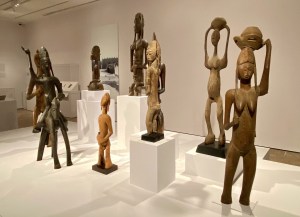
Wood sculptures of Mali’s Bamana people, from the 15th to 20th century
An intriguing 15th-century Italian map-painting documents Mansa Musa, a 14th-century emperor from Mali, who achieved global celebrity status for his over-the-top pilgrimage to Mecca via Cairo and was inspired to develop Timbuktu into a center of Islamic scholarship.
The display of Bamana sculptures, dating from the 15th to 20th centuries, in the rear gallery is the show’s dramatic conclusion, although the walls depict incredible resist-dye textiles made by early 20th century women in Mali and couture-level embroidery on pure white status garments of the Timbuktu elite from the Sixties.
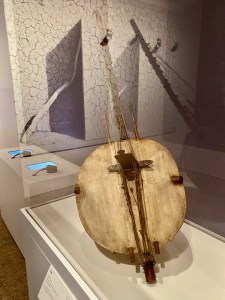
Senegalese kora made before 1878, used by griots to perform social narratives.
The show was an epic undertaking by the Met – organizing a narrative and objects to tell two thousand years of relatively unknown history; first-time loans of national treasures from the museums in Niger, Mali, Senegal, and Mauritania; arranging for an 8,000-lb. monolith to be shipped across the Atlantic to New York.
The epic histories recounted by griots playing traditional instruments over the centuries play a large role in the exhibition. Koras and percussion instruments are on display, and music permeates the galleries.
Here’s a peaceful walk through the exhibition with music by Toumani Diabaté with Ballake Sissoko:
For an in-depth understanding of this ground-breaking show, join in on this conversation with Met curator Alisa LaGamma and scholar and writer Manthia Diawara:
Learn more about the epic history of the Sahara in the Met’s exhibition guide.
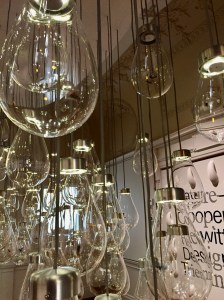
Visitors are immediately drawn into front room of the Carnegie Mansion to enter a magical environment in which insects appear to be fluttering inside hand-blown glass bulbs in the entry to Nature: Cooper-Hewitt Design Triennial, on display through January 20.
But it’s actually artificial insects that are creating the commotion, programmed to activate as a visitor approaches – all replicas of extant and extinct species of New York State created by Austrian design team Mischer’Traxler.
This CuriosityCloud installation serves as the introduction to an expansive show that presents how innovative designers are applying new technical solutions inspired by nature to architecture, agriculture, textiles, construction materials, and robotics.
In cooperation with the Cube Design Museum in Kerkrade, Netherlands, the show highlights the work of over 60 international design teams who explore biomimicry, new materials, and artificial intelligence as they create solutions to climate challenges and sustainability in the real world.
2019 Fantasma garment by design studio Another Farm from transgenetic glowing silk
Among the highlights, shown in our Flickr album – textiles printed by rain and pigment-producing microbes, a fruit tree grafted with dozens of fruit varieties, a biodegradable Michelin tire, a personal food computer, and a robotic bionic ant programmed to interact autonomously with other similar ants, just like they do in real life.
The showpiece on the second floor of the exhibition is the concept garment by design studio Another Farm from transgenetic glowing silk, manufactured by Kyoto’s Hosoo textile company. The silk was engineered by injecting DNA from bioluminescent coral into silkworm eggs and using it to create the fabric. Visitors used special glasses to see the other-worldly glow.
Another favorite is the Cosmic Web project by Kim Albrecht, based upon the scientific research on 24,000 galaxies. Take a look:
To spread the good work, the Cooper Hewitt and Cube are installing a portion of the show at the World Economic Forum in Davos, Switzerland in January, hoping to inspire global thinkers to look into the future of possibilities for a changing world.
Listen as one of the Cooper-Hewitt curators introduces the exhibition and hear contributing artists talk about their work in a video produced by ALL ARTS as part of the documentary series ClimateArtists.
Visionary Dorothea model created from cut paper and found objects in 2007 welcomes visitors to the show.
You can see what dreams are made of on MoMA’s upper floor when you walk into a world created by a self-taught artist from Zaire who saw all the possibilities of a new nation as his country transitioned from Belgian colonization.
Closeup of 1996 Ville Fantôme, a large utopian cityscape of cut paper, packaging, collage, and paint.
Bodys Isek Kingelez: City Dreamsis a retrospective of visionary cities, skyscrapers, public buildings, stadiums, and monuments created from paper, cardboard, packaging, paint, ink, bottle caps, and other stuff over his lifetime. Experience the sheer genius of it all – and a virtual-reality tour – through January 1.
Three of his eight fully realized city models are featured at MoMA – examples of work that was eventually shown in (and collected by) art museums throughout the world.
Kingelez (1948-2015), who came from a small colonial village in the Congo, was taught by missionaries early on and went on to teach secondary school. But when political change came to the Belgian Congo in the Sixties, Kingelez became determined to contribute his vision to what his country could become. And he used the materials at hand to create models of buildings that symbolized harmony, peace, and understanding.
After his work was shown in Paris, the international art world came calling, and Kingelez had the opportunity to work full time as an artists, creating ever more elaborate cities and models. Although he never traveled out of Zaire until 1989, Kingelez always imbued an international vision to his creations.
Detail of 1992 Reveillion Federal, a temple to democracy.
The models are precise, clean-cut visions of the future. MoMA has created a VR-headset experience where you can walk through one of the cities, fly to the top of skyscrapers, and cross bridges to the future. It’s a great way to enter 2019.
Take a look at our Flickr album of some of the work in this amazing show.
Enjoy this video of the artist himself showing how nature and lofty ideas can be put to work in architecture, engineering, and design:
For more on Kingelez and his life, click here. For a soundtrack, MoMA’s assembled a great one from Zaire here.
Balenciaga’s 1967 silk wedding dress in the Romanesque Chapel at the Met Cloisters
The brilliant installation of haute couture in the historic halls of the Met Cloisters, Heavenly Bodies: Fashion and the Catholic Imagination, closing October 8, also serves as a surprising showcase for the spectacular medieval art residing in the same space.
Curator Andrew Bolton’s thoughtful placement and narrative creates a genuine conversation between European couture and religious-themed works made over 500 years ago at both the Cloisters and the Met’s Fifth Avenue location.
The Cloisters show starts spectacularly with Balenciaga’s 1967 wedding dress dramatically casting shadows across the floor of the largest room at the Cloisters, the Romanesque chapel with its outsized arch and crucifix.
Closeup of Jean Paul Gaultier’s 2007 evening ensemble printed with 15th c. image of the Virgin by Jean Fouquet.
The jeweled pieces of German stained glass are echoed by Gaultier gowns, and Craig Green’s avant-garde ensembles created from Islamic prayer rugs are at home amidst the 13th century tapestries in the Hall of Heroes. Looking at each contemporary expression fully reflects the magnificent artwork resting just a few feet away.
Hidden spaces, leafy cloisters, underground tombs, light-filled corridors, and dark, secret corners of the Treasury all provide surprises and context for exploring visitors – Valentino’s Garden of Eden dress, Galliano’s Machiavelli gown for Dior, Dolce & Gabbana’s gold silk-and-metal macramé wedding ensemble, and McQueen’s crown-of-thorns headpiece. Seek and you will find.
Sleeve detail of monastic paper taffeta 1969 evening dress by Madame Grés.
Take a look at our Flickr album to see many close-up the details of all the clothes and surrounding artwork.
The Met has gone all out to make the connections between clothes and the Catholic themes explicit, providing innovative high-res photos, several brief videos and blog posts. Read more about the themes here.
Andrew Bolton, the show’s curator, gives an overview of all the inspiration and documentation of the exquisite clothing, jewelry, and inspirational art work in the show in this video here.
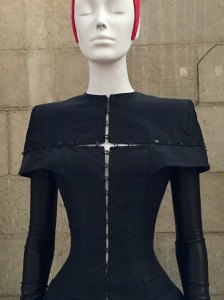
Closeup of Olivier Theyskens’ 1999 evening dress with a hook-and-eye closure in the shape of the cross. From the Crusades section of the show in the Gothic Chapel.
Click here to walk through every room of the Cloisters with Andrew Bolton and hear him explain how he made the selections according to the surrounding artworks.
The Fifth Avenue portion of the show is, like so much of Catholic pageantry, more of a public event, filling the Medieval hall with fashions inspired by angels, secular clergy, nuns, Mary, and saints, all dominated by an Ecclesiastical Fashion Show.
The Fifth Avenue portion of the show is, like so much of Catholic pageantry, more of a public event, filling the Medieval hall with fashions inspired by angels, secular clergy, nuns, Mary, and saints, all dominated by an Ecclesiastical Fashion Show.
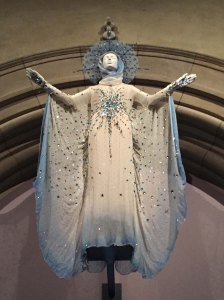
Highlights include a procession of works from Gianni Versace’s last collection, Gaultier’s hologram votive dress, Mugler’s floating angel, and the loft high above it all, populated by ethereal figures wearing choir robes by Balenciaga.
1984 dress by Thierry Mugler from his Winter of Angels collection, part of the Celestial Hierarchy at Fifth Avenue
An important part of the Met’s undertaking is a spectacular mini-exhibition of incredible works of clothing art from the Vatican, which took significant negotiation. Here, Andrew shows highlights of the items on loan from the Vatican, some of which have never been displayed abroad before.
Walk through the Met’s Vatican section of the show here.
Sixth graders listen to explanation of Native American innovation map
The sixth-graders were having the time of their lives cramming into the rocking kayak, finding secret treasures from far-away cultures in the drawers, and comparing sturdy lacrosse sticks made from natural materials.
It was all part of the joyous opening day of the new imagiNATIONS Activity Center, on the ground floor of the Smthsonian’s National Museum of the American Indian, right off Bowling Green in downtown Manhattan.
NMAI officials blessed the proceedings with percussion and chant, but the genuine thrill was seeing the kids pour into the new center to listen to and experience a new take on science, math, and engineering.
Tip of a contemporary surfboard – originally invented by Hawaiians.
When you walk inside, a wonderful wall summarizes the story – a map of North and South America populated with technical inventions by Native Americans over the last several thousand years! It’s a brilliant summary of the fresh ideas that you’ll encounter around the corner.
Although this sparkling, new, inspirational ImagiNATIONS Activity Center was conceived for children, rest assured that any adult museum lover will be blown away by discovering the technical innovation story too.
Although the first settlements in Manhattan and Broadway itself were created by native populations, city dwellers often get so overwhelmed by towering skyscrapers that they don’t immediately connect native cultures with what exists downtown.
Yup’ik kayak frame created by Bill Wilkinson of Kwigillingok, Alaska from spruce, cedar, driftwood, and walrus bone
OK, maybe no one is reading the news on steles in Mayan hieroglyphics anymore, but the much of the work displayed here is made by living, breathing native artists. The next time you’re stuck on a subway because of a signal malfunction, consider the fact that in the Andes, the community assembles each year to repair their chasm-crossing fiber foot bridges. Now, that’s a commuter maintenance plan!
Or consider that Arctic kayaks are custom designed to suit each individual’s weight and shape. Or that cool surfer dudes in Hawaii are simply carrying on a wave-riding tradition that extends back thousands of years.
Cold weather waterproof kayak-hunting system
Every step makes you stop and think. How is it that the Mayans were one of three cultures to invent concept of zero in mathematics? What brilliant minds perfected making waterproof parkas from carcass leftovers or salmon skin? Or the engineering it takes to design watercraft that doesn’t tip?
Sixth graders learn how igloos are engineered.
The mannequin in the corner displays recently crafted components of “system dressing” for hunting from kayaks in freezing waters. The parka has waterproof stitching and attaches to the kayak opening. The visor includes walrus whiskers that aren’t just decoration – they transmit subtle, silent vibrations to the visor that tell expert hunters that their prey has shifted course.
Everything you experience in the center was designed to help teachers inject something new to supplement schools’ math and science curriculums. But the fun factor for learners of all ages is truly off the charts.
You’ll experience how all the significant contributions made by native people in food, architecture, sports clothing, agriculture, and engineering really add up in day-to-day modern life. You’ll want to get into the kayak and open all the drawers yourself.
Port Authority executive Janice Stein and colleague who loaned steel cables from the Bayonne Bridge
From attending the opening, we were able to meet the people from the Port Authority of New York and New Jersey, who donated a piece of repair cable from the recently upgraded Bayonne Bridge for the engineering display. Perfect for seeing and touching to see how Andean fiber cables compare to urban steel.
We also heard the story of how the kayak overhead made a 4,000 journey on a sea plane, a ship, and a truck from the workshop of Bill Wilkinson in Kwigillingok, Alaska to Anchorage to Seattle and to New York City.
Take a look at our Flickr album and make a trip to the Battery as soon as you can. The center, like the NMAI, is free, fully staffed, and open seven days a week.
Exploring drawers of textile samples.
Take your own kids, your neighbor’s kids, or your inner child and get your hands on that igloo downtown and think about what you owe the people living south of the border for the invention of chocolate.
Dancers strike poses inspired by the surrounding works of art in a piece collaboratively choreographed with Nick Mauss
Cecil Beaton’s 1937 Vogue photo of poet Charles Henri Ford in a costume by Salvador Dali
Go when the dancers are there. Entering Nick Mauss: Transmissions, installed on the top floor of the Whitney through May 14, you’ll see them moving behind a transparent scrim as the elevator doors open.
The artist had a vision and the Whitney curators gave him the freedom to scour their deep-storage archives, delineate a space for dancers, install works of art, and write scintillating details about the fruits of his research.
Nick’s vision was to create a visual conversation about the collisions between modern art and dance in New York between 1930 and 1950 – a time when bon vivants, peripatetic painters, scandalous artistes, and boundary-pushing dancers expressed themselves in every manner possible.
He succeeds spectacularly. But the show isn’t laid out in a chronological manner like a history show. It’s more of a curated, free association experience that genuinely works.
Visitors encounter Whitney works that are almost never displayed, photos from the Kinsey Institute, works from the NYPL’s Jerome Robbins Division archive, ephemera from personal collections, and Nick’s own creations.
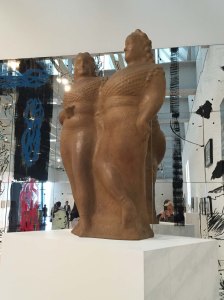
1928 dancer-inspired sculptures by Elie Nadelman stand in front of Nick’s mirrored mural.
Nick’s put a quartet of live dancers at the center of the swirl, encouraging and challenging visitors to explore clues surrounding them – private artistic photos, Diaghilev’s calling card, costume designs by Dorothea Tanning, a video of Balanchine in rehearsal.
As dancers quietly assume poses, visitors are left to move about and make their own connections. Do the dance poses echo the quiet Gaston Lachaise or Elie Nadelman sculptures, or the over-the-top expressions of NYC ballet superstars in Carl Van Vechten’s slide show splashed across the opposite wall?
Nick’s research unearthed an extraordinary wealth of information about relationships among artists, cross-currents of artistic influence, intimate social circles, and gay life. His idea was to inject a little more color to the American modern-art narrative.
One of 830 slides taken of American Ballet Theatre dancers by Carl Van Vechten, America’s first dance critic.
When the Whitney staff read the captivating associations that Nick uncovered as he selected objects for the installation, they decided that it was too rich to simply identify things in the traditional cut-and-dried museum label card format
The curators mounted Nick’s extraordinary background stories next to the artworks, photos, stage set mock-ups, and costume designs to let visitors get inside Nick’s head and share in his fun.
The stories – like the dance quartet – encourage visitors to connect their own knowledge about the origins of modern dance and modern art in New York with what they see and read:
What impact did modern dance pioneers Loie Fuller and Ruth St. Denis have on 1920s sculpture? How did a Ballet Russe-obsessed cultural impresario convince George Balanchine to start the New York City Ballet?
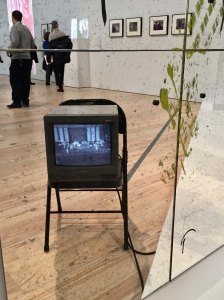
Reflected in Nick’s mirrored mural, a monitor shows videos of Balanchine rehearsing the New York City Ballet.
What was a sophisticated dance critic doing in his studio with props, costumes, Agnes de Mille, and stars of the New York ballet world?
The beauty of Nick’s installation is that people wandering about the space are able construct their own visual and mental narratives and understand the swirl of modernism from that time in a new way. Take a look at our Flickr album to view some of our favorite works in the show.
The choreographed piece was developed collaboratively by Nick and the dancers. The complete experience is poetic, revelatory, interactive, and constantly in motion.
The dancers perform from 12 p.m. to 4 p.m. daily, and also on Friday nights from 6 p.m. to 10 p.m.
Here’s a short clip of the quartet of dancers performing in the gallery:












 itsnewstoyou