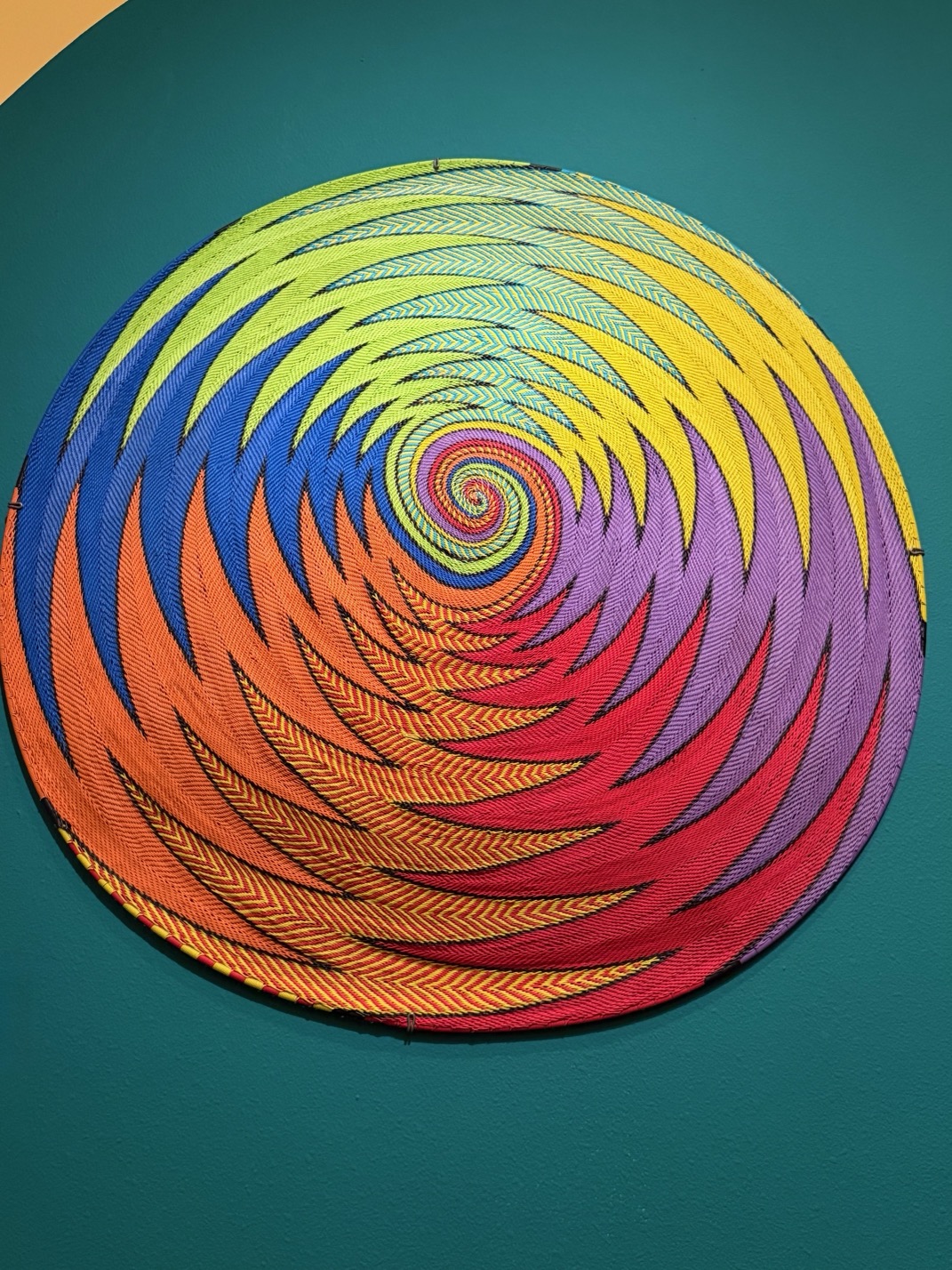
How do you take a domestic beer pot and lid and turn it into art? Take a look at the dazzling designs on display in the first museum exhibition dedicated to one of the most unique art forms to blossom in post-Apartheid South Africa – iNgqikithi yokuPhica/Weaving Meanings: Telephone Wire Art from South Africa, on view at Santa Fe’s International Museum of Folk Art through March 29, 2026.
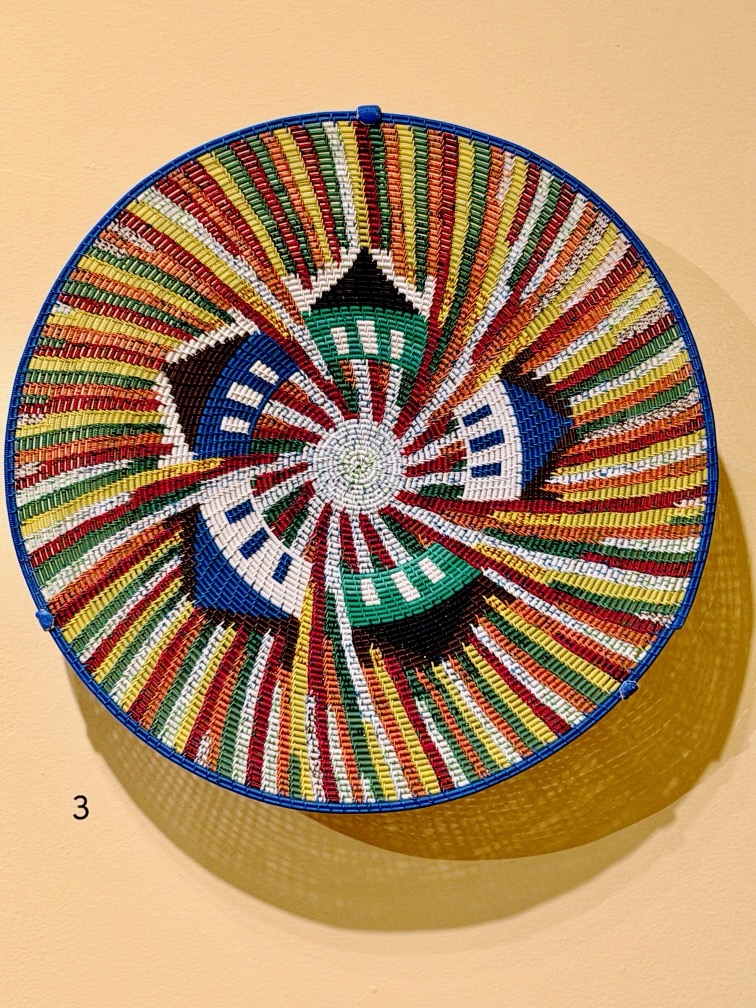
It’s easy to be overwhelmed at the the intricacy of the colorful, whirling designs that first meet your eye. But when you slow down to look more closely, all sorts of meanings appear – ancient tribal writing, village scenes, Zululand wildlife, patriotic emblems, and even celebrated achievements in the sports world
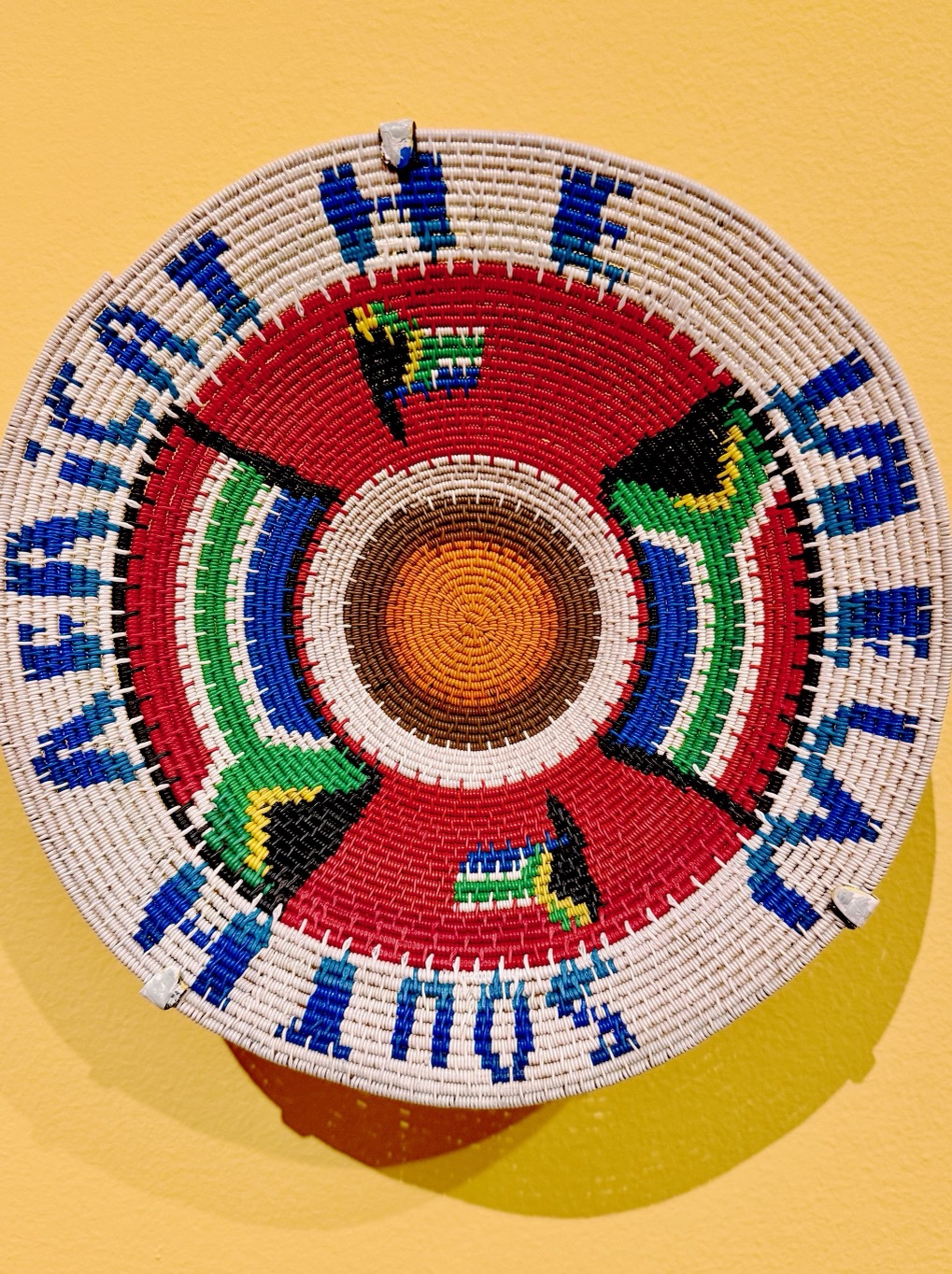
Dudu Cele’s 1990s The New South Africa telephone-wire weaving celebrating the end of apartheid featuring the colors of the nation’s new flag.
Take a look at some of our favorite works in our Flickr album.
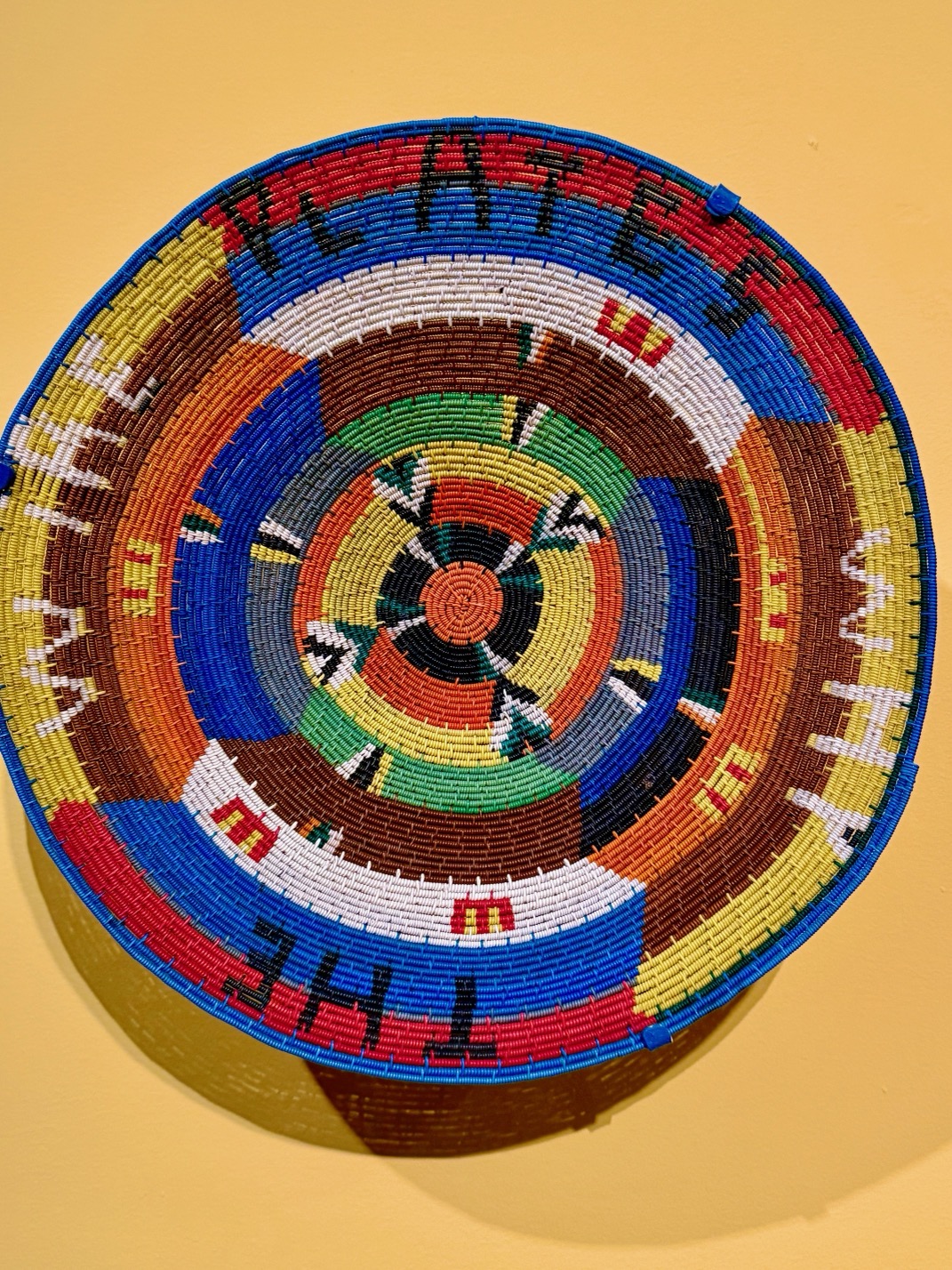
The journey begins with Bheki Diamini’s 1990s telephone-wire basket, whose text asks the question “Why the Wire Plates?” T
The exhibition answers by explaining the long history of African wire weaving, the stories of innovators who started using colorful telephone wire in the 1990s, and how it became an economic game-changer for practitioners.
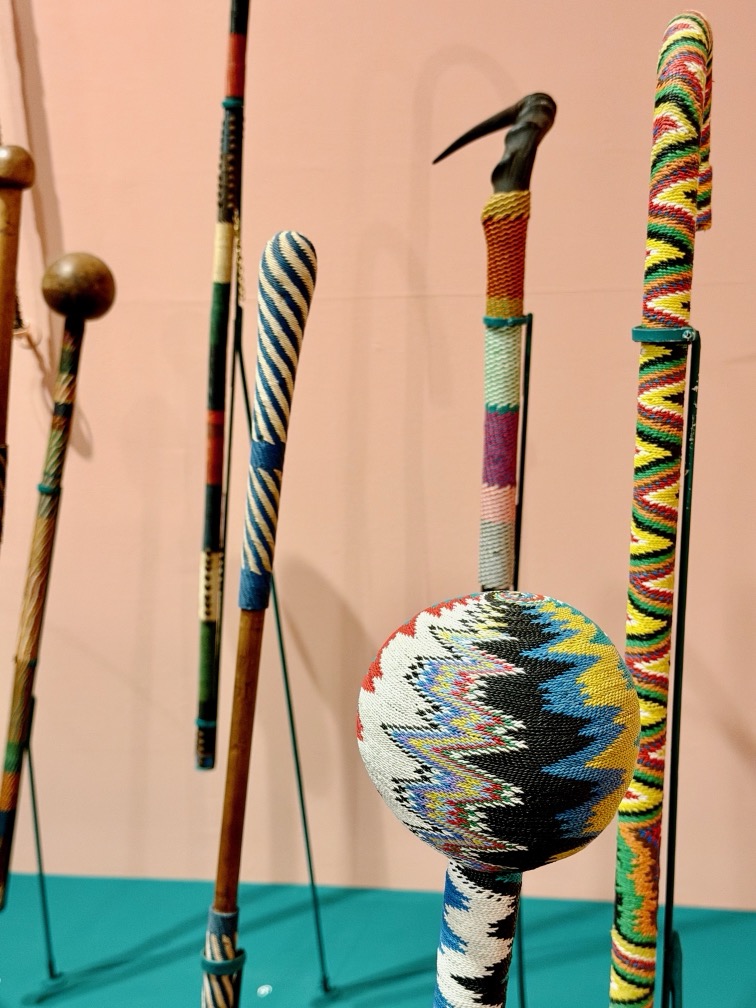
As far back as the 16th century, wire and metal rods were popular trade items in South Africa, and by the 19th century, everyday people were embellishing snuff containers and traditional sparring and walking sticks with intricate wire weaves. Although traditional beer and grain pots were made of woven fiber, and sometimes people wove in beads to personalize (and identify) their own.
An array of sparring sticks embellished with telephone wire and other materials –dancing sticks, 2005 walking stick, and Peter Lekotjo’s 2005 knobbed fighting stick.
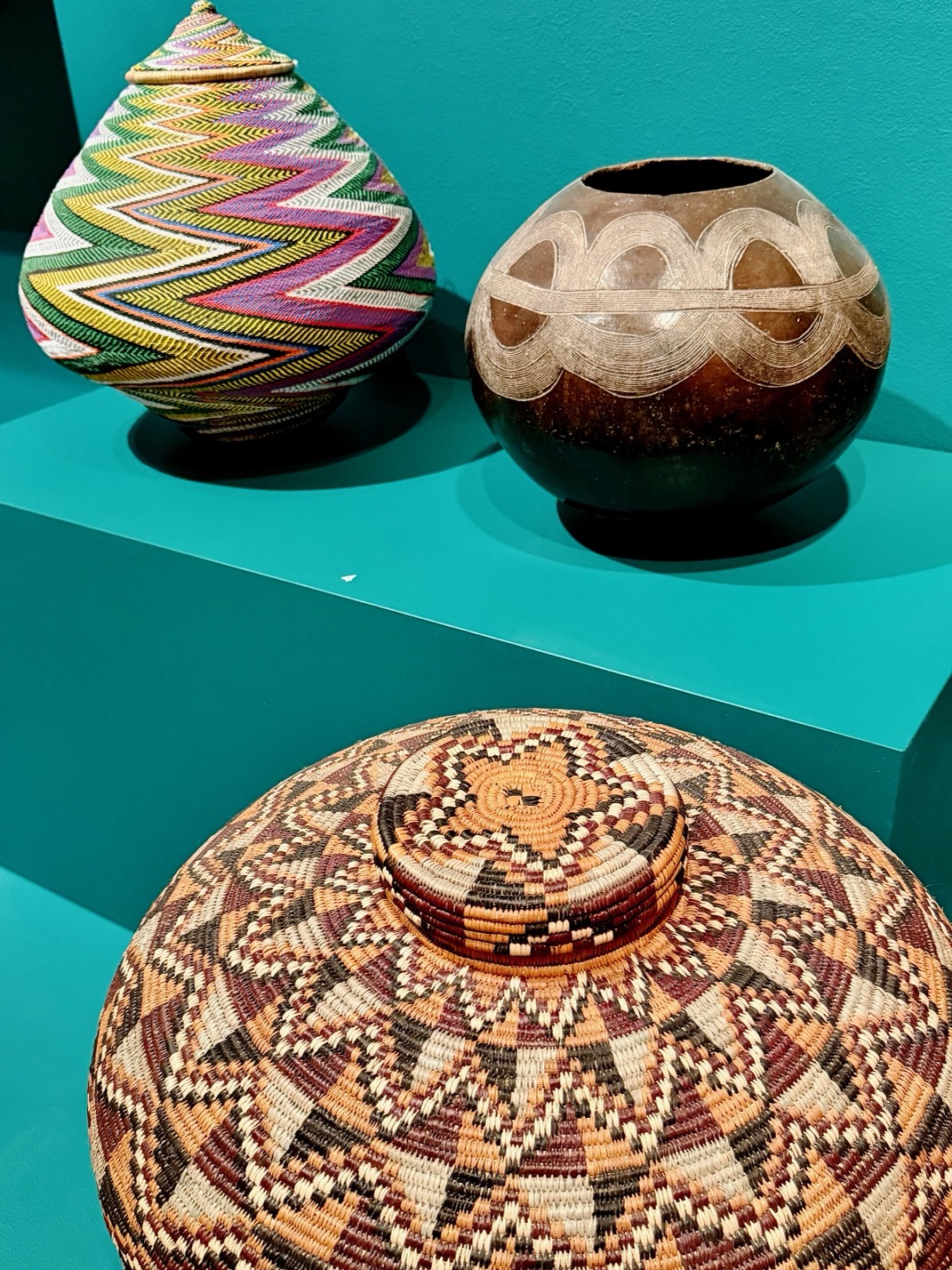
Rare late 20th-century works made of telephone wire and natural materials – a palm and grass basket embellished with telephone wire, an earthenware grain-storage pot, and Laurentia Diamini’s grain storage basket woven with palm and grass.
In the 20th century, when a few weavers began incorporating colorful telephone wire into their work, it didn’t take long until highly decorated sticks, colorful hats, amped-up drinking cups, and beer pot lids were transformed. Under the repressive apartheid system, Black South Africans lived under highly restrictive work-life conditions, just scraping by and hardly able to afford most art making materials.
As telephone technology was deployed across Black communities in South Africa, the spools of colorful, coated wire surged in popularity as a tool more creative expression because workers often cast it off when industrial projects were done. Cheap (or free!), plentiful, and in a dozen colors! Perfect!.
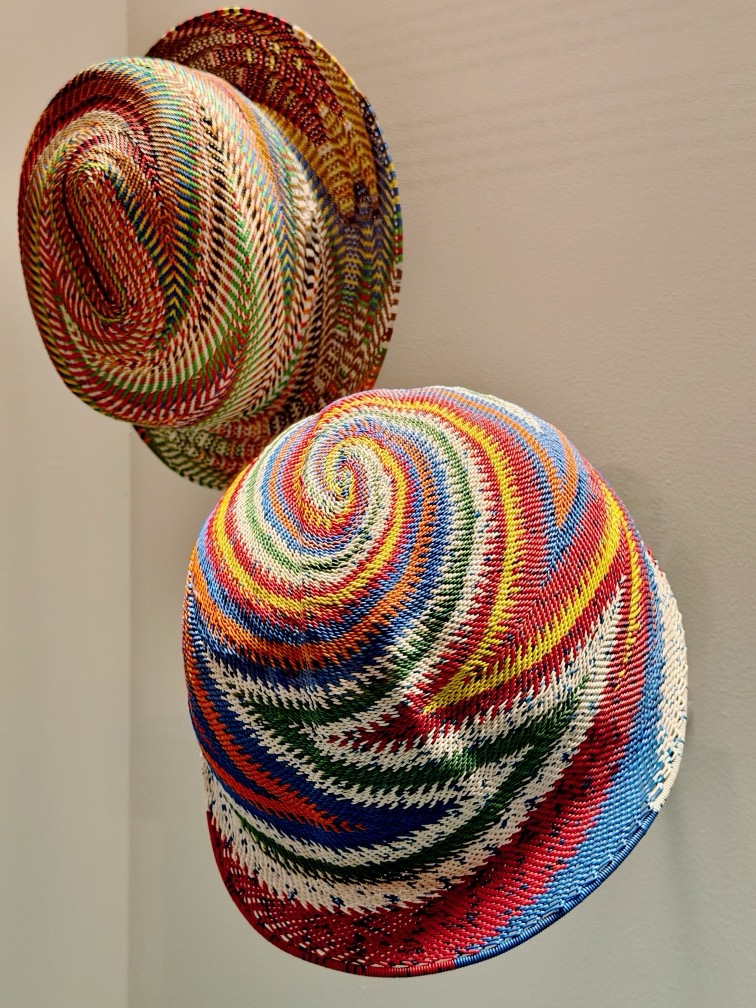
Two hats embellished with telephone wire – a top hat (pre-2007) and Shadercke Ntuli’s 2000 hard hat – similar to those used for mine-worker dance performances.
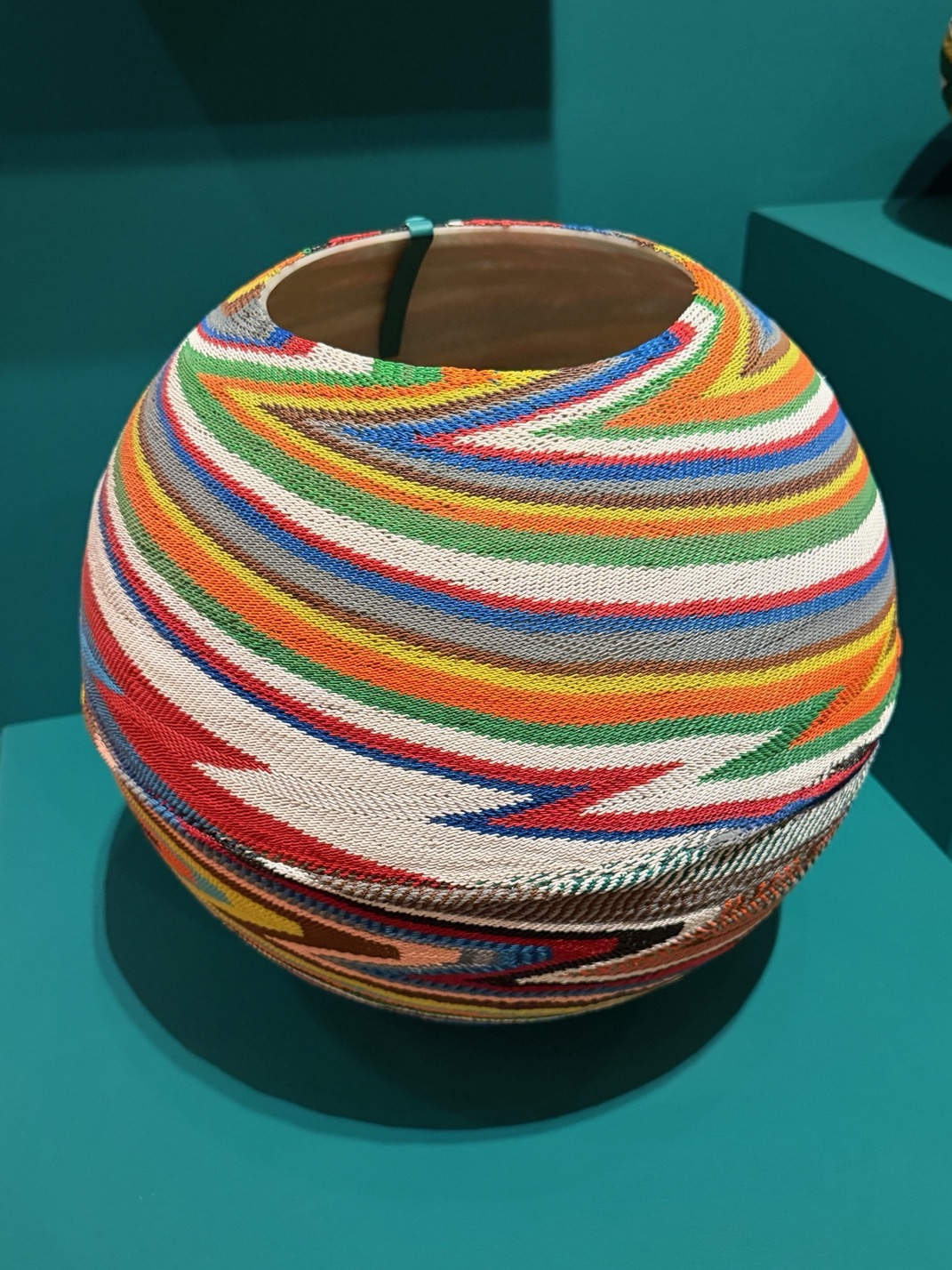
Michael Mfeke’s late 20th-century telephone-wire basket in the shape of a beer pot (ukhamba).
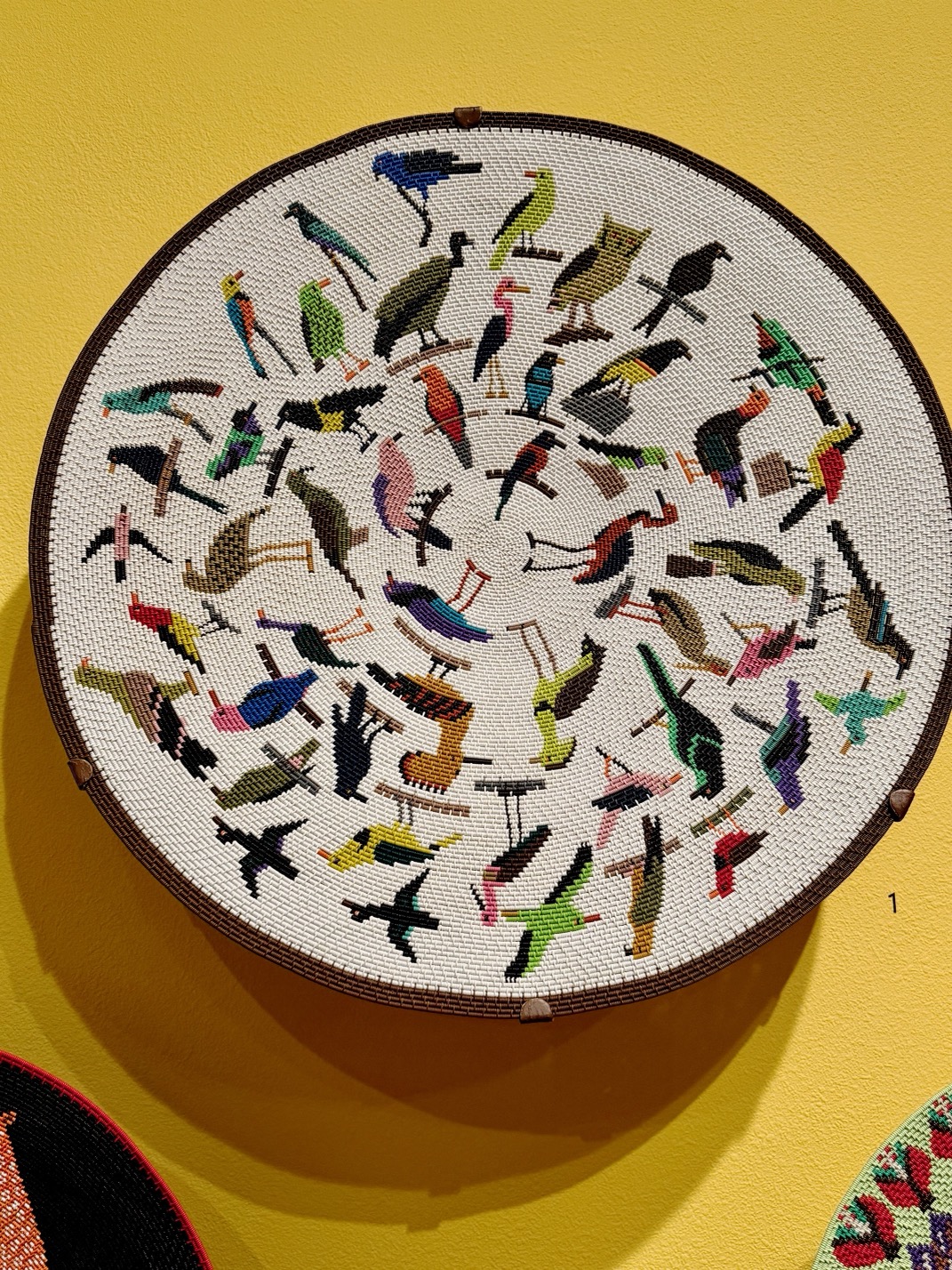
Rather than making an historical exhibition, the curators have chosen to focus on grouping work by and presenting biographies of the innovators – like master weavers Bheki Diamini, Jerita Mmola, Elliot Mkhize, Vincent Sithole, and othes – who popularized this art form with makers in their own country and collectors internationally. It’s captivating to see all the ways Sithole, for example, incorporated wildlife into his designs to satisfy demand from tourists who began flocking to South Africa as a safari destination.
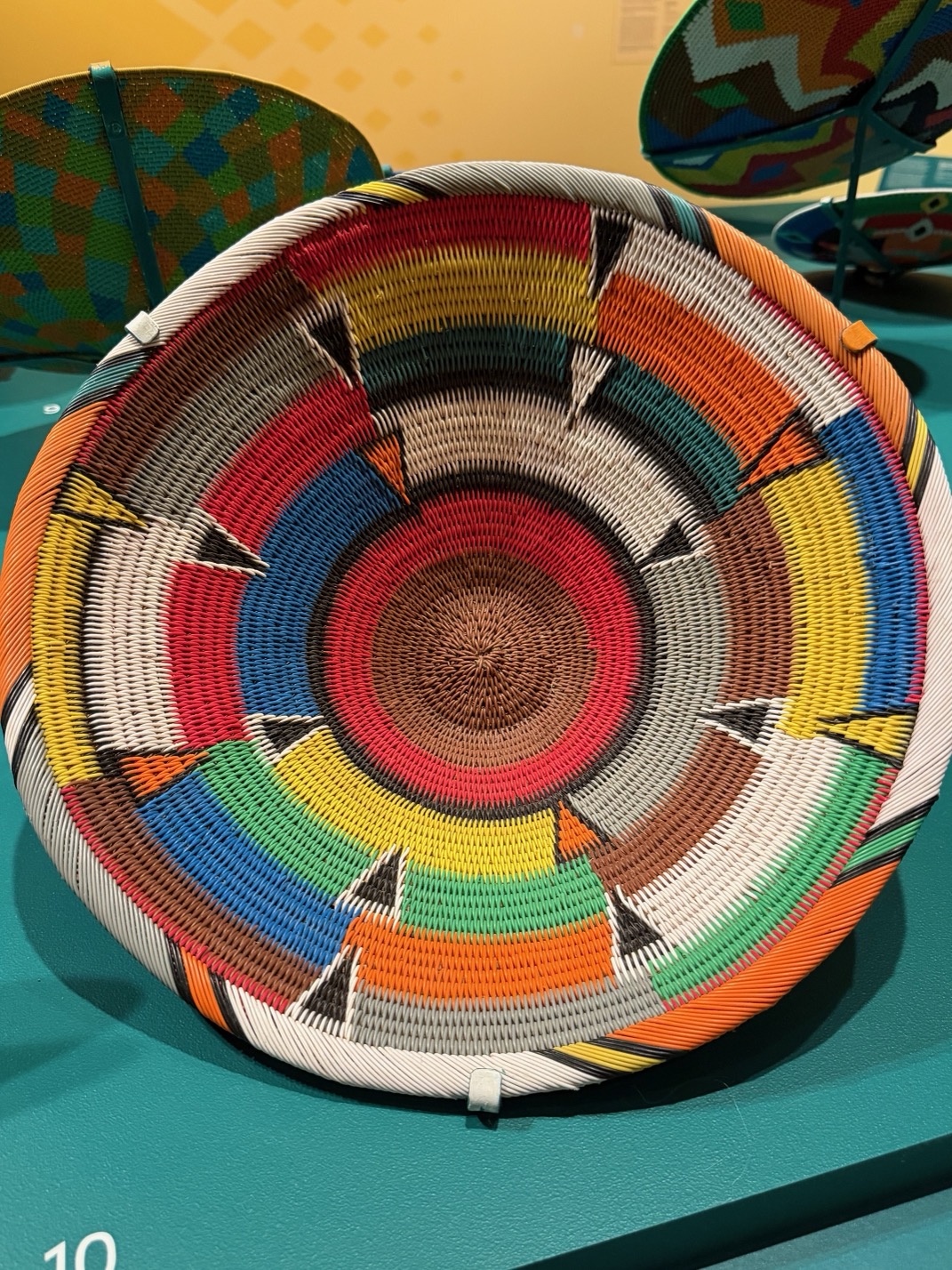
Colorful 1990 telephone-wire food basket (xirutu) by Jerita Mmola of Limpopo, South Africa.
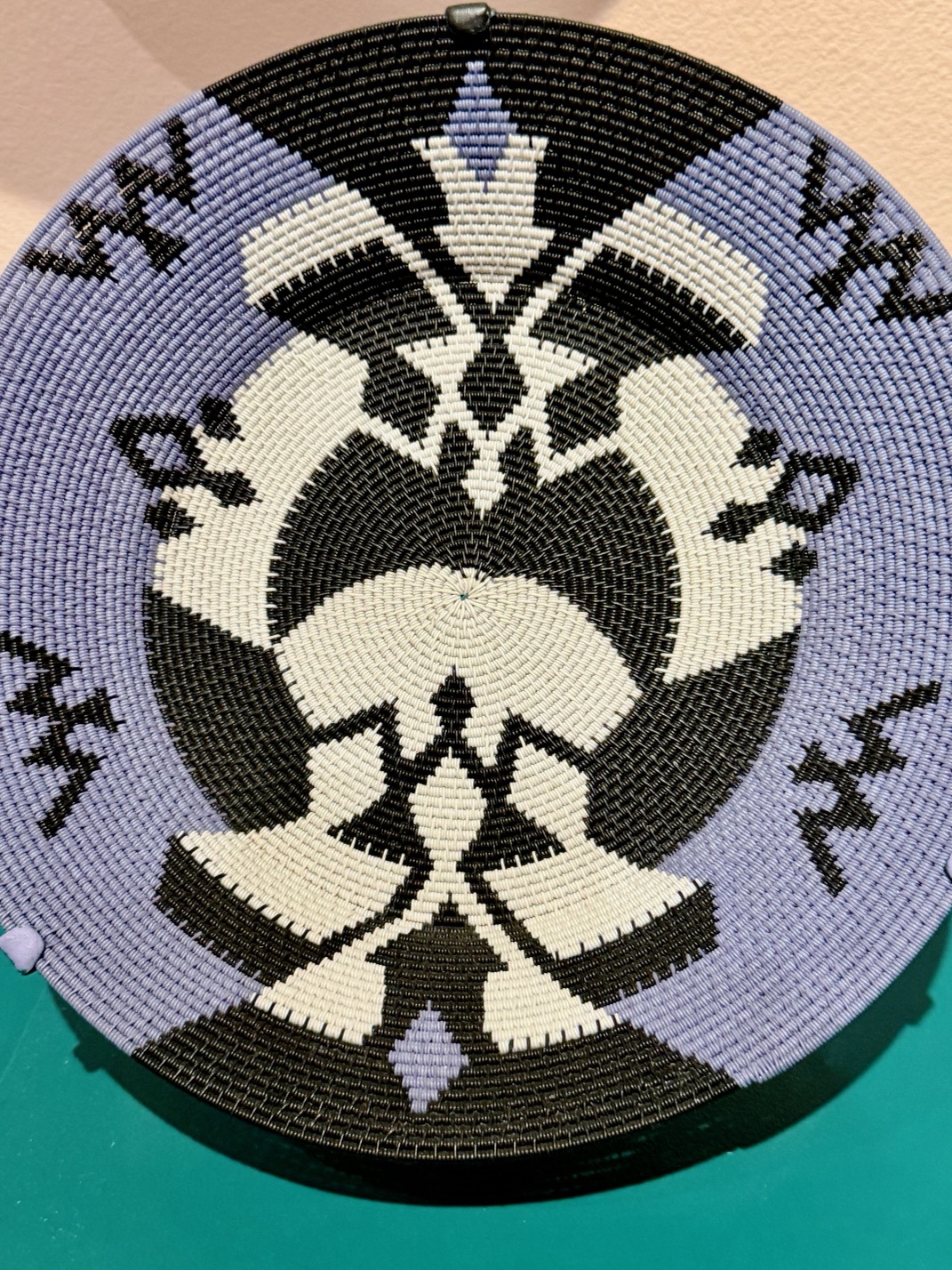
Elliot Mkhize’s 1997 telephone-wire basket with abstract symbols inspired by ancient Zulu hierographic writing.
A compelling video in the center of the exhibition takes visitors into the Maphumolo family home to show how increased revenue from art sales – in South Africa and abroad at art festivals – have boosted living standards and opportunities for artists on an intergenerational basis.
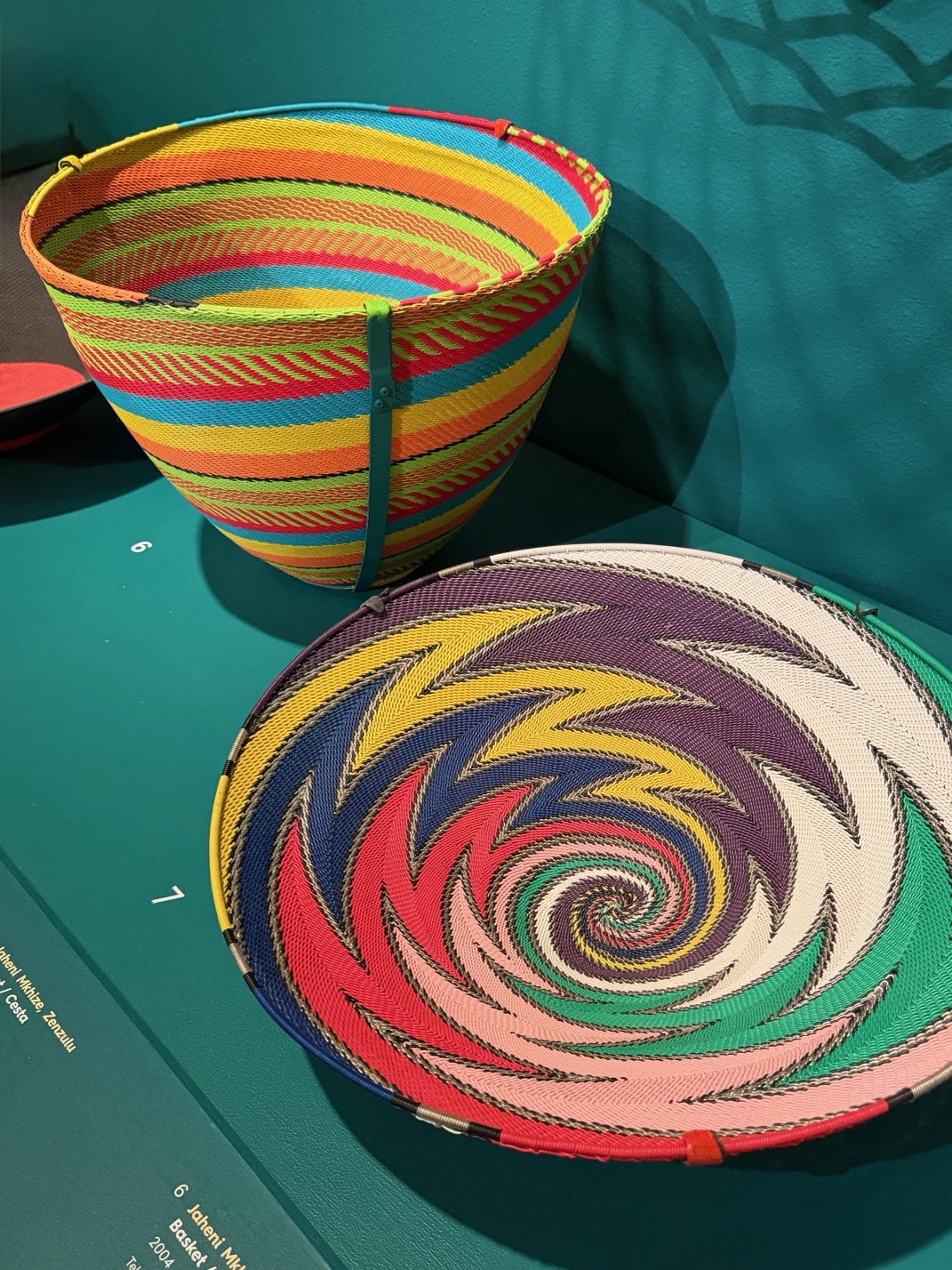
Two by master soft-wire innovator Jaheni Mkhize – 2004 cone-shaped basket and colorful 2000 telephone-sire basket.
In the mid-1990s and early 2000s, as tourism to South Africa increased, weavers began to incorporate South African wildlife, create whimsical wire animals, and depict rural villages to boost a new pride in the homeland. Sports triumphs are celebrated by weavers, too.
Figurative master Vincent Sithole’s 2008 telephone wire basket depicting numerous species of South African birds. Courtesy: Arment-Rimelspach collection.
Octavia Gwala’s 2005 telephone-wire and wire weaving showing a rondavel – a circle of thatched-roof Zulu homes that form a homestead.
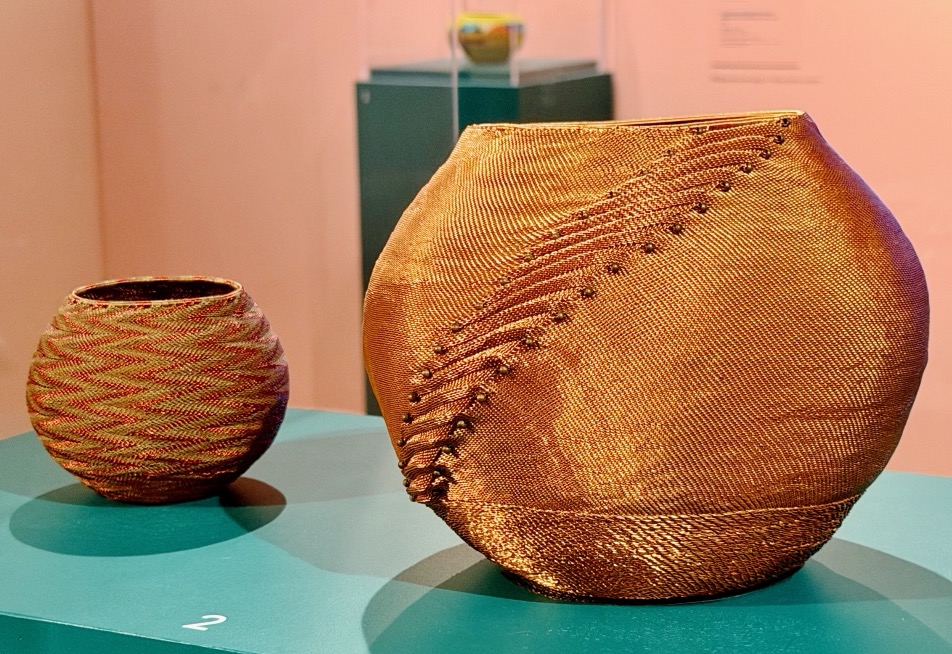
The exhibition walk-through concludes with work exemplifying new trends – baskets that incorporate pop culture references. three-dimensional wall pieces, and shimmering works in gleaming woven copper wire.
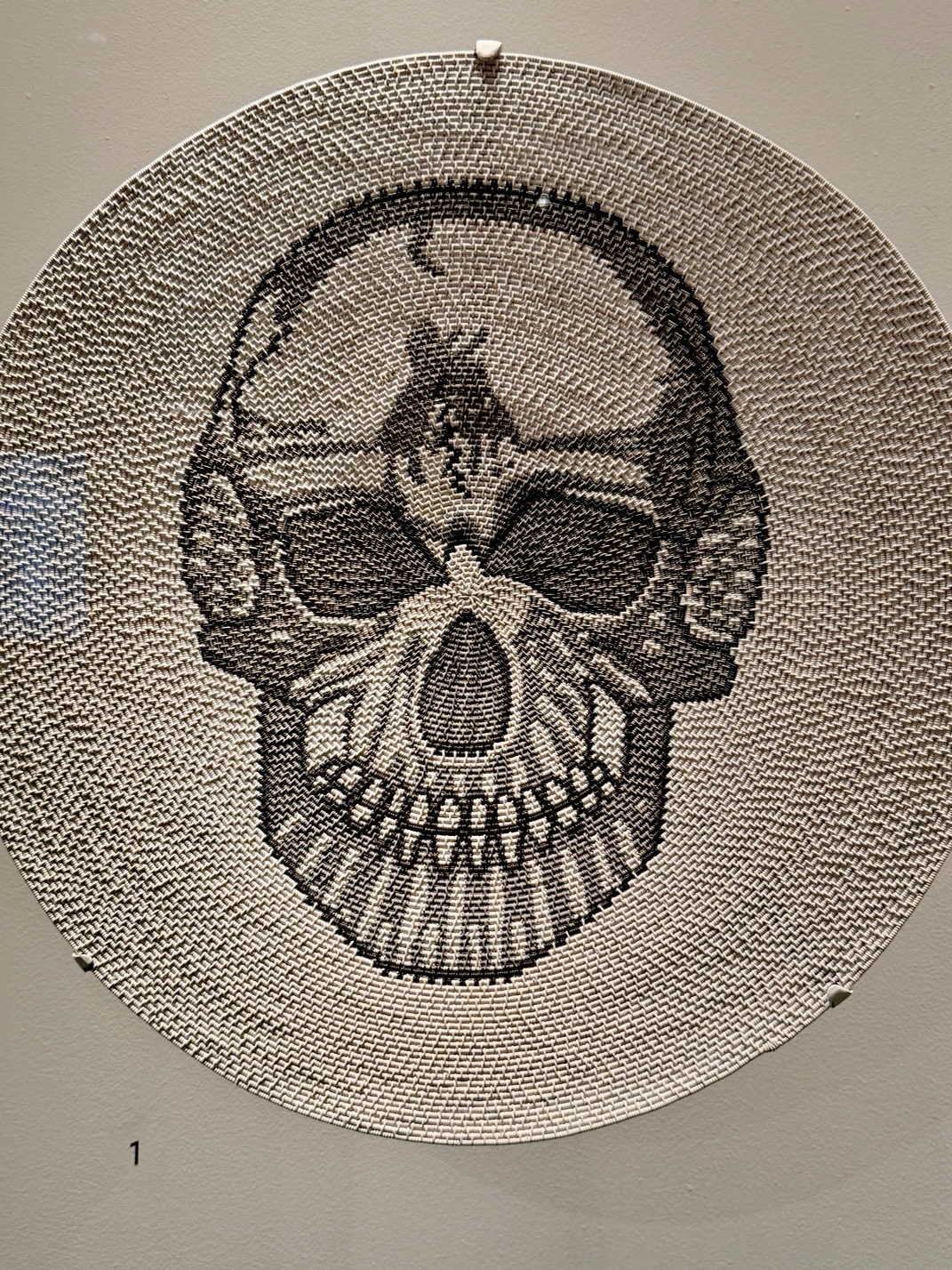
Simon Mavundla’s 2013 telephone-wire and wire basket Grey’s Anatomy Series: Norma Frontalis from a design by Marisa Fick-Jordaan. Courtesy: Arment-Rimelspach collection.
Details of 2009 Nature Series, Wall Platter, Rousseau, a three-dimensional telephone-wire sculpture designed by Marisa Fick-Jordaan
In the exhibition promo, indigenous knowledge-keepers explain more about what these artworks mean and see some of the masters at work.
Enjoy this look at the riches on display in this beautiful show.
Thanks to collectors David Arment and Jim Rimelspach, whose passion, patronage, and vision have introduced us to beautiful work by the most innovative artists and families creating in South Africa today, and donated so many exquisite works to IFAM’s permanent collection.
Two metal baskets from Threads of Africa project: Bandile Mtshali’s 2010 brass and copper-wire basket and Jobe Sithole’s 2016 copper wire and brass bead basket.
In her day, she was considered a style icon, spendthrift, deviant, monster, and hapless victim. And why are we still talking about her and dissecting her lifestyle, look, and acquisitions over 200 years later?
You’ll find the answer in the South Kensington V&A galleries with portraits, clothes, artifacts, and haute couture fashion in Marie Antoinette Style, on view in London through March 22, 2026.
The Victoria & Albert Museum has pulled incredibly well-preserved fashions from its own 18th-century collection, and has also borrowed from Versailles and European collections that scooped up Marie’s stuff when it was ransacked and put on the open market after her death during the French Revolution – jewels, furniture, Sèvres table settings, and remnants of her dress fabric.
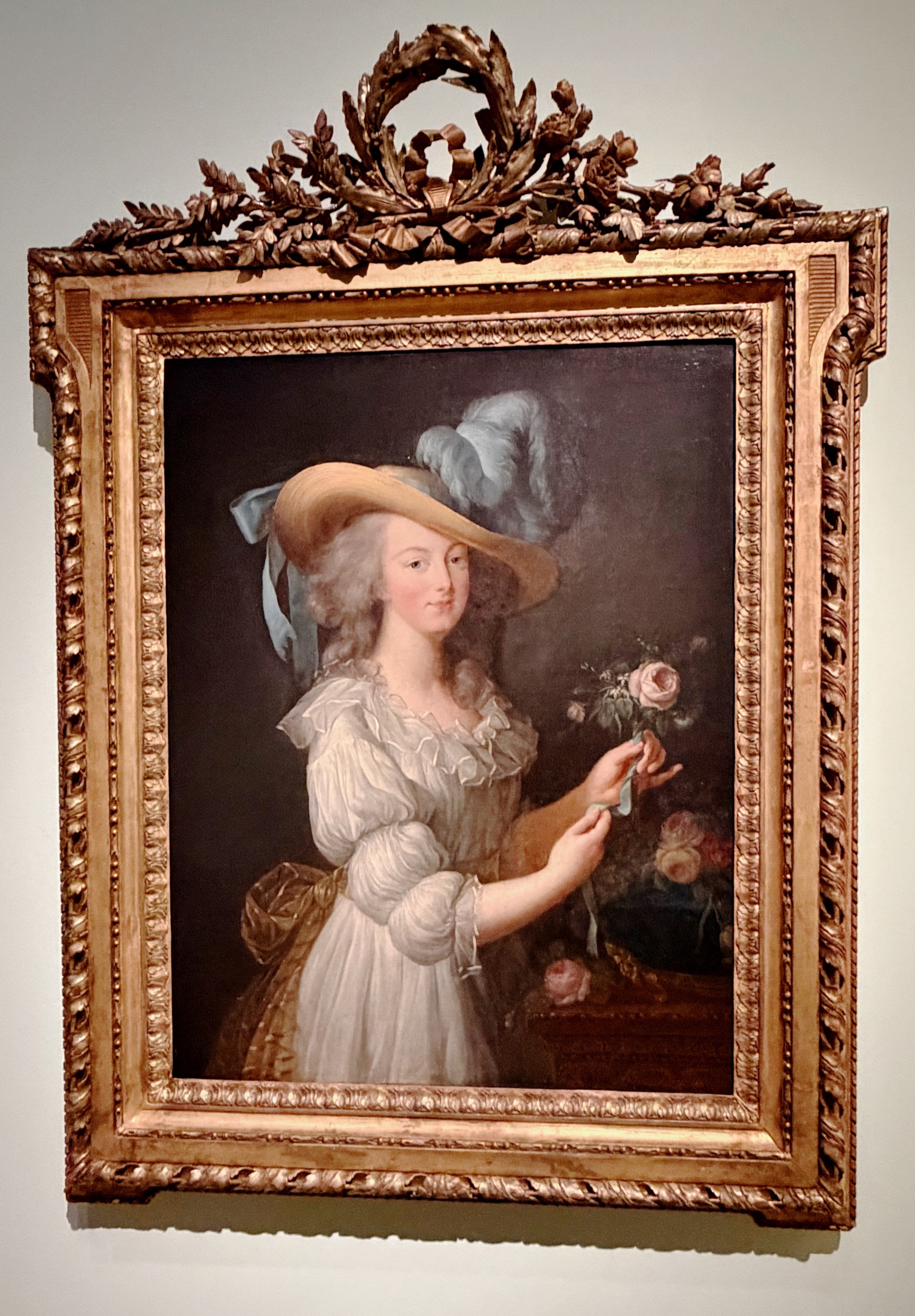
1783 Marie Antoinette in a muslin dress by Elisabeth Louise Vigée Le Brun; seeing the queen in a dress resembling underwear shocked everyone who saw it at the Paris Salon, but it soon became the style. Courtesy: National Gallery of Art, Washington, D.C.
As befitting a Versailles icon, the introductory gallery is a dazzling room of mirrors. With the dramatic illumination of opulent court dresses, wedding attire, royal portraits nof Marie, fans, and swaths of over-the-top embroidered silk, the effect is magnified by the points of light dancing across multiple reflections of sumptuously draped fabric.
Take a look through some of our favorites on display in our Flickr album.
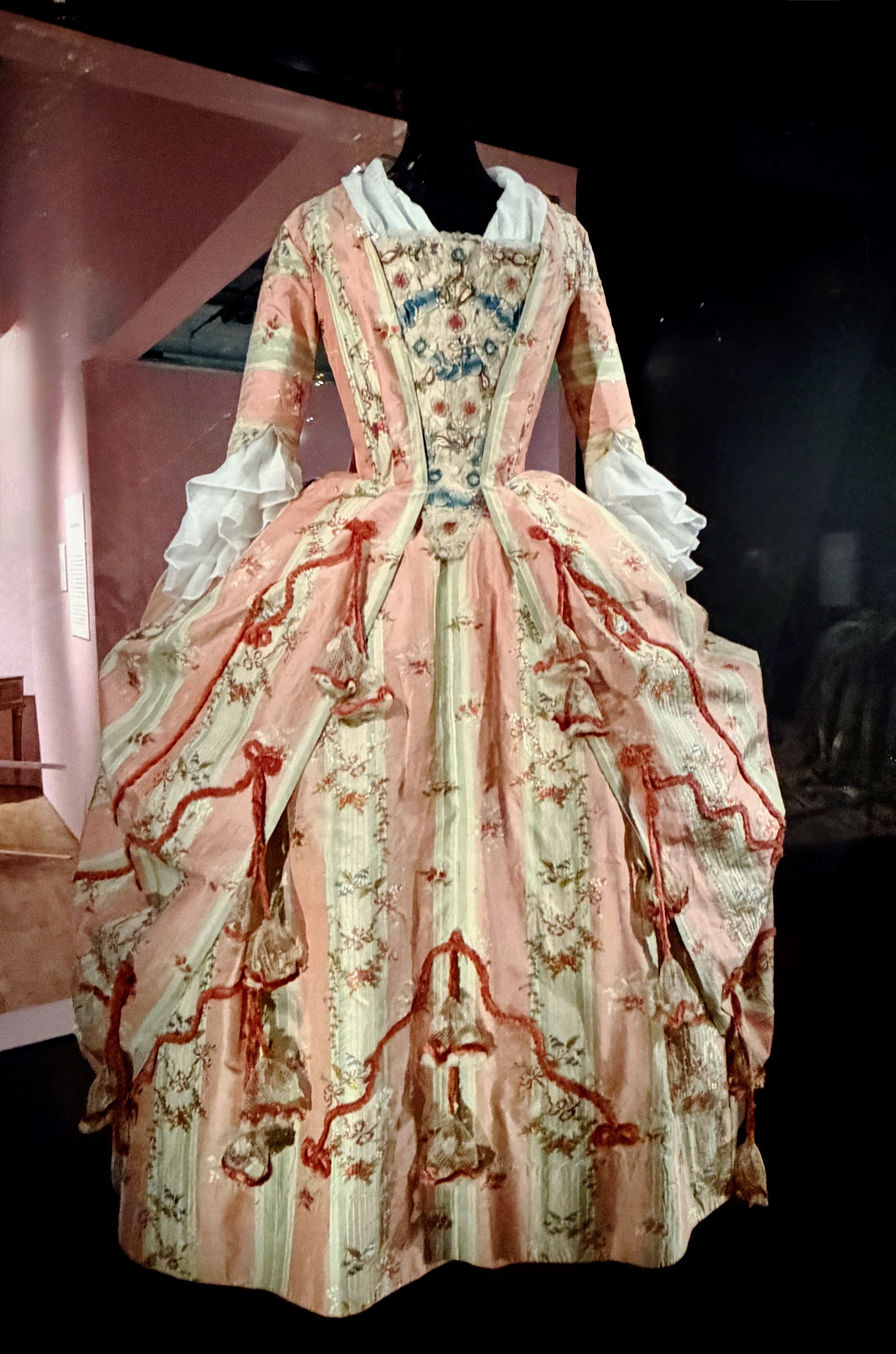
1775 French robe à la française à la Polonaise silk taffeta, silk chenille, and linen lace; less formal style with skirts looped up to create volume. Courtesy: Los Angeles County Museum of Art.
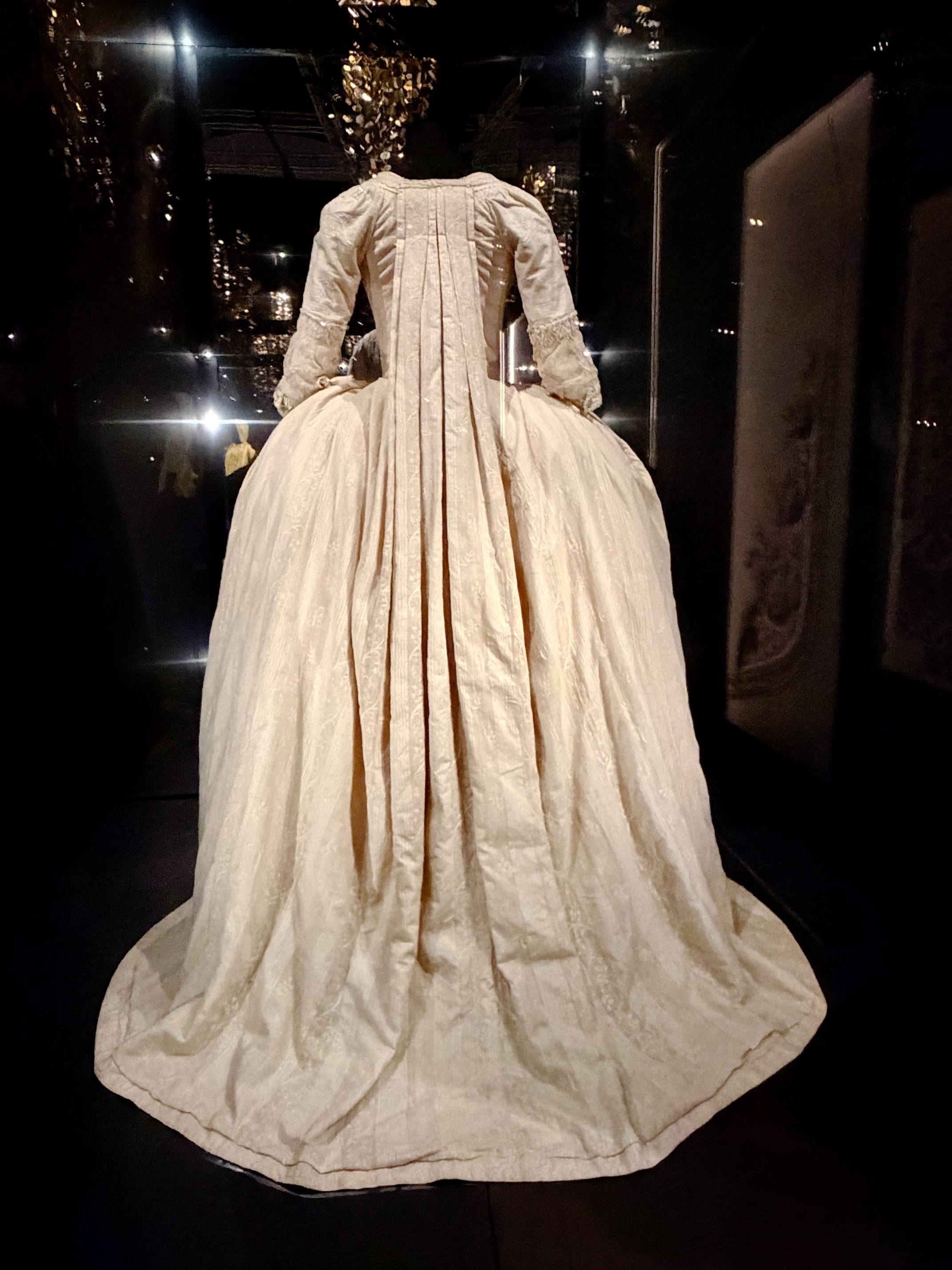
1775-1780 French embroidered cotton and linen muslin robe à la française – a fresh, light style innovated by the French court; silk lining creates a blush effect. Courtesy: V&A
You experience how Marie’s fashion sense changed from the big-time Rococo style she sported as a teen to the more minimal muslin style she popularized as she and her friends gallivanted around the Tríanon grounds in jaunty Italian straw bonnets.
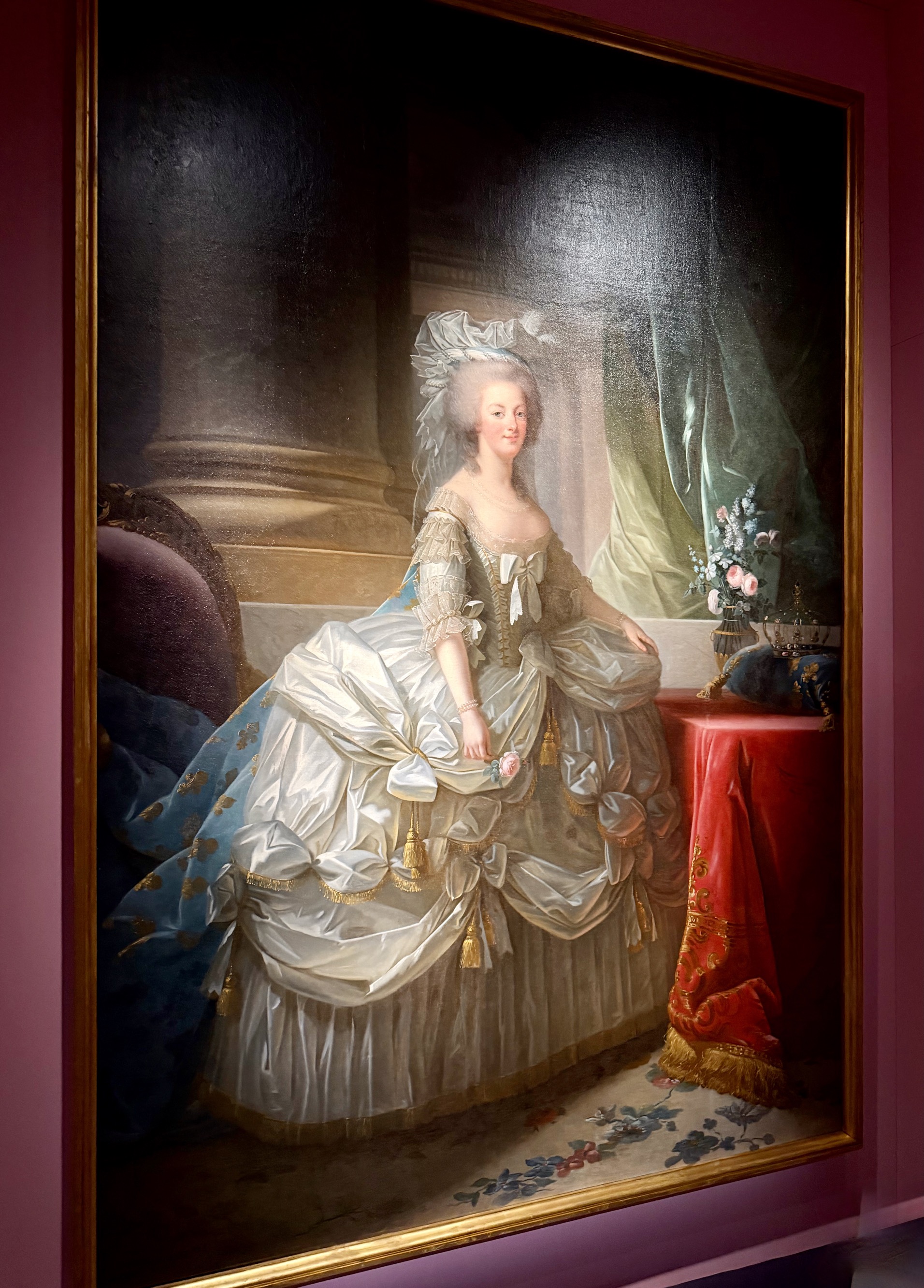
Style icon: later painting based on 1778 oil Queen Marie-Antoinette in Court Dress by Elisabeth Louise Vigée Le Brun; the queen at 22. Courtesy: Versailles, musée national des chateaux de Versailles.
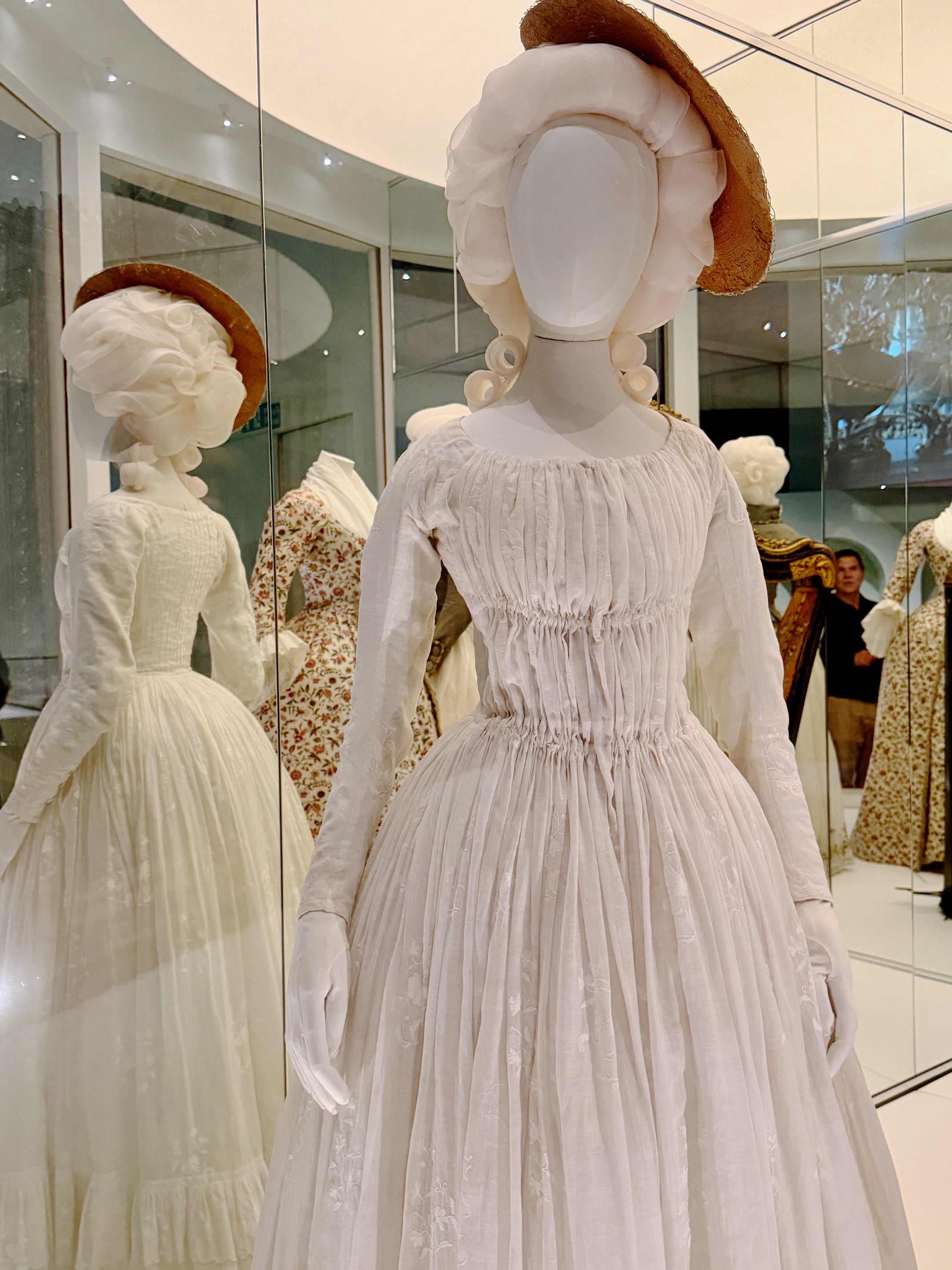
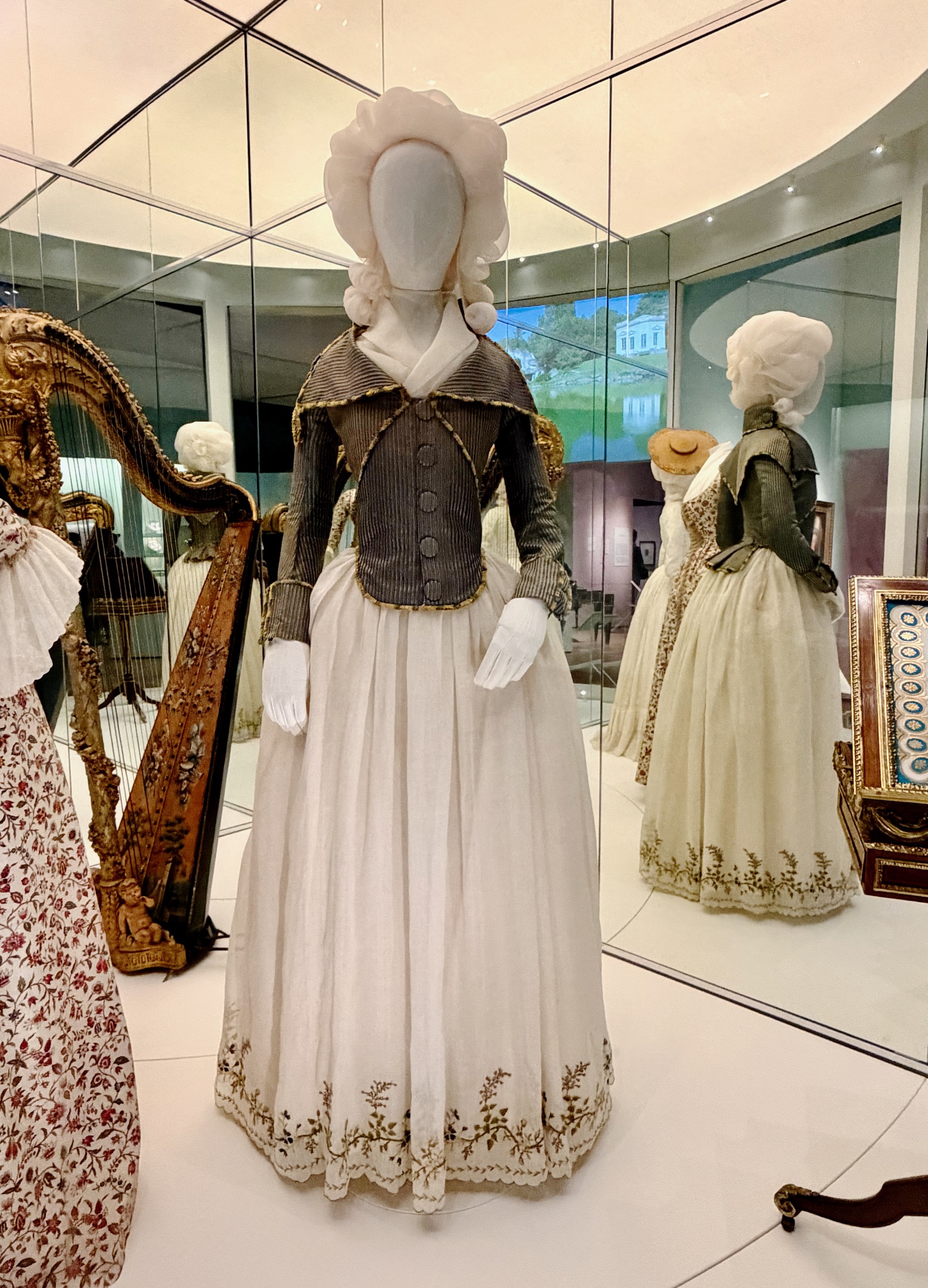
Informal dress that Marie popularized: 1760-1780 “shepherdess” hat (bergères) of Italian straw and a rare 1785-1790 embroidered muslin dress (robe en chemise) owned by Madame Oberkampf of Jouy-en-Josas. Courtesy: V&A; Musée de la Toile de Jouy
Plates from 18th-century fashion publications show off the latest extravagant details of hair poufs that Marie popularized. Incredibly, there’s also an actual shoe owned by the style icon herself. As queen, she received four new pairs of shoes per week! Watch this short video to get a close-up view of her 230-year-old silk and kid shoe that survived!
During her reign, Marie had an outsized influence on interior design, landscape architecture, the decorative arts, and music. Her fashion selections and hairstyles were noted, discussed, and copied.
When the winds of democratic change came to France, Marie’s attire changed again to a more pared-down republican look that every patriotic woman in Paris also sported, right down to the patriotic silk cockades pinned to hats and lapels.
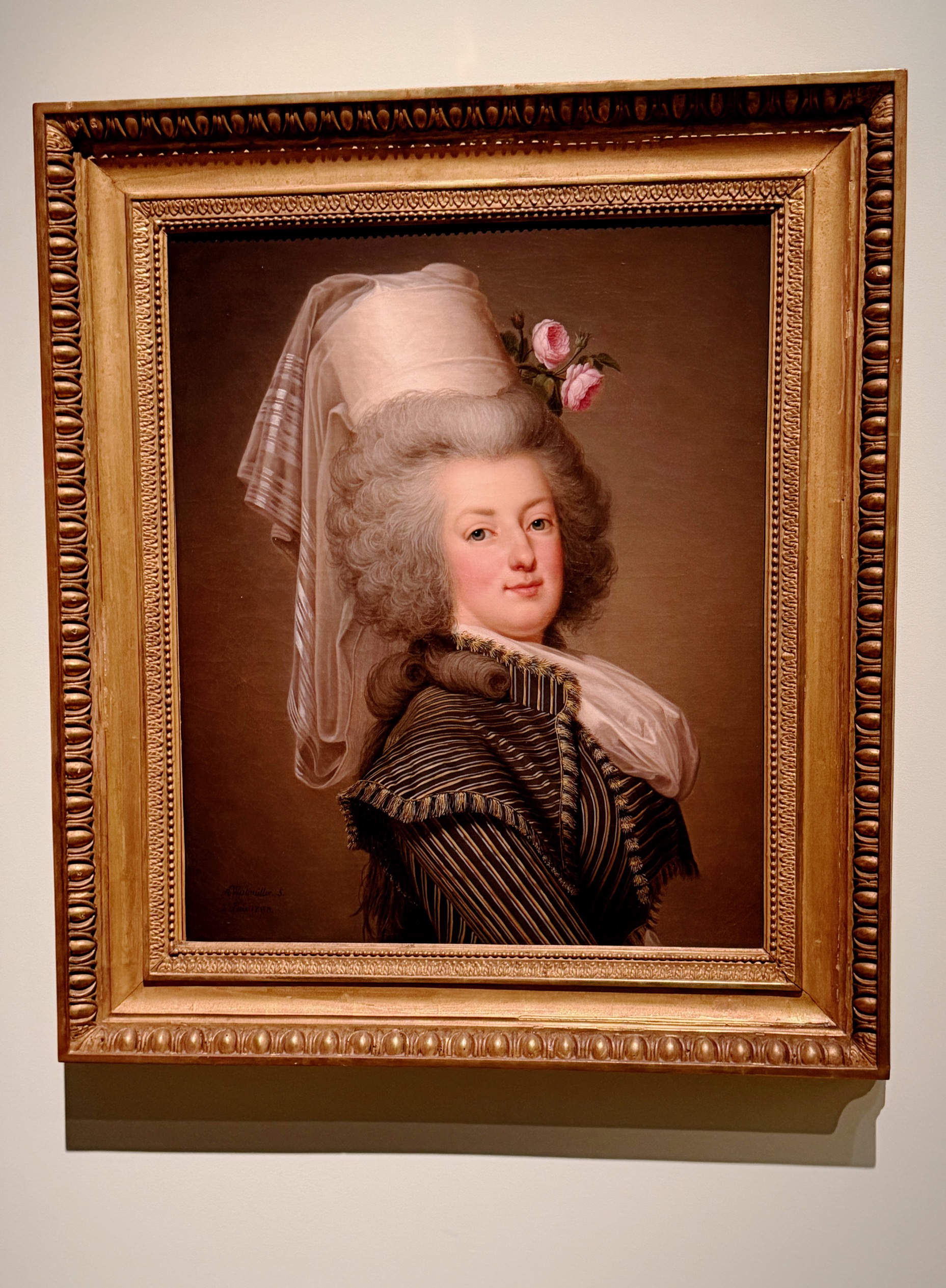
Years of the Republic: 1789 oil Marie Antoinette wearing a fashionable jacket (pierrot) and gauze-draped white silk fez; portrait by Adolf-Ulrich Wertmüller. Courtesy: Versailles, musée national des chateaux de Versailles et de Tríanon.
Years of the Republic: Height of French 1780s-1790s fashion – a 1790 striped silk pierrot (jacket) work atop a muslin petticoat, decorated with tambour embroidery. Courtesy: V&A
But by then public opinion had turned against Marie, largely due to the unfortunate incident that completely tarnished the public’s view of her – The Diamond Necklace Affair. In an exhibition section titled “The Queen of Sparkle,” the curators display a modern copy of the necklace that created the ruckus alongside lavish jewelry created from the diamonds removed (and resold) by an 18th-century con artist.
Here, the V&A’s Senior Curator Sarah Grant provides a close-up look at those infamous diamonds and tells the story:
Decried, denounced, and executed, it’s remarkable that 75 years later, Marie-Antoinette style and influence had a come-back, thanks to an obsessive 19th century fan, Empress Eugénie of France. Eugénie loved Marie’s fashion sense began sporting her look at various fancy-dress balls. She even commissioned haute courtier designer Charles Frederick Worth to design some looks, and he was happy to oblige.
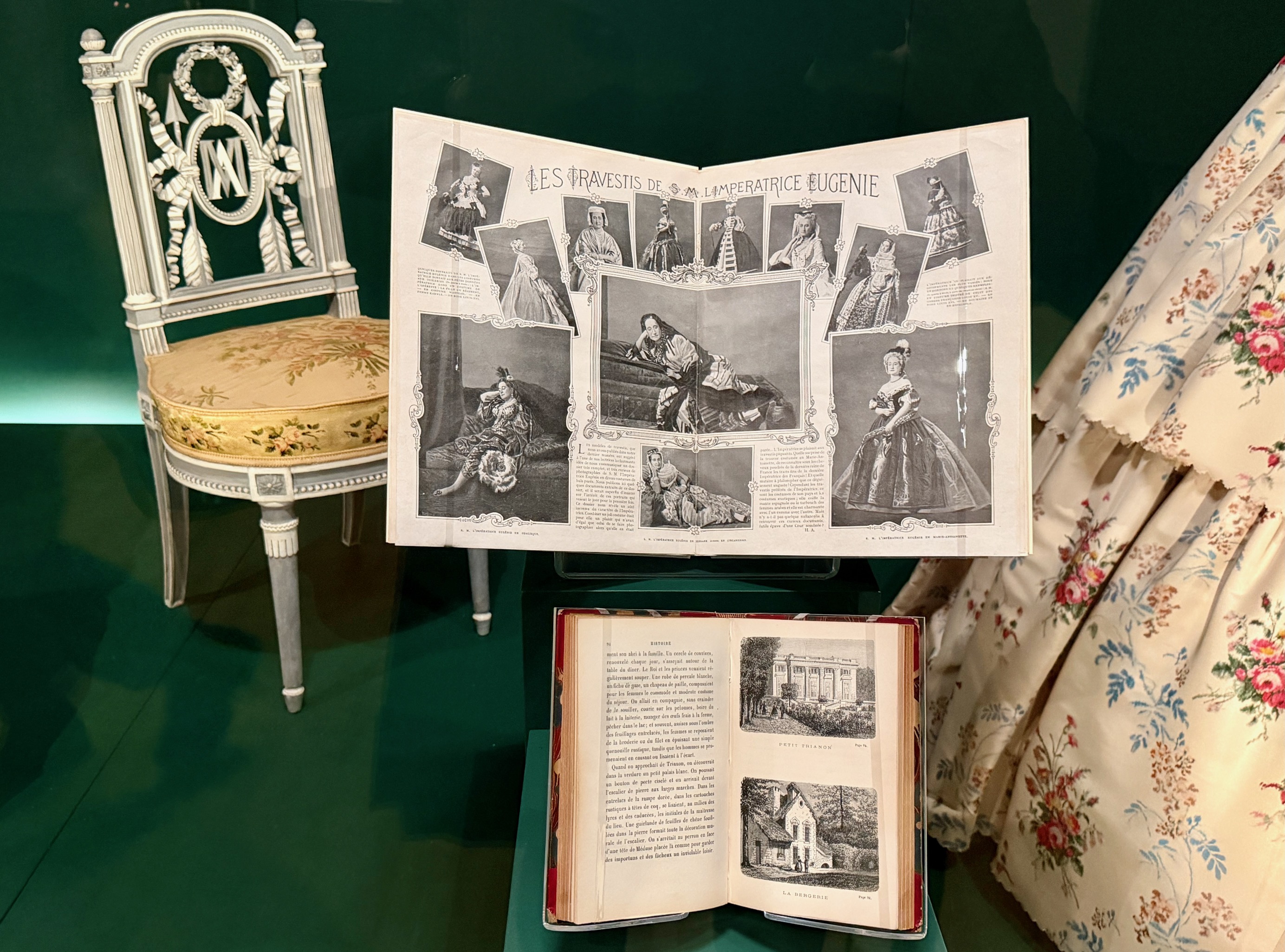
Over the years, the Marie Antoinette’s Tríanon retreat had fallen into extreme disrepair and its contents scattered. Eugénie set about to find much of the furniture Marie had commissioned, did a major rehab job on the property, and had a big, public exhibition about Marie at the Tríanon’s reopening in 1867.
Style revival: Marie Antoinette’s 1784 carved monogrammed chair, part of a four-piece set; 1911 Fémina magazine article about Empress Eugénie’s love of big court costumes; and Eugénie’s 1867 exhibition catalogue about Marie Antoinette at the Petit Trianon. Courtesy: Versailles, musée national des chateaux de Versailles et de Tríanon; private collection; V&A
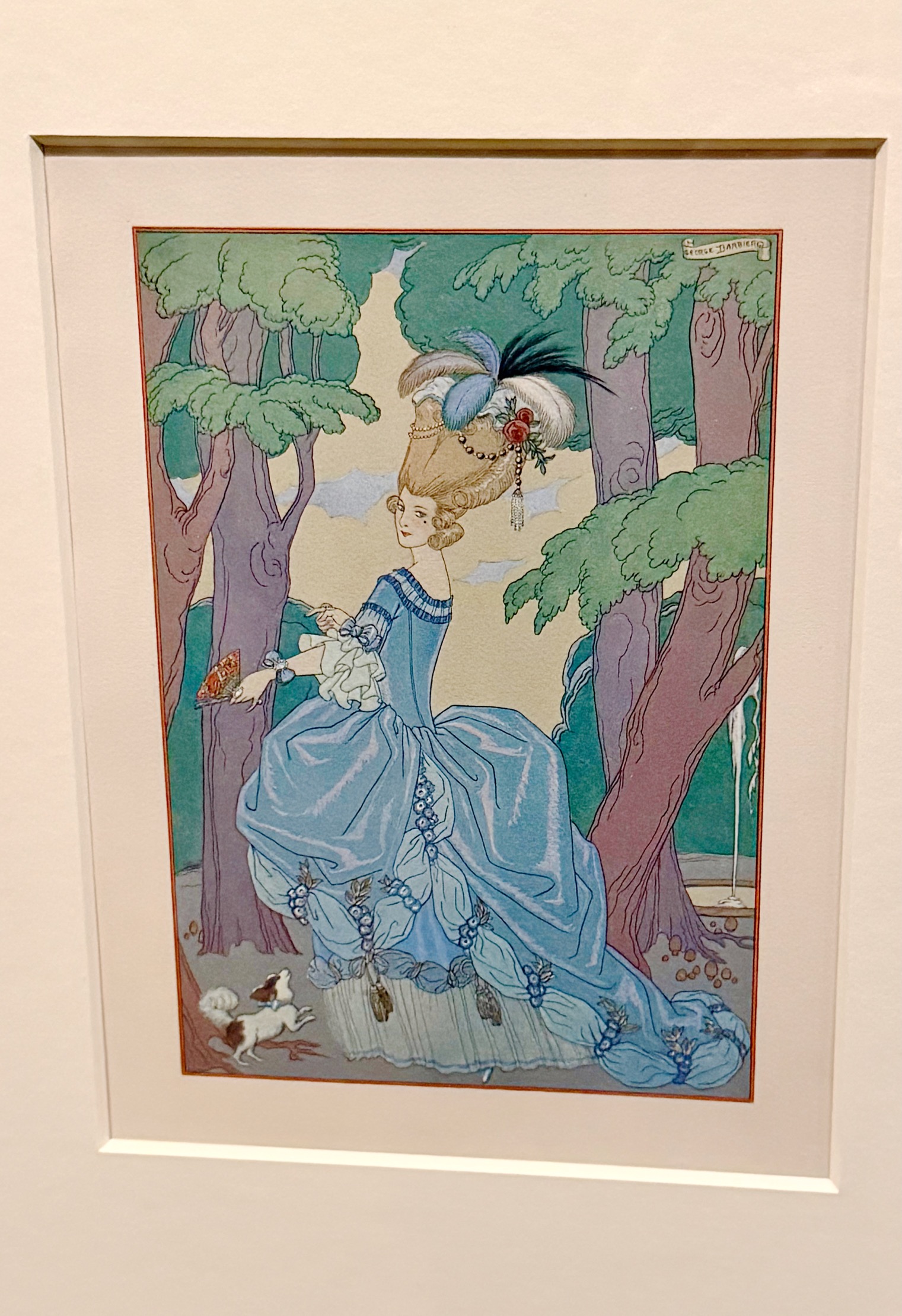
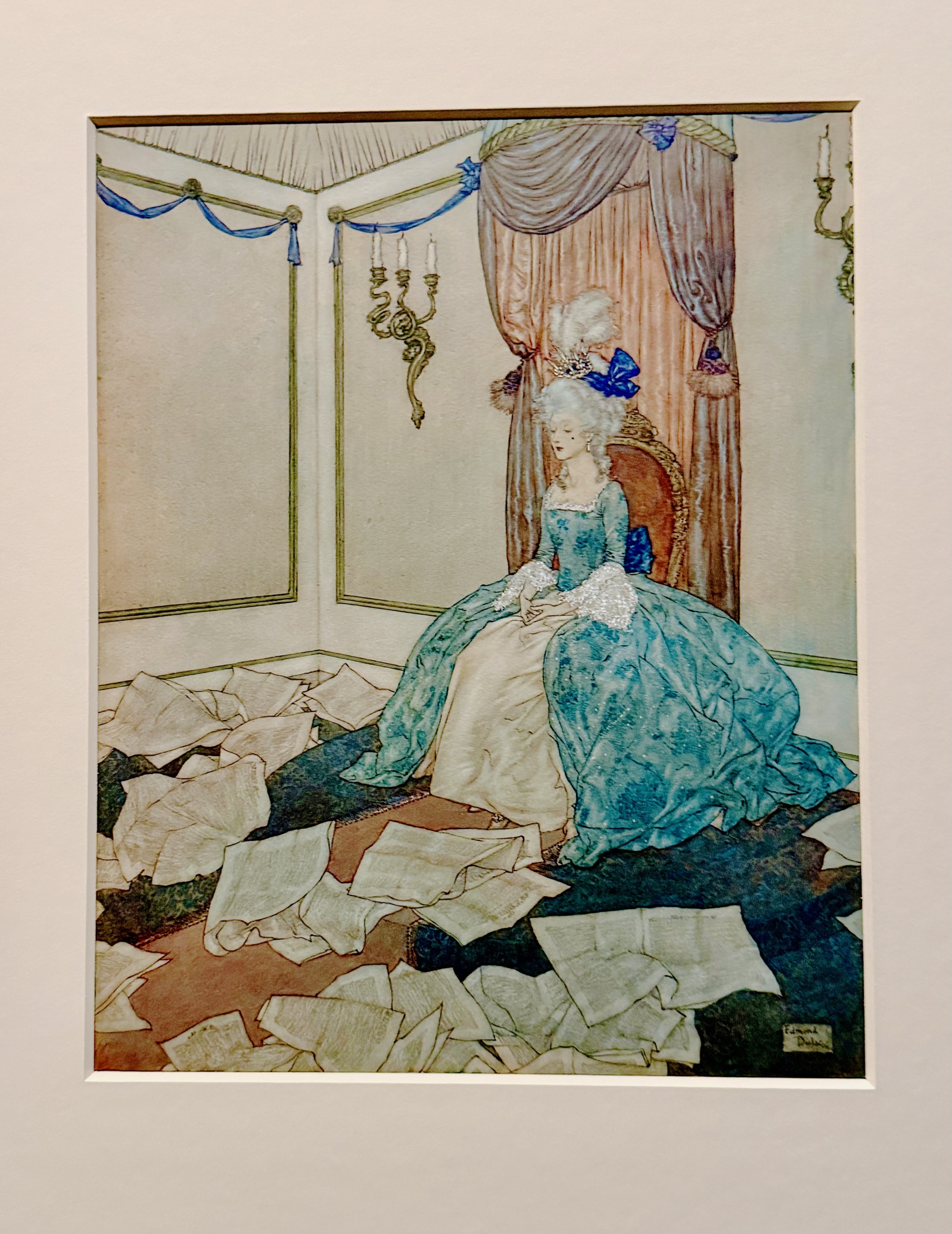
Spurred by Eugénie’s very public fandom into the 20th century, pop culture did not lose sight of Marie Antoinette as a style on display at upscale costume parties or as the evergreen image of fairy-tale princesses. The V&A shows illustrations using the queen’s pouf-do, tiny waist, princess-heel shoes, and voluminous 18th-century gowns to convey royal ingenues right into the 1910s and 1920s.
20th c. fairy tale princess: George Barbier’s 1928 illustration “L’Allée (The Pathway)” for Fete Galantes (Gallant Festivities) featuring an Art Deco image of Marie Antoinette based on Elisabeth Louise Vigée Le Brun’s portrait. Courtesy: private collection
20th c. fairy tale queen: Edmund Dulac’s 1911 watercolor illustration of Marie Antoinette as Hans Christian Anderson’s Snow Queen; aloof, seated on an icicle throne. Courtesy: private collection.
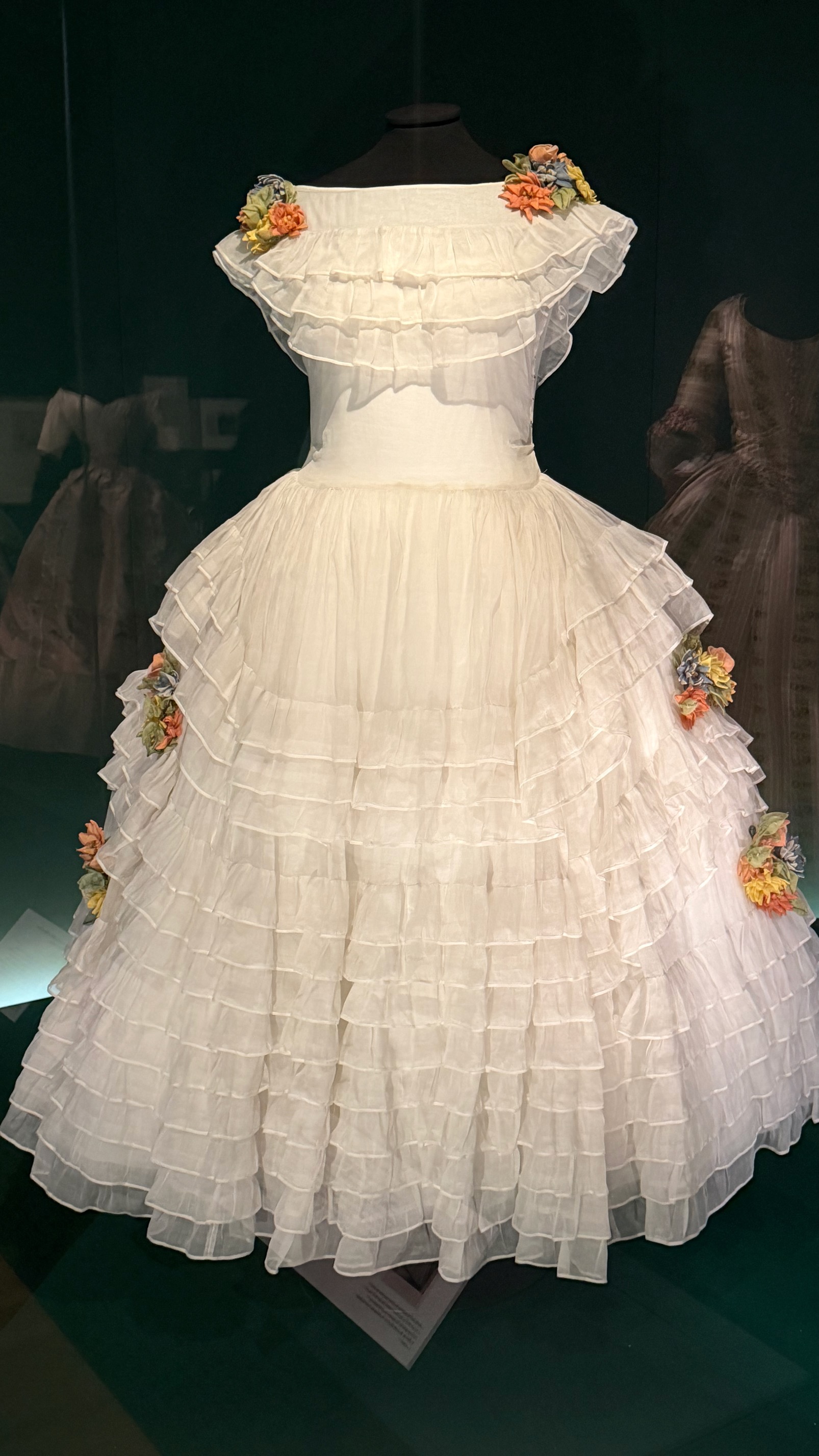
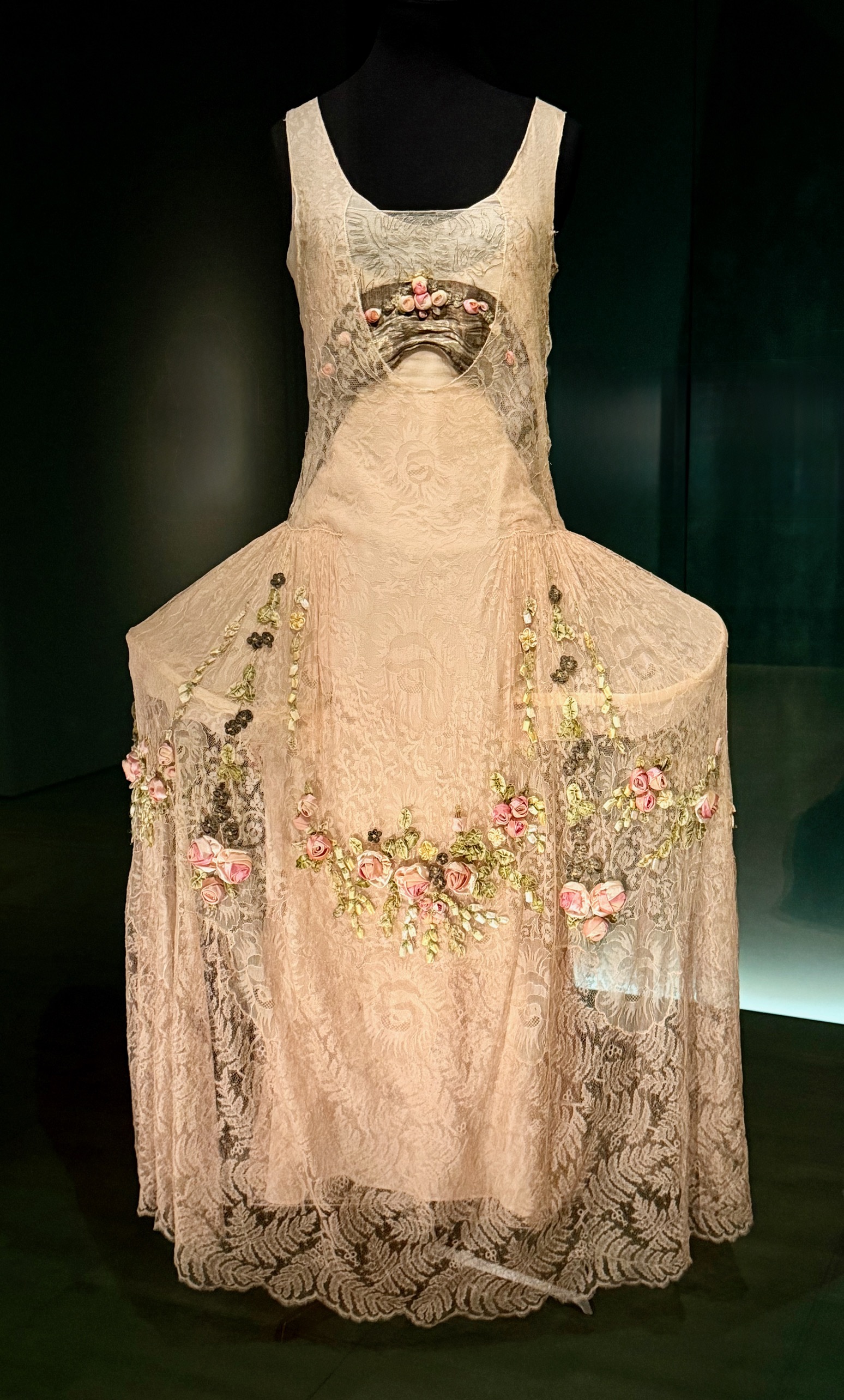
And 1920s fashion designers took note, mixing gauzy references to Marie’s muslin dresses with full skirts and panniers.
Referencing Marie Antoinette’s lingerie style: Jeanne Lanvin’s 1922-1923 silk organiza robe d’style (evening dress); a chemise with panniers. Courtesy: V&A
Boué Soers’ “lingerie frock” – a 1923 appliqued silk chiffon robed’style (evening dress) with panniers and ribbon roses; advertised showing models as Trianon shepardesses. Courtesy: Designmuseum Danmark
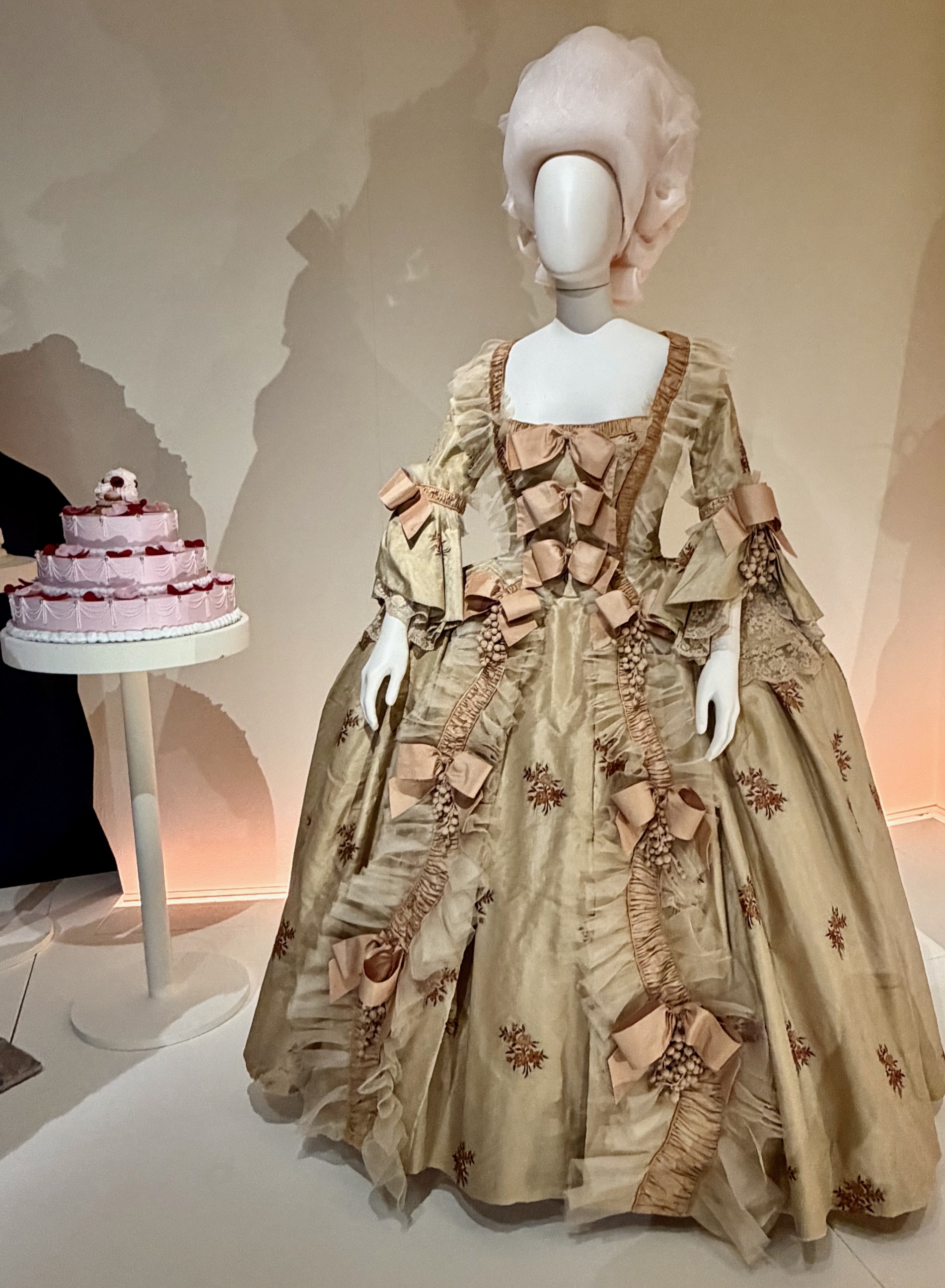
The spectacular finale to the exhibition pays tribute to the costume designers and haute couturiers who have translated Marie’s style into modern times. Even Manolo Blahnik jumped at the invitation to make shoes for Coppola’s Marie Antoinette film actresses, making each pair himself and basking in the glamor of using truly opulent silks and embellishments. It’s fun to see an entire wall of them.
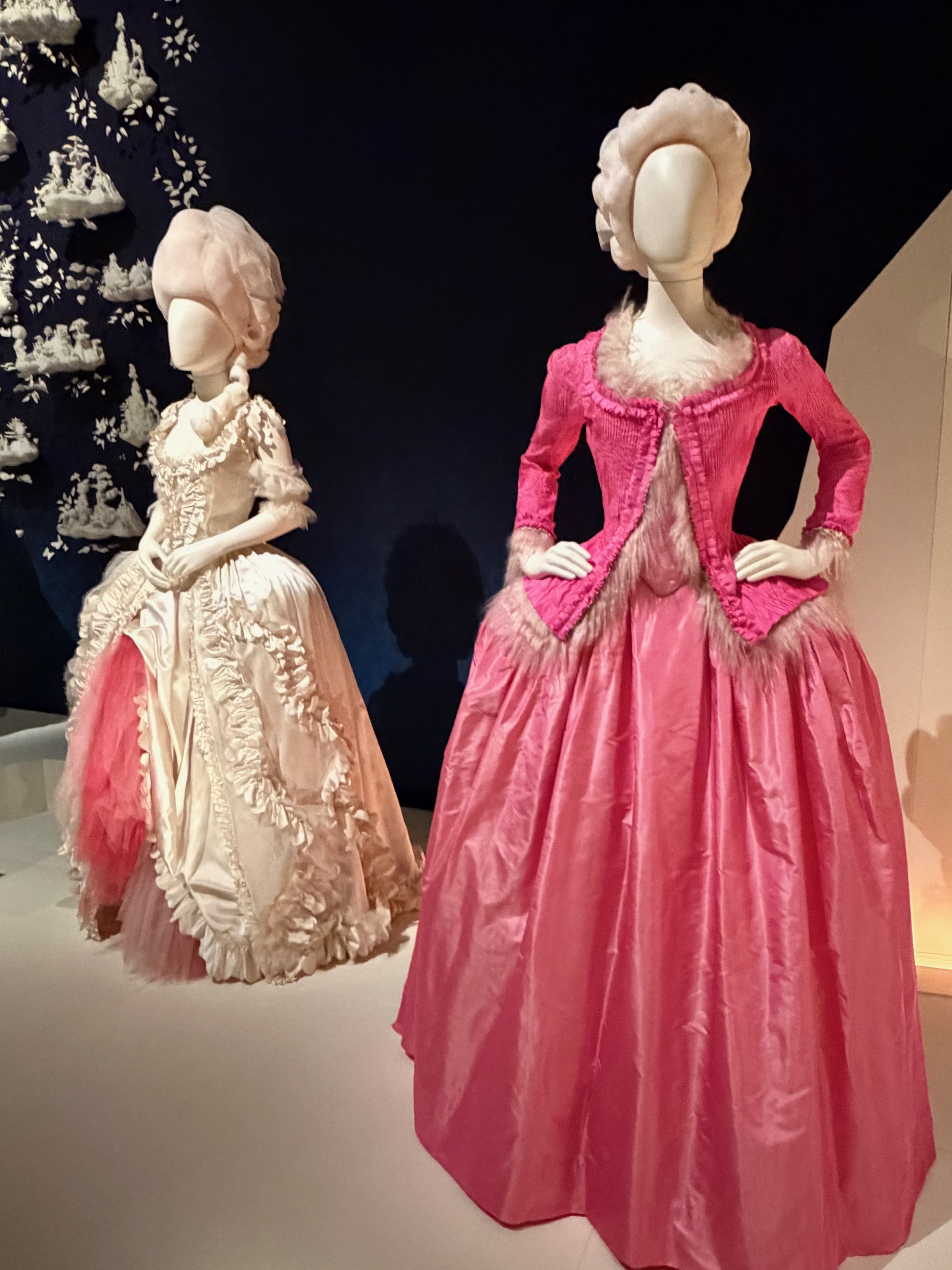
Neon pink costumes by Milena Canonero worn by Kirsten Dunst in Sofia Coppola’s 2006 film, Marie Antoinette. Courtesy: private collection.
Adrian’s silk gown worn by Norma Shearer in Willard Van Dyke’s 1938 Marie Antoinette film. Courtesy: private collection
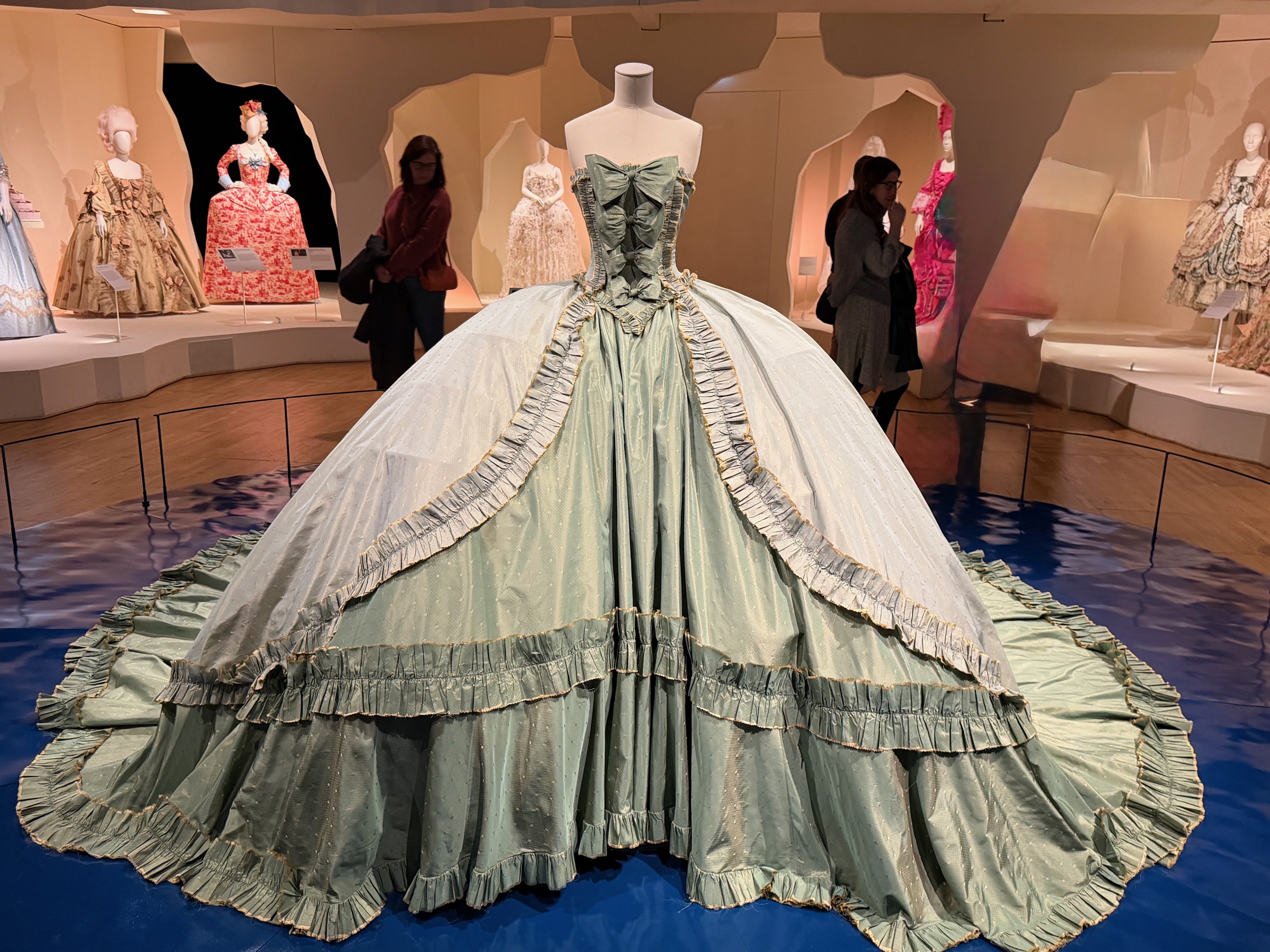
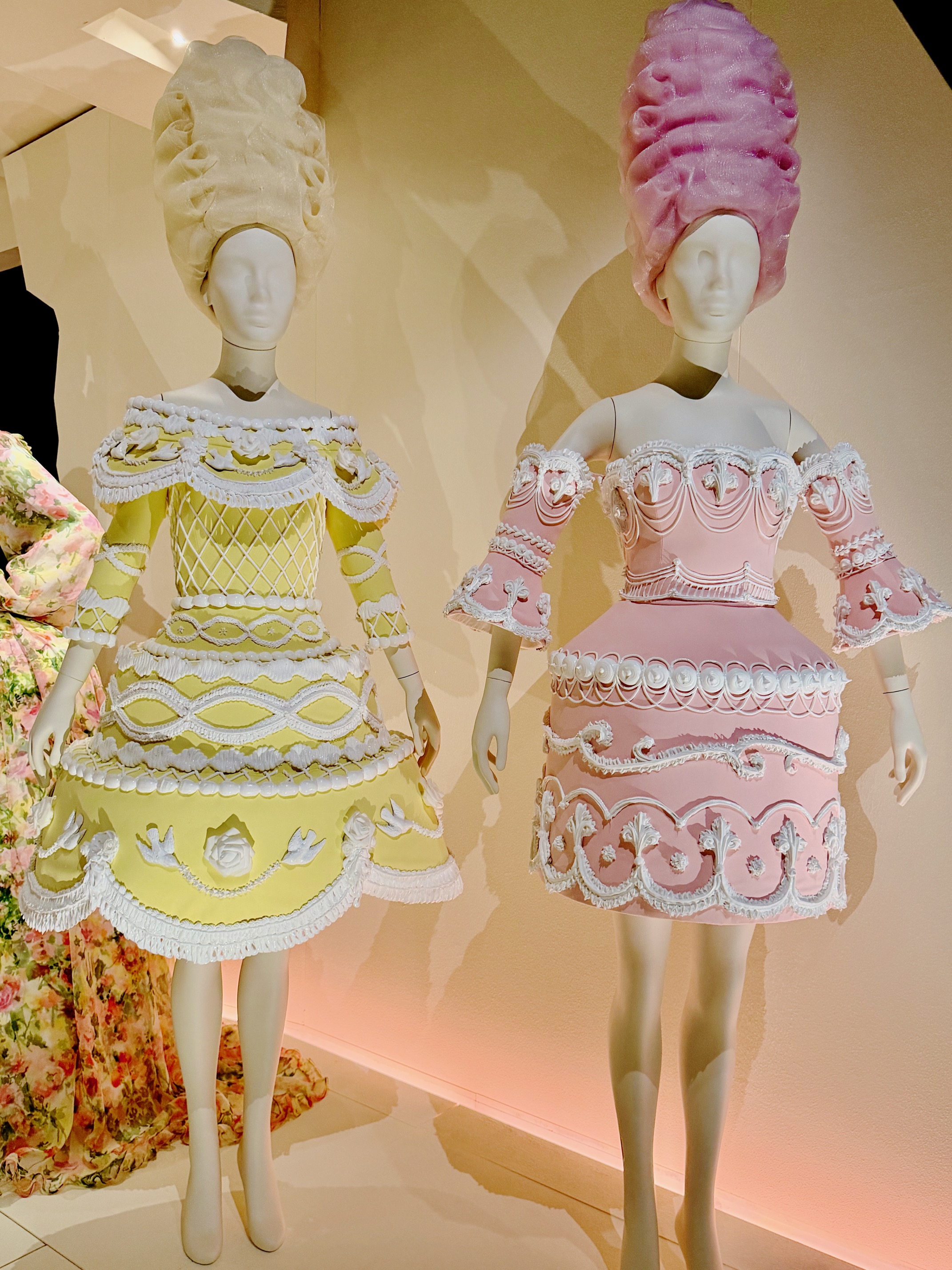
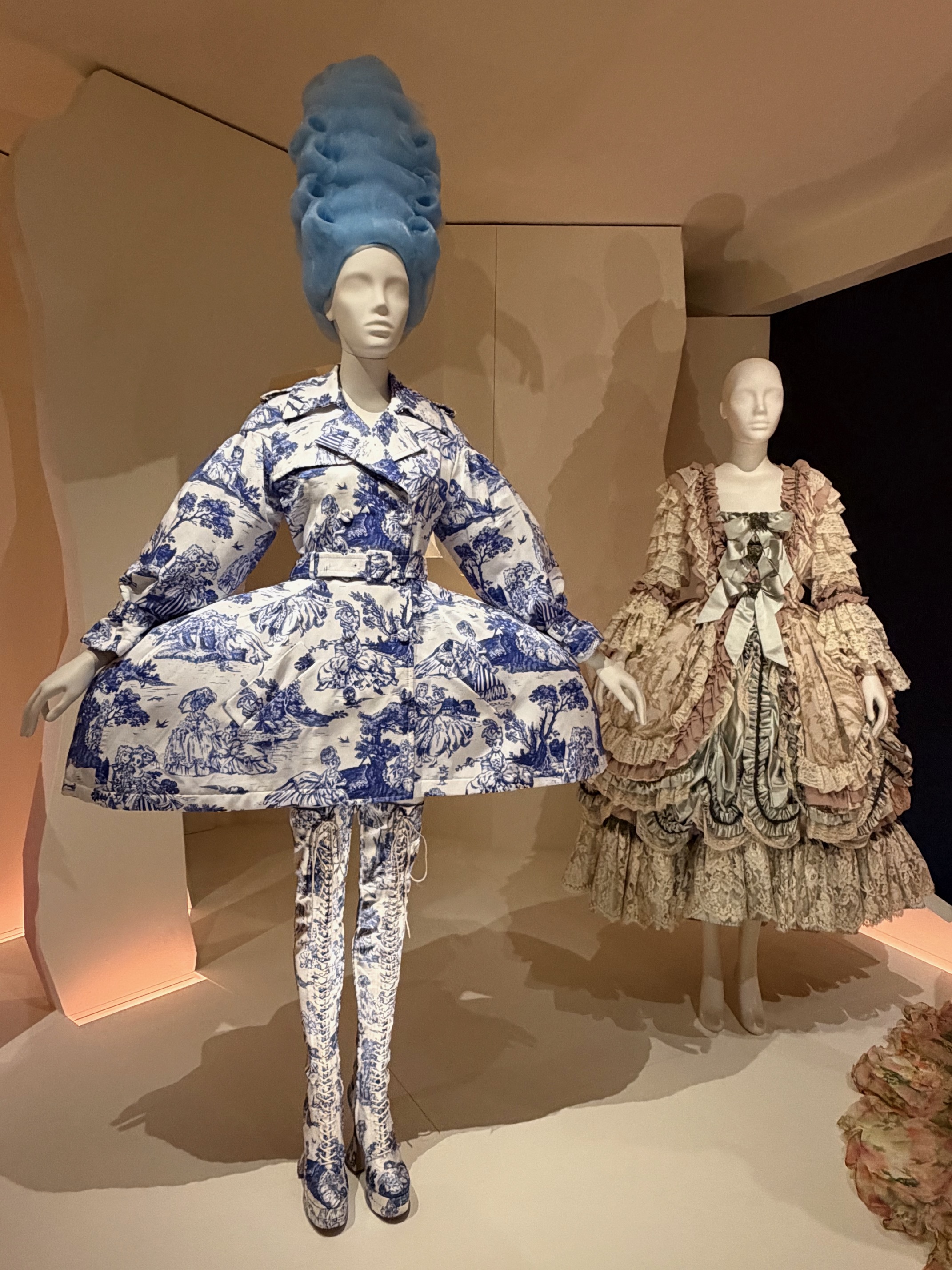
The show closes with a bigger-than-big wide gown by Galliano for Dior, surrounded by two tiers of Moschino silicone cake dresses, Moschino toile de jouy pannier spoofs, Marmalade’s drag ensemble, Vivienne Westwood’s bridal take, and even Lagerfeld’s take on those scandalous diamonds for Chanel.
Gallery of restyled Marie Antoinette fashions by contemporary designers; at center, John Galliano’s 1998 iridescent silk taffeta Marquise Masquée gown for Dior. Courtesy: Dior
It’s an unmistakable style that’s recognizable hundreds of years later, and one everyone who’s seen this unforgettable show is still talking about!
Be forewarned: Schiaparelli opens at the V&A South Kensington on March 28, 2026.
Jeremy Scott’s 2020-2021 silicone cake dresses from a runway show mixing contemporary and 18th century style and fun. Courtesy: Moschino archives.
Jeremy Scott’s 2020-2021 cotton anime Toile de Jouy mini-pannier dress with matching boots and Franco Moschino’s 1990 silk and lace robe á la polonaise. Courtesy: Moschino archives.
Berlin’s Neue Nationalgalerie mounted the show to bring never-before-seen works to the United States and tell the story of how modern art became an ideological battleground in Germany during the early 20th-century and how the history of politics, artistic innovation, and social commentary are reflected in the institution’s collections today.
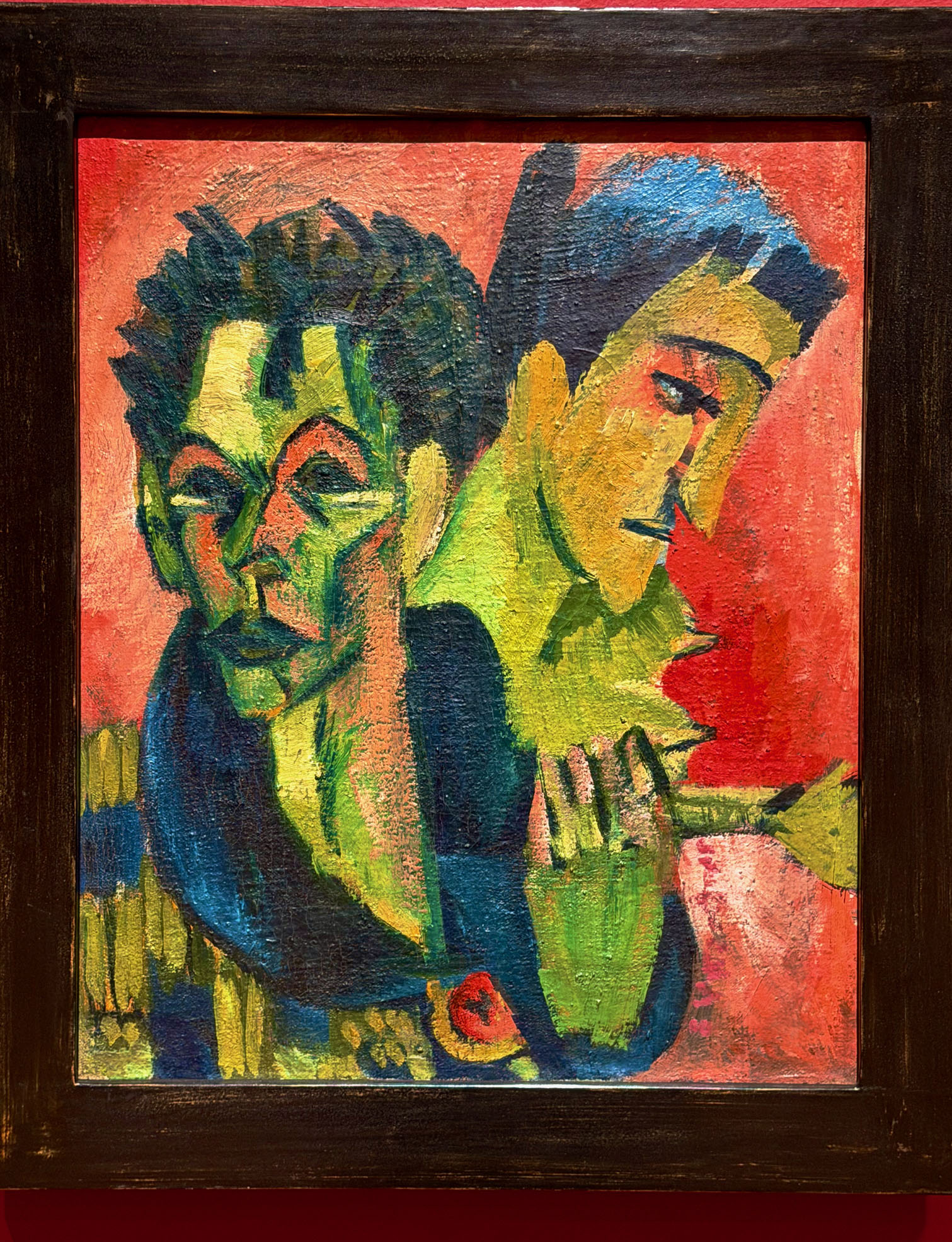
Ernst Kirchner’s 1914-1915 vividly expressionist Self-Portrait with a Girl.
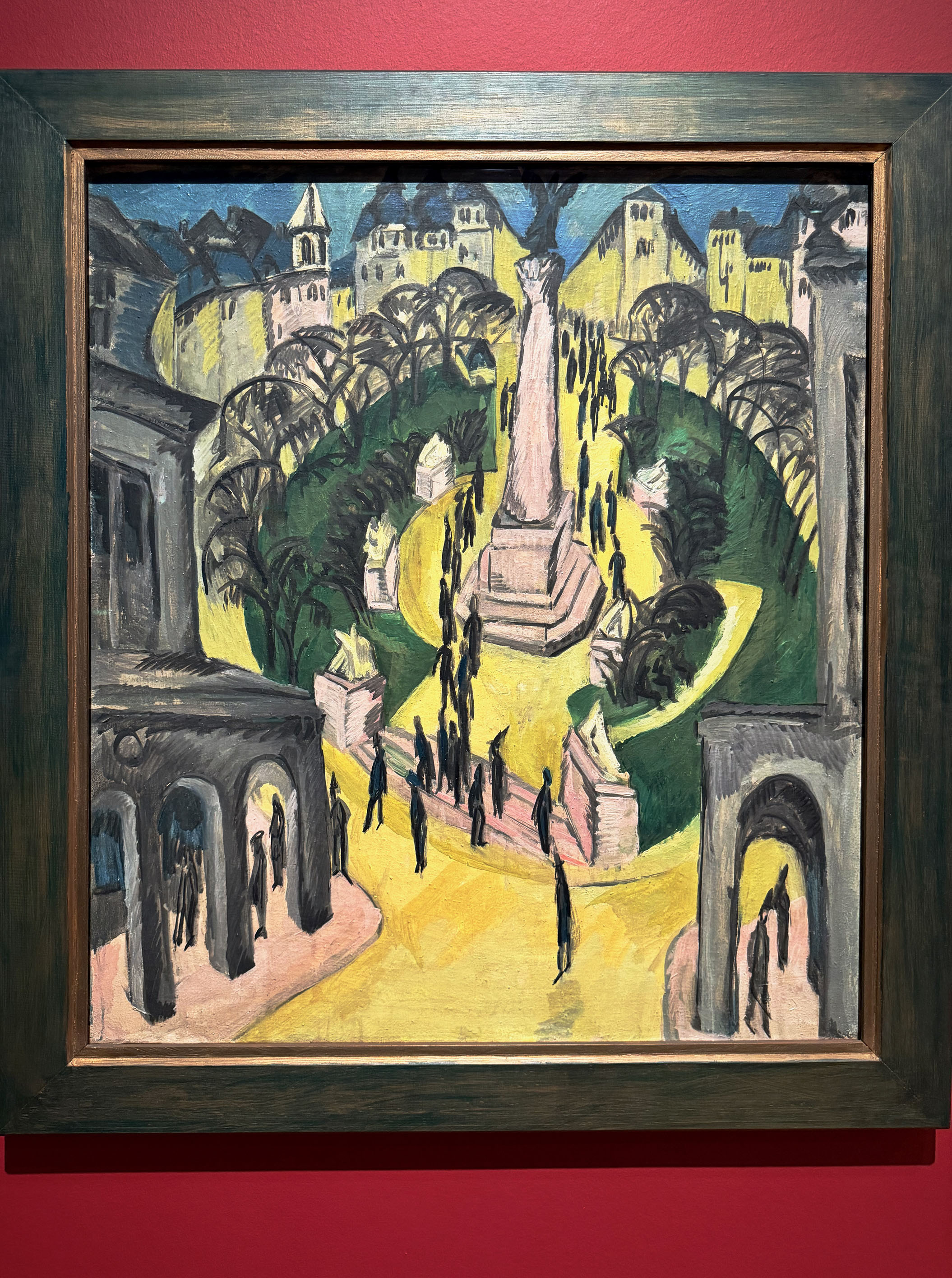
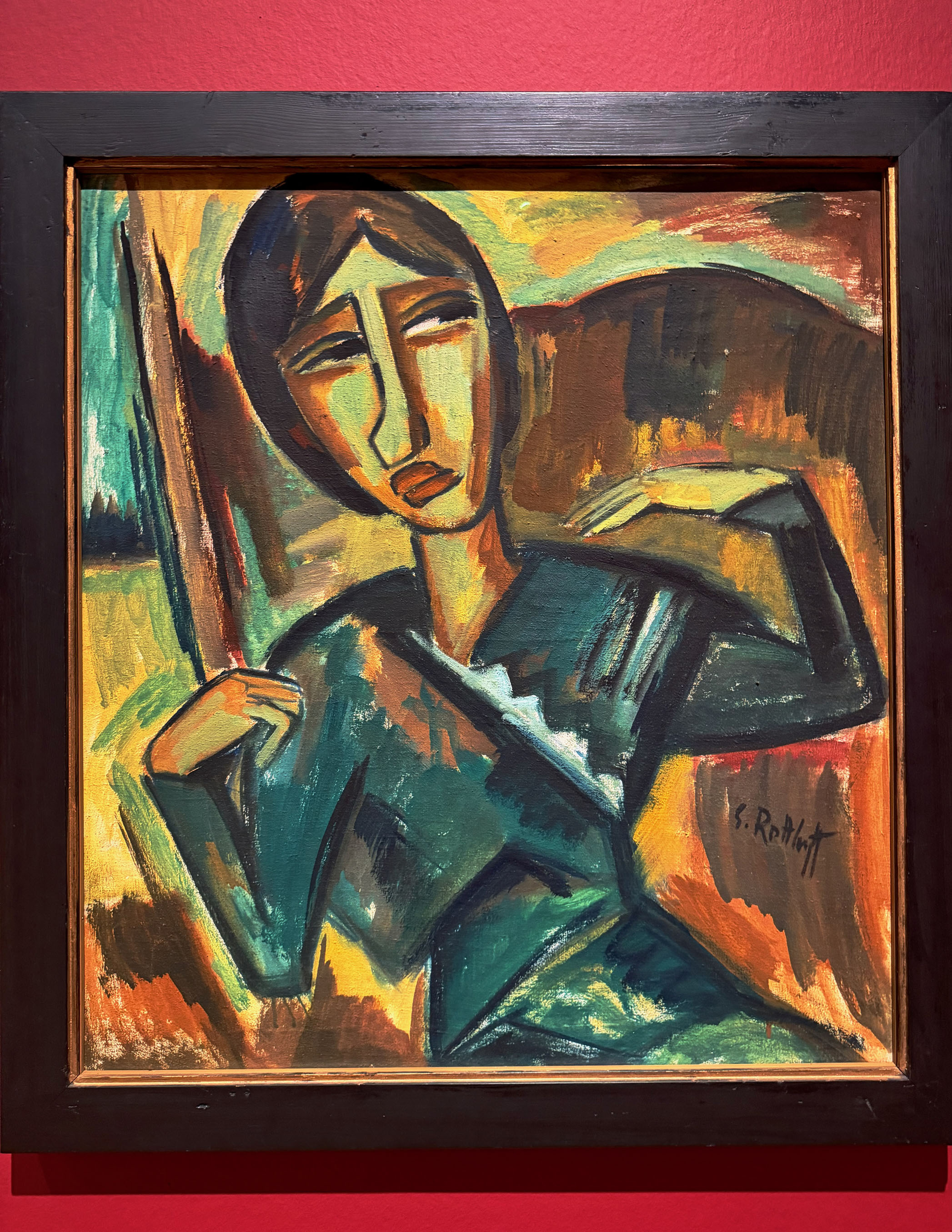
The exhibition opens with works from some of the best-known German expressionists – Kirschner, Pechstein, Schmitt-Rotluff, and Nolde. Slalshes of wild color, sharp angles, and modernist portraits nearly leap out of the frames of paintings, showing the influences of the French avant-garde fauves and Picasso’s angular Cubist planes.
Ernst Kirchner’s 1914 expressionistic city view Belle-Alliance-Platz in Berlin.
Karl Schmitt-Rotluff’s 1915 expressionist painting The Green Girl.
Another section of the exhibition presents portraits of influential German art dealers who brought the best of the avant-garde to Berlin, Munich, Dusseldorf, and other German culture capitals in the early 20th century. Works by influential modernists Picasso, Leger, and Kokolschka hang alongside works by the Russian ex-pats who formed the forerunner group to Die Brücke in 1909 – Kandinsky, Alex Jawlensky, and Marianne von Werefki.
See some of our favorite works in our Flickr album.
Austrian avant-garde: Oskar Kokoschka’s 1909 oil portrait of Viennese architect, Adolph Loos; both artists represented by Berlin gallery owner Herworth Walden.
In 1911, the German modernists formed Die Brücke – a group that celebrated getting an artist’s inner feeling out on the canvas – not just a formalist declaration against classical painting and historical norms. When World War I broke out, many went to the front. If they survived, they continued painting to process the psychological agony of the War and the economic toll it took on the homeland.
The exhibition also features a gallery full of works that are a logical outcome of experimentation – abstract works by German artists that merge the symbology and energy of Italian Futurism with the riotous colors of Orphism.
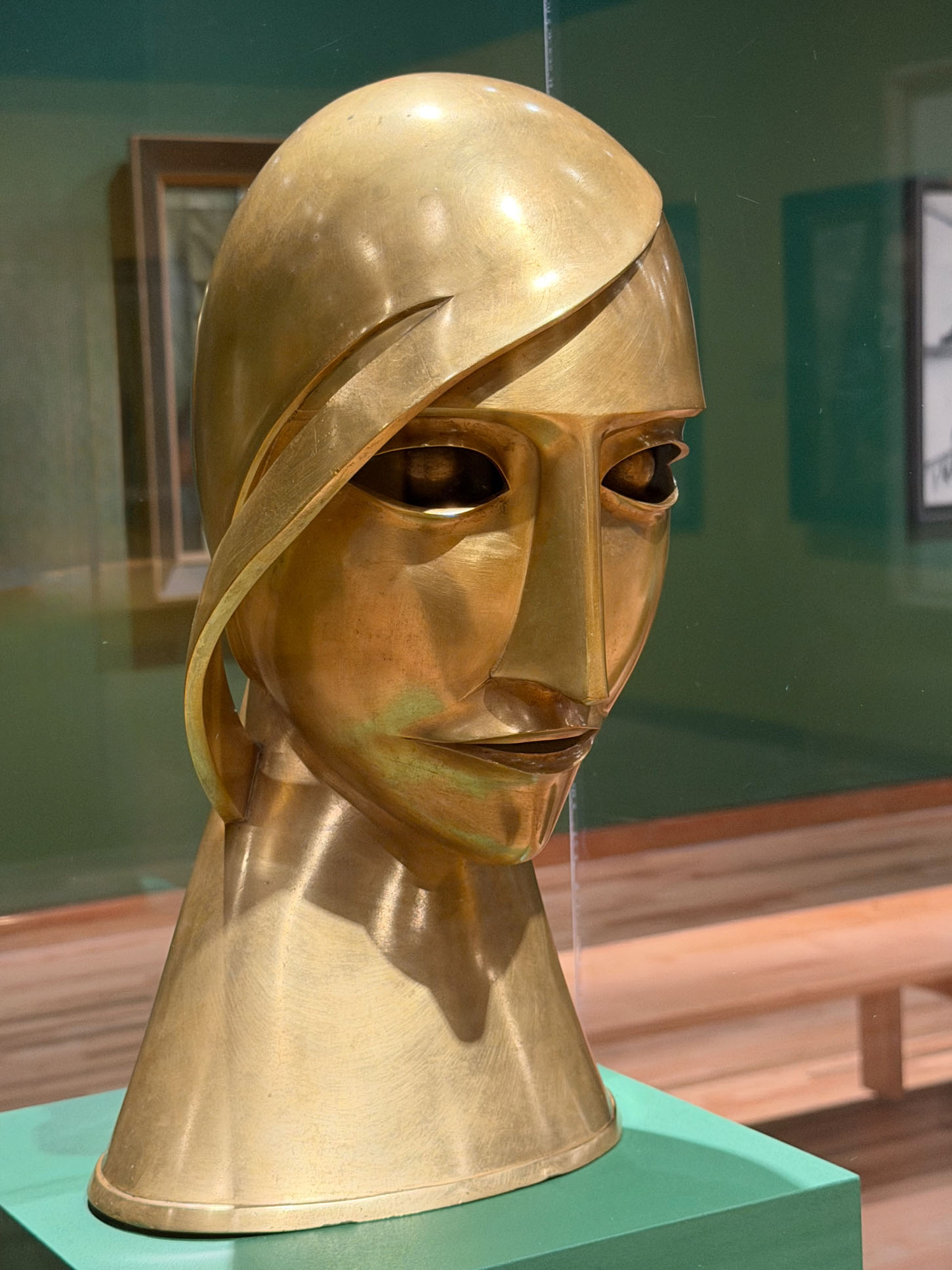
Abstract innovator: Rudolf Belling’s 1925 sculpture Head in Brass – confiscated and labeled “degenerate” by the Nazis in 1937.
Abstract innovator: Otto Möller’s 1921 oil painting City – influenced by Futurism.
Surviving hardship together, the end of World War I only motivated the survivors to come together, form societies and political action committees and keep creating.
Leading up to World War I, it seemed as though modernism would sweep the Continent and become the dominant art style collected by the progressive National Gallery. However, during the 1919-1933 democratic Weimar Republic, art preferences shifted to a highly literal, figurative style dubbed “the New Objectivity.”
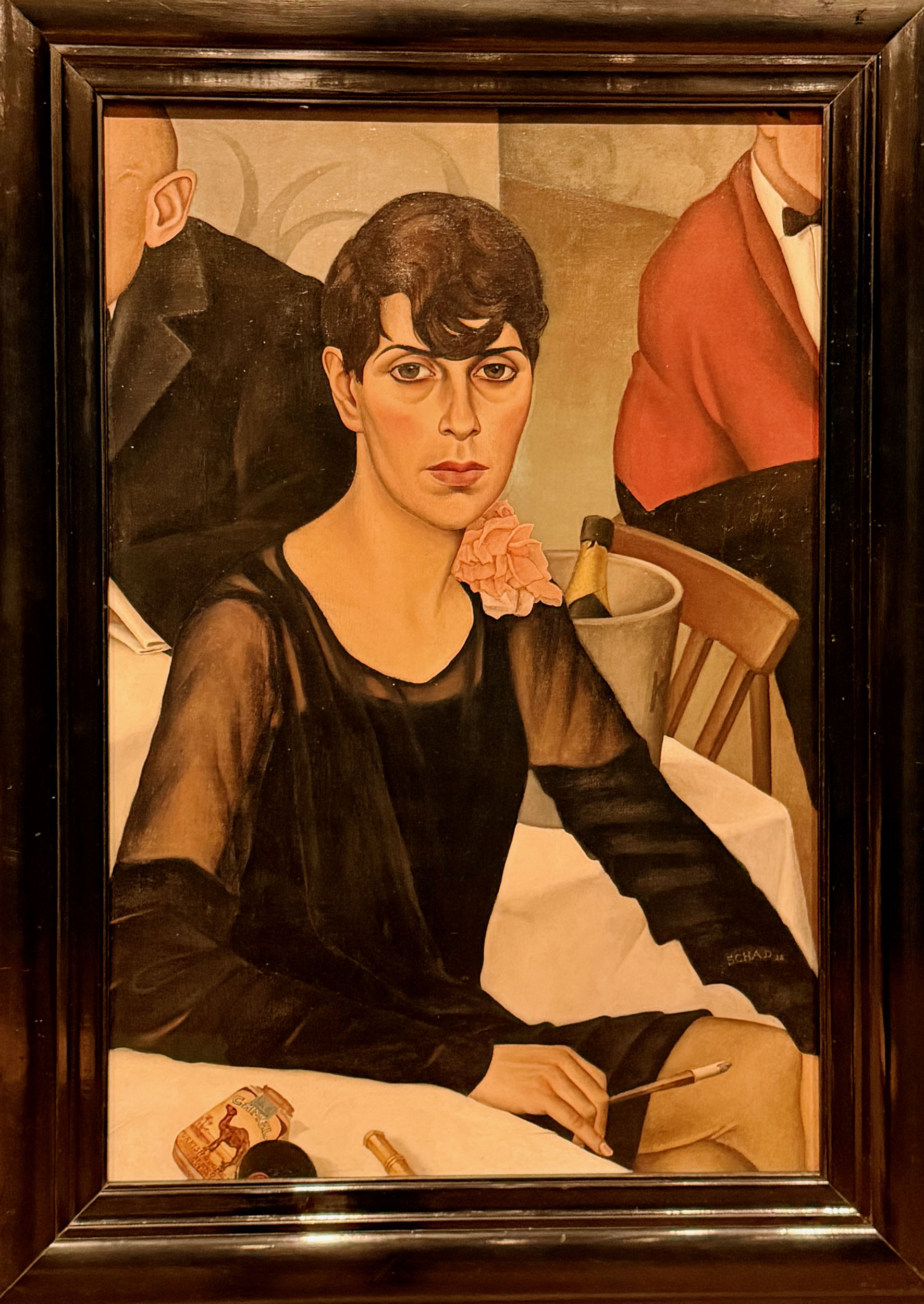
This gallery shows the artistic and political shift to realistic portraits with hints of social commentary, depictions of new technology, and a new culture of enfranchised, emamcipated women (exemplified by the museum’s iconic Sonjaby Christian Schad).
But over time, the political mood shifted, and the National Socialist Party rose.
New Objectivity: Christian Schad’s 1928 Sonja– a portrait of the new emancipated women
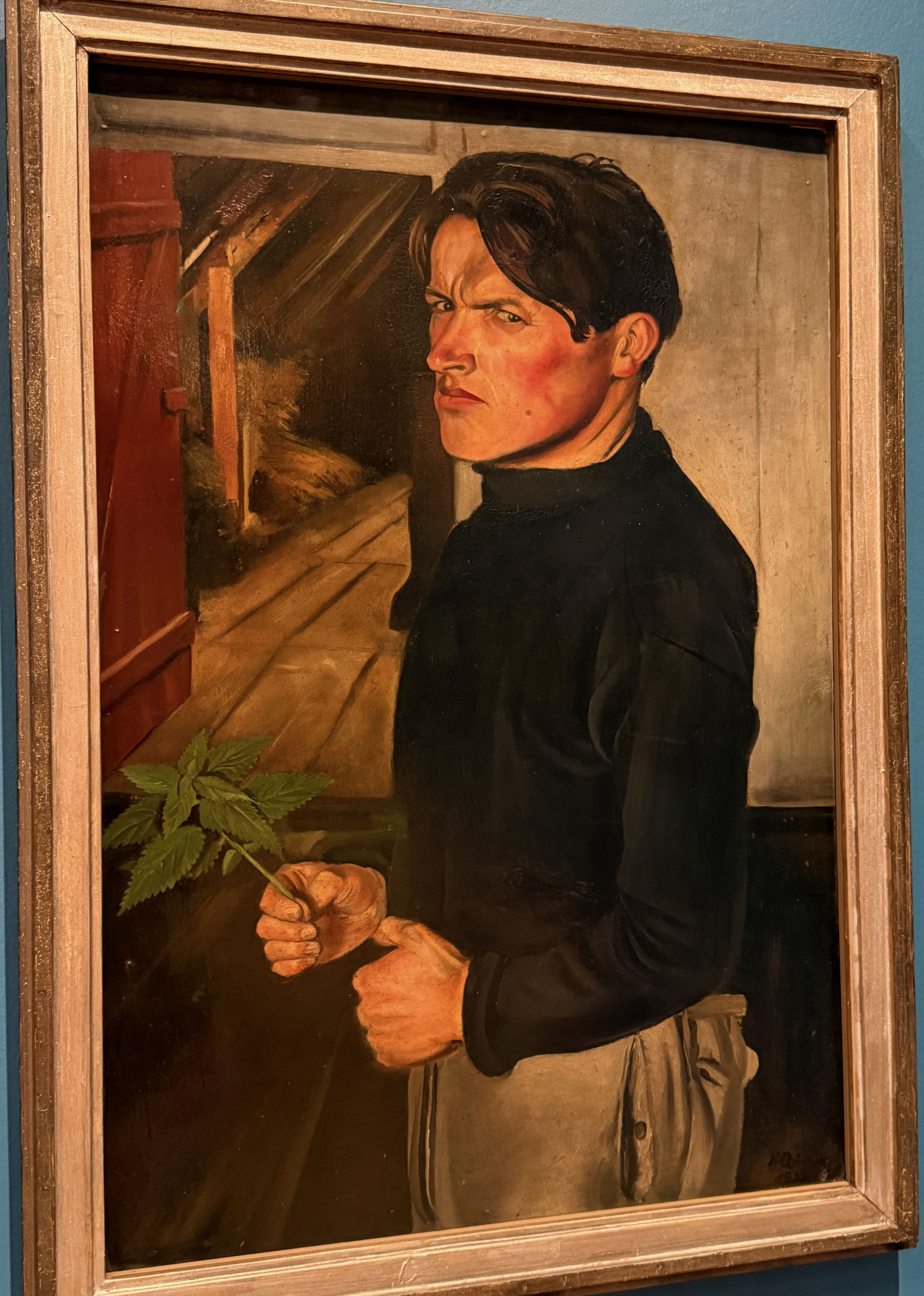
New Objectivity: Curt Querner’s 1933 oil on cardboard painting Self-Portrait with Stinging Nettle – painted in secret (and hidden) as a reaction to a violent police raid on a Communist Party meeting.
Throughout the 1930s, increasingly militaristic and anti-semetic groups formed in Germany, and as the National Socialists came to power, they fired heads of the leading art schools, shuttered the innovative Bauhaus, and banned abstract art and modernism because it did nothing to support their agenda. Artists either went underground (painting in basements) or fled the country entirely.
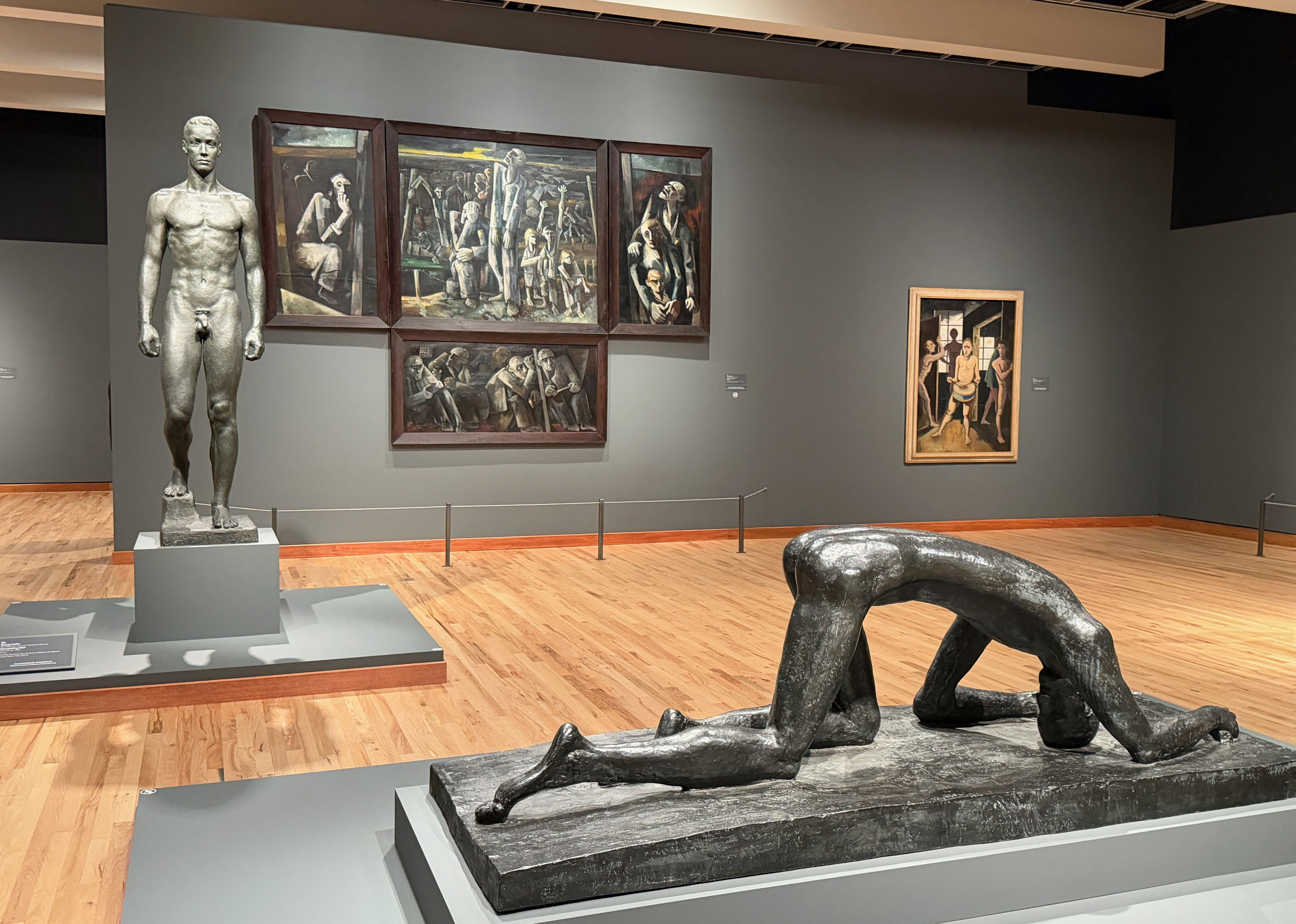
Art responding to WWI and WWII: Georg Kolbe’s 1939-1940 bronze Descending Man, Horst Strempel’s 1945-1946 oil on burlap Night Over Germany, and (foreground) Wilhelm Lehmbruck’s 1915-1916 bronze (cast 1972) Fallen Man.
The exhibition concludes by showcasing works made at the end of the war by German artists reacting to the societal disruption and atrocities. In some cases, banned artists like Karl Kunz were able to paint in secret, wait until the War ended, and emerge to help a divided Germany revive the arts in the post-war years.
Watch the exhibition’s opening lecture by Berlin curator Irina Hiebert Grun, who provides an overview of the Neue Nationalgalerie’s collecting history, responses to the changing politics that affected early 20th century art, how the museum reassembled its collections and personnel after the Nazi-era persecutions.
The war destroyed the buildings and the Allies divided the country, but the story of this museum’s incredible 21st-century renaissance is one for the ages.
After the exhibition closes in Albuquerque, it be on view at the Minneapolis Museum of Art March 7 – July 19, 2026. Don’t miss it!
Banned modernist Karl Kunz was inspired by Picasso’s Guernica to paint Germany, Awake! in secret in 1942 – Kunz survived the war in Germany and participated in its post-War artistic resurgence.
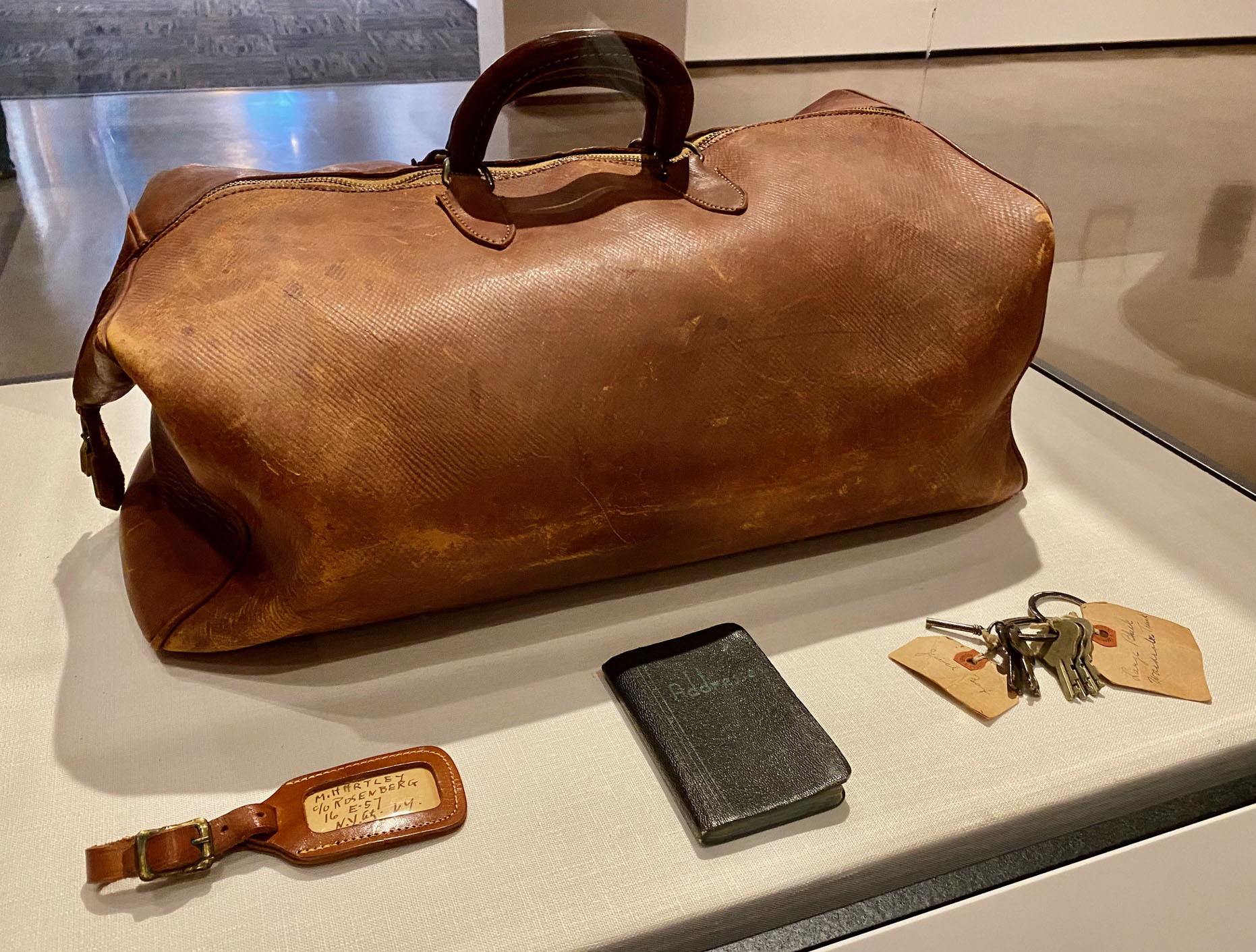
With his traveling valise sitting in the center of the introductory gallery and a map nearby, you understand instantly that superstar artist Marsden Hartley was a man on the go.
Marsden Hartley: Adventurer in the Arts, on view at the New Mexico Museum of Art in Santa Fe through July 20, 2025, uses his personal possessions, works painted on two continents, and non-stop itinerary to demonstrate how landscape, life, and modern-art legends led him to create an epic body of work.
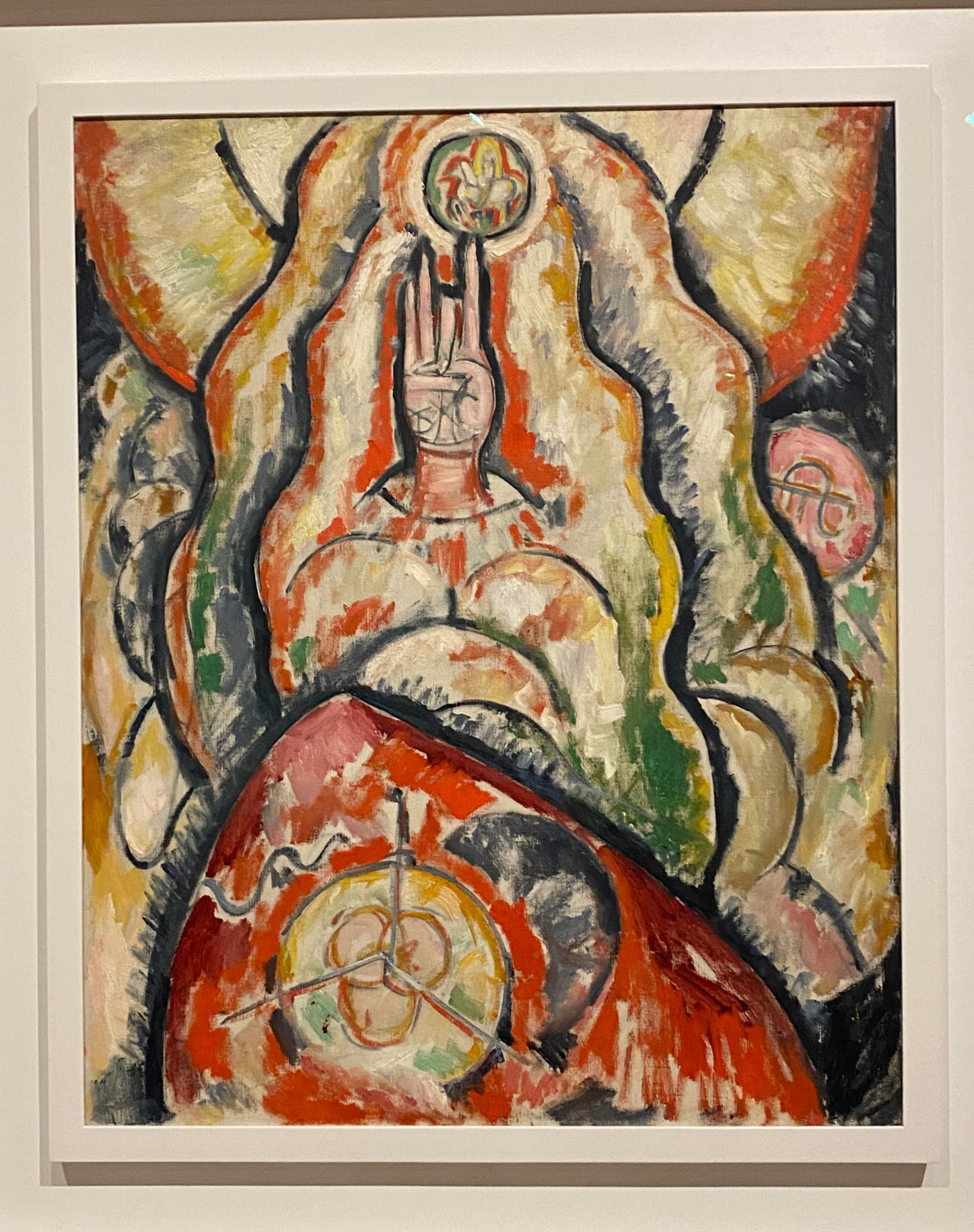
Hartley’s 1914 Berlin Series, No. 2 – flat, abstracted natural symbols. Courtesy: Jan T. and Marica Vilcek Collection.
Ready to travel – Hartley’s leather valise, address book and luggage tags. Courtesy: the artist’s estate; Bates College Museum of Art.
Looking around, there’s a wall of Maine mountainscapes he did in his thirties, a painting done just after Stieglitz sent him to Paris to soak up the vibes in Gertrude Stein’s salon, his accessories of rings and cigarette cases from Berlin in the 1920s, a Fauve-ist impression of Mount Saint-Victoire at Cezanne’s old stomping grounds in Aix, and photos of him and his dog at his Maine studio in the 1940s.
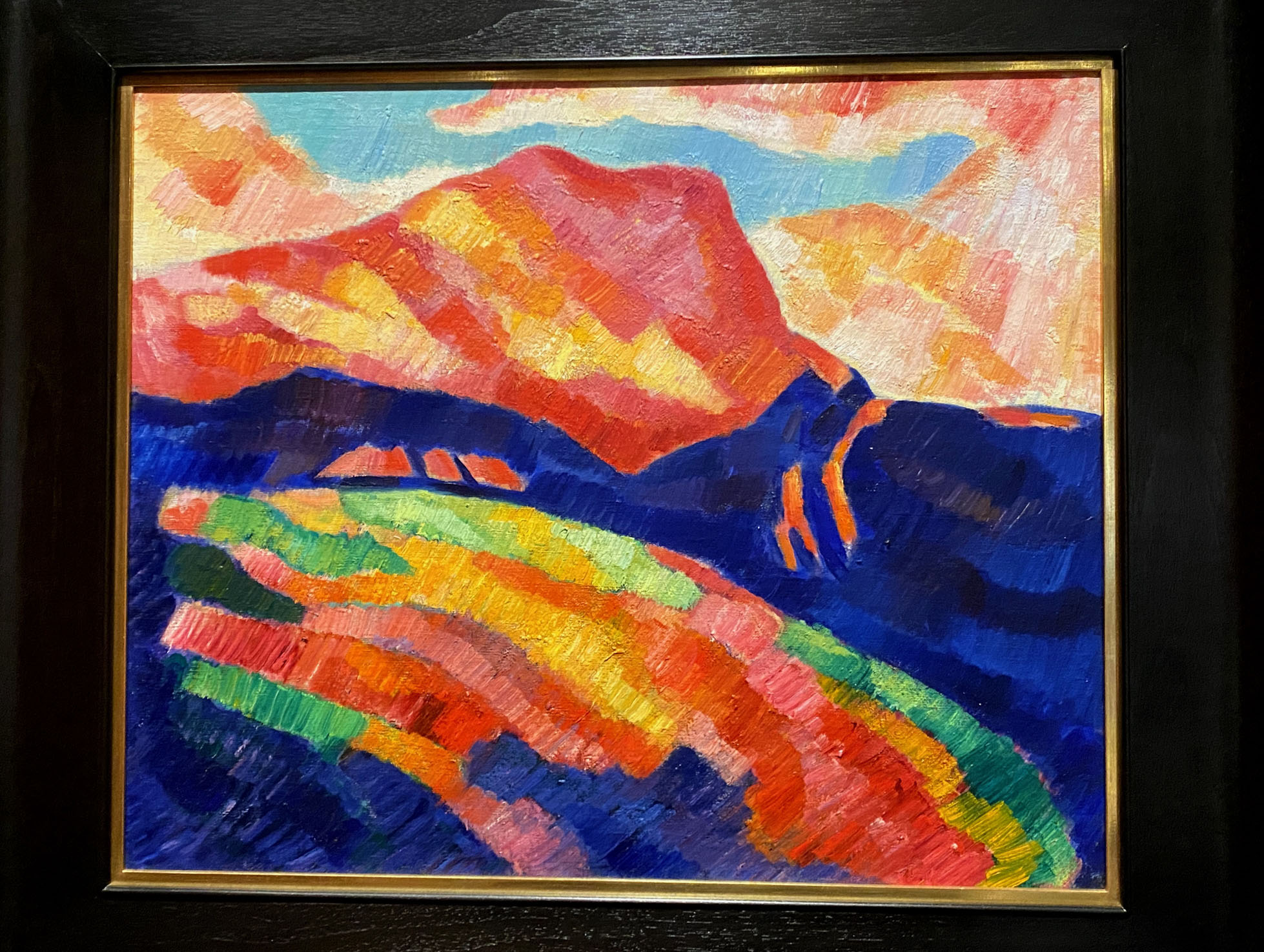
Hartley’s 1927 oil Mont Sainte-Victoire – painted in Aix, France where Cezanne once lived. Courtesy: Jan T. and Marica Vilcek Collection.
The exhibition merges Hartley’s paintings from the Jan T. and Marica Vilcek Collection with items donated by his favorite niece to Bates College in Maine – items he collected as he traveled; sketches and stuff sent to his neice; his camera, books, and snapshots; his studio paintbox, and other personal art. Together, the exhibition tells a story of innovation, personal journey, and relentless art making.
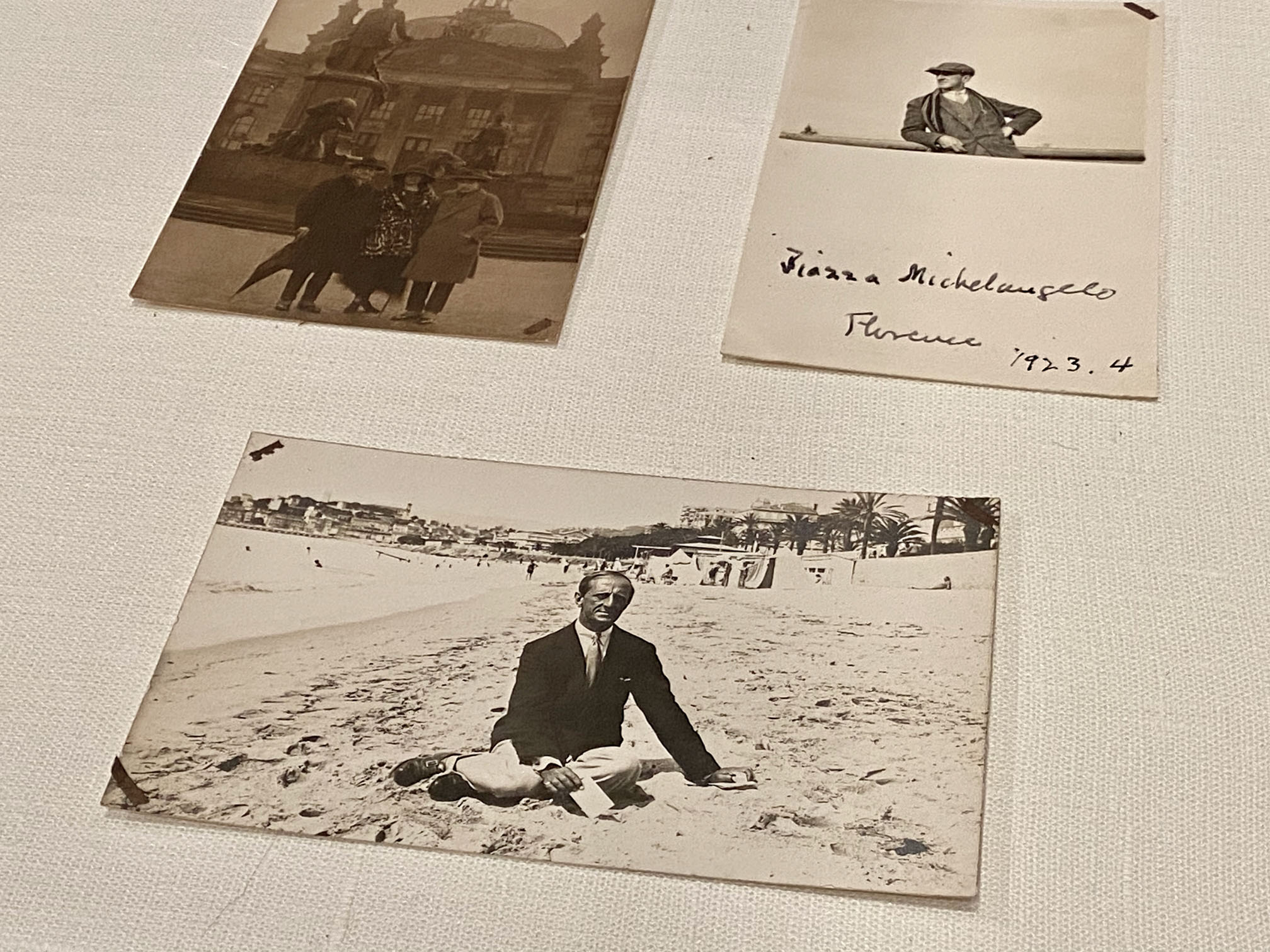
Hartley’s personal photos from his 1920s European adventures. Courtesy: Bates College Museum of Art
Hartley emerged from a hardscrabble childhood to see, feel, and experience art, nature, and transcendental spiritualism in New York, Boston, and Maine in 1890s.
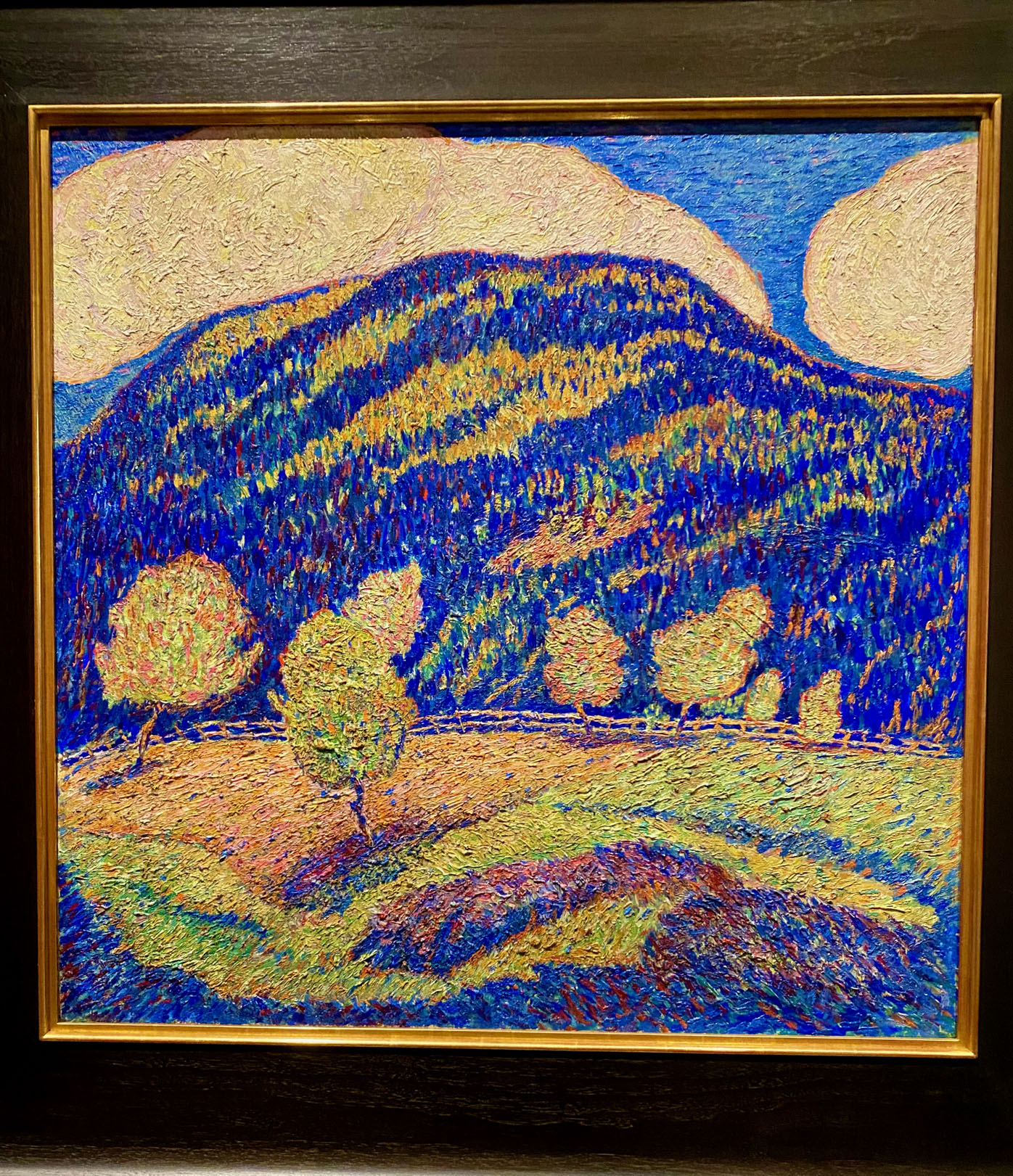
He loved painting mountains and depicted water, earth and sky as a color-filled flat plane filled with jabbing brushstrokes – an approach that stuck with him throughout his life as he journeyed through New Mexico, the Alps, Mexico, and back in Maine.
Hartley’s 1907-08 oil Silence of High Noon – Midsummer painted in Stoneham Valley, Maine. Courtesy: Jan T. and Marica Vilcek Collection.
By the time he was in his early thirties, he had shown his landscapes to The Eight, knocked on Stieglitz’s gallery door, and got a one-man show (and a dealer for the next 20 years) at 291, the hottest modern art gallery in America.
Hartley’s 1910 Untitled (Maine Landscape)– water cascading down a rock face. Courtesy: Jan T. and Marica Vilcek Collection.
Getting to Europe in 1912, the color, cubism, and symbolism of the Blue Rider, Matisse, and Picasso made his head spin. His German friends introduced him to Kandinsky’s book Concerning the Spiritual in Art. He went out of his way to meet the man himself, and his painterly wheels turned.
The second gallery presents a large work from his Cosmic Cubism series – an airy, dreamy arrangement of signs, spiritual symbols, colors, and planes – along with drawings from his Amerika series, based loosely on Native American symbols and other abstract shapes. On view for only the second time in the United States, Schiff is a dazzling creation drawing signs and symbols from Native American and Egyptian cultures that spill out onto the painted frame.
Hartley’s 1912-1913 Portrait Arrangement, No. 2, created in Paris. Courtesy: Courtesy: Jan T. and Marica Vilcek Collection.
Schiff – part of the Amerika series Hartley painted in Germany. Courtesy: Vilcek Collection. April 5 – July 20, 2025
Up to this point, Hartley’s only encounter with indigenous American culture came from visits to ethnography museums in Paris and Berlin, but that would soon change. The advent of World War I tore apart the avant-garde, his social circles, and the direction of his work. Although these Berlin abstractions were long considered by late 20th century critics to be the high point of his career, Hartley abandoned this artistic path when forced to return to the United States, started over, kept wandering, and went back to landscapes and still lifes to discover his “American” expressionist vision.
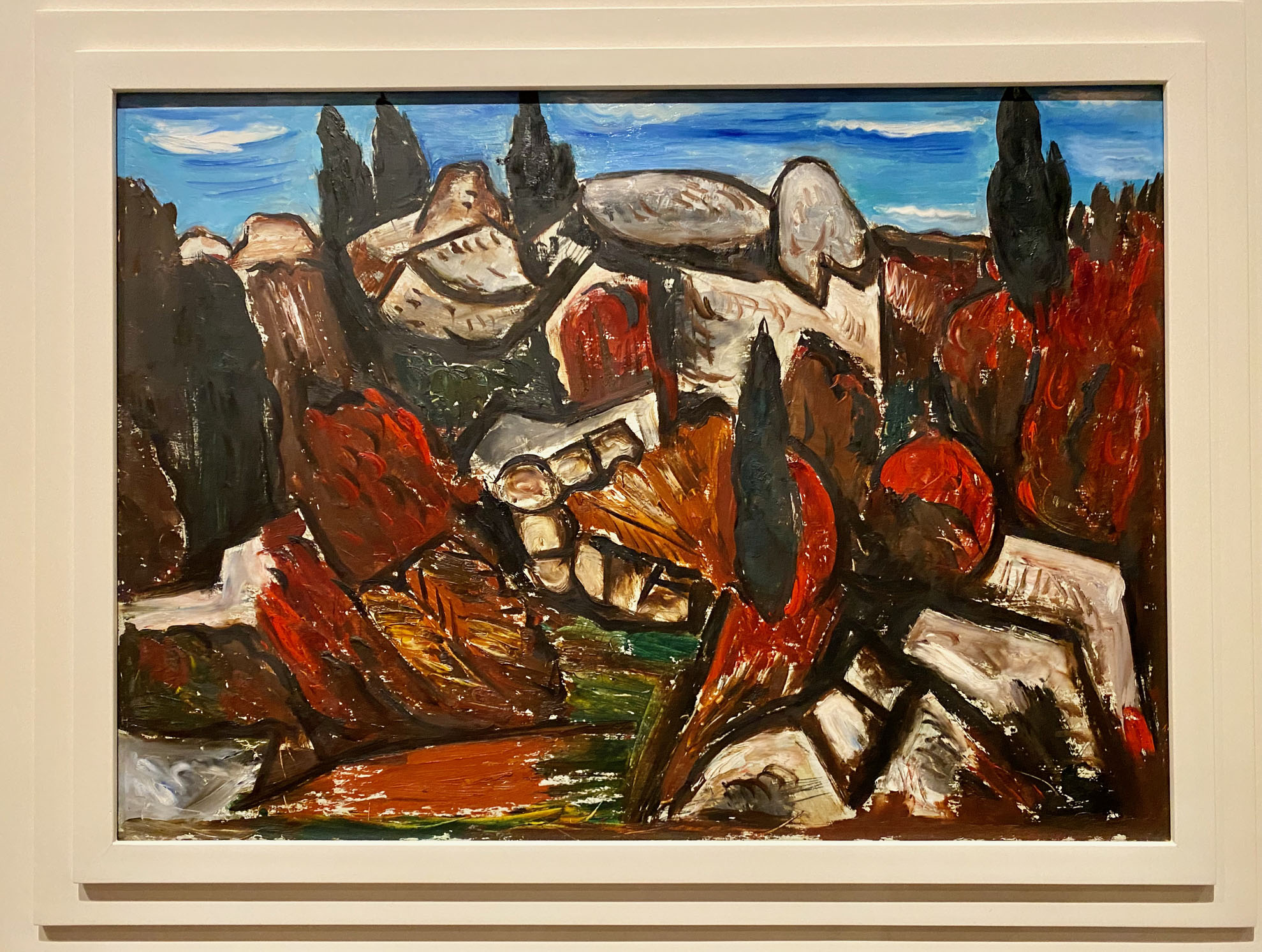
Hartley’s 1934 Autumn Landscape, Dogtown – a colorful painting made near Gloucester, Maine. Courtesy: Jan T. and Marica Vilcek Collection.
The exhibition does not unfold chronologically. Instead, it shows how much friends, place, and spiritual encounters affected him.
Near the Berlin abstractions are highly expressionist 1930s rockscapes from Maine and pointy Alpine peaks from his return to Bavaria. There’s an example of his stripped-down 1916 “synthetic cubist” work in Provincetown, a 1917 New England still life painted in Bermuda when he was budget-bunking with Demuth, and a red-saturated still life that is a therapeutic tribute to his Nova Scotia friends who died at sea in the late Thirties.
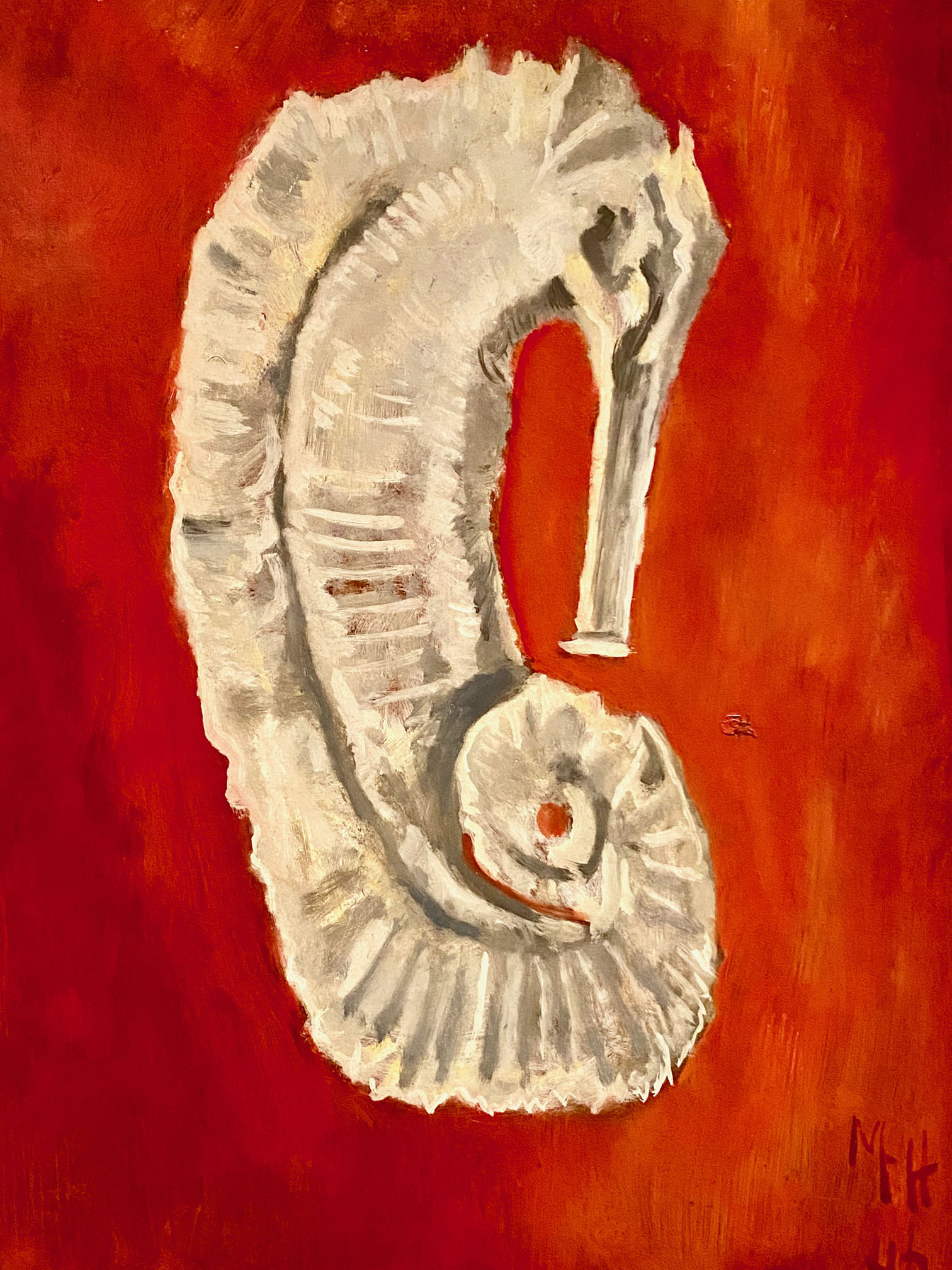
Hartley’s 1942 White Sea Horse – part of a series with vivid backgrounds done in Maine. Courtesy: Jan T. and Marica Vilcek Collection
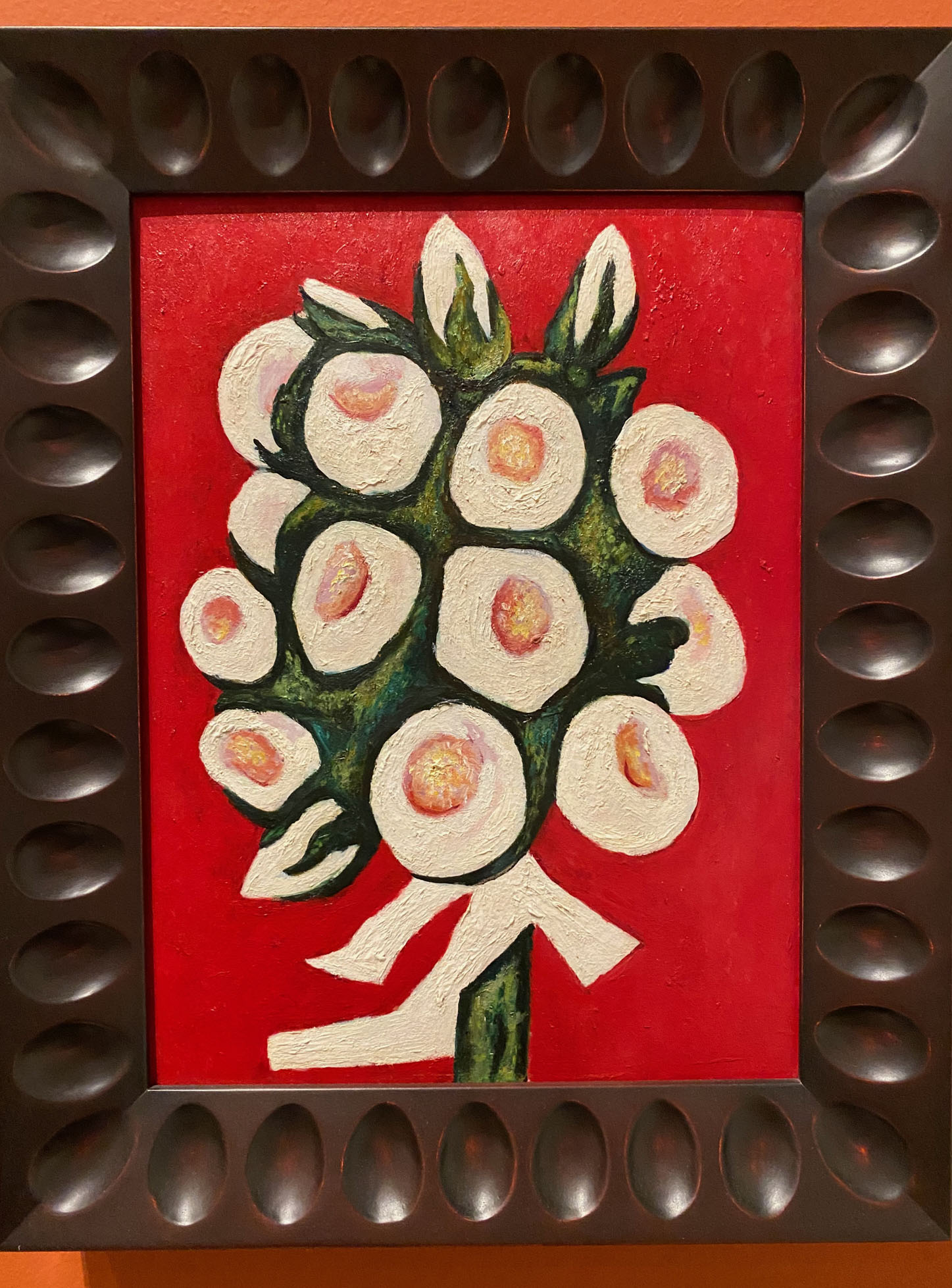
Hartley’s 1935-39 Roses for Seagulls that Lost Their Way –made in Bermuda to honor his Nova Scotia friends lost at sea. Courtesy: Jan T. and Marica Vilcek Collection.
In the middle of this gallery are vitrines with highly personal, everyday stuff from a painter who never settled down, stayed on the move, and always kept creating.
Here’s his camera, a scrapbook of personal photos, his 1923 published book of poetry, a few books from his library, and a little toy and pressed flowers sent to his niece.
Hartley’s photos from his 1917-1918 trip to Santa Fe. Courtesy: Bates College Museum of Art
Except for the Provincetown piece, all the surrounding paintings have direct, bold outlines, vivid colors, and vigorous, unglamorized visions – a fitting prelude to the last gallery of New Mexico landscapes.
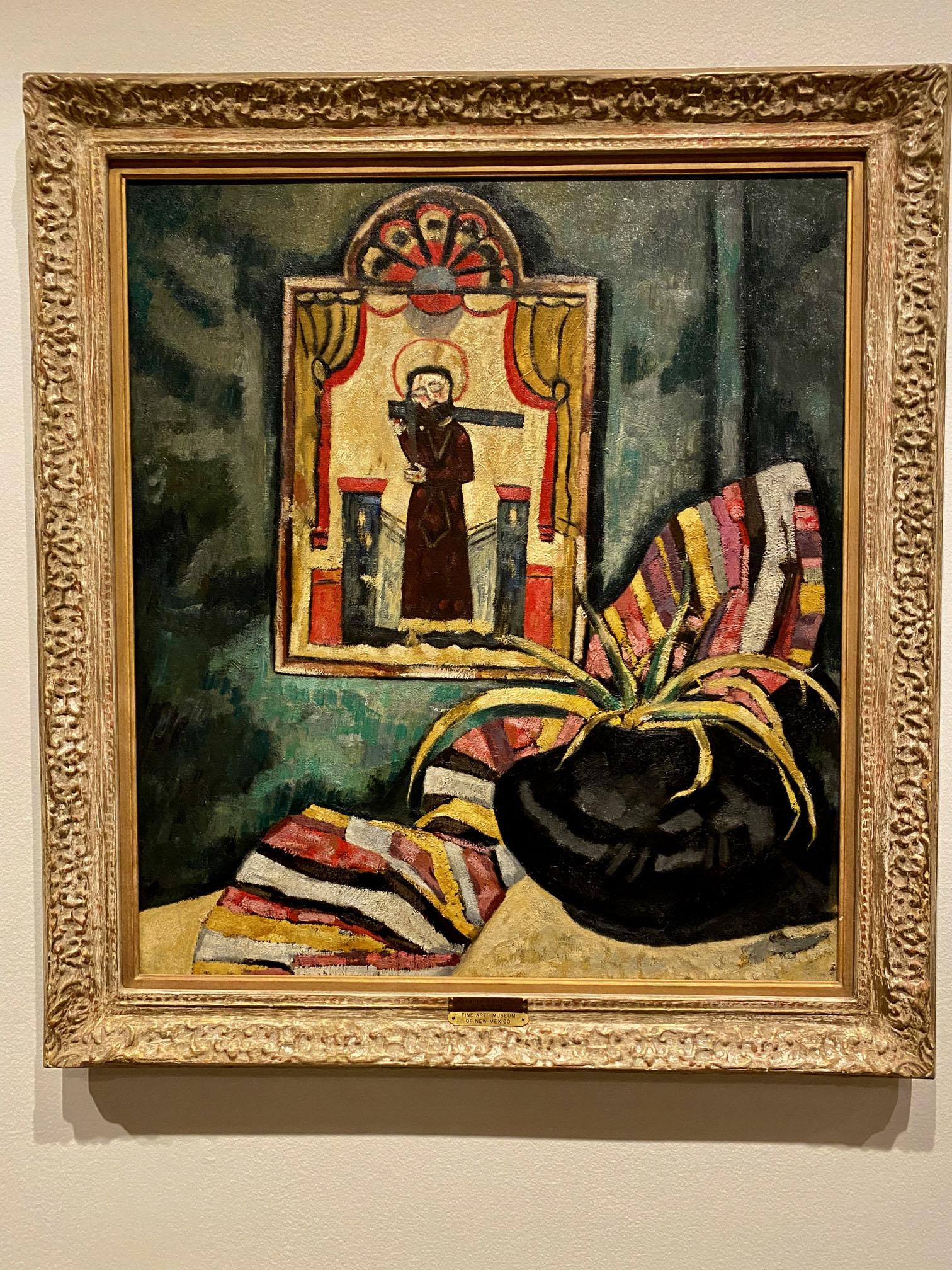
Hartley’s 1919 El Santo painted in New Mexico.
The final gallery provides a panorama of landscapes, plus a dramatic image of a ridge of Mexican volcanoes. Hartley only spent part of
1918 in Taos and Santa Fe, where he traversed the hills, attended Pueblo ceremonies, and wrote about the indigenous culture. He also completed his El Santostill life with a black-on-black ceramic vase, a striped textile, and a Northern New Mexican retablo of a suffering Jesus.
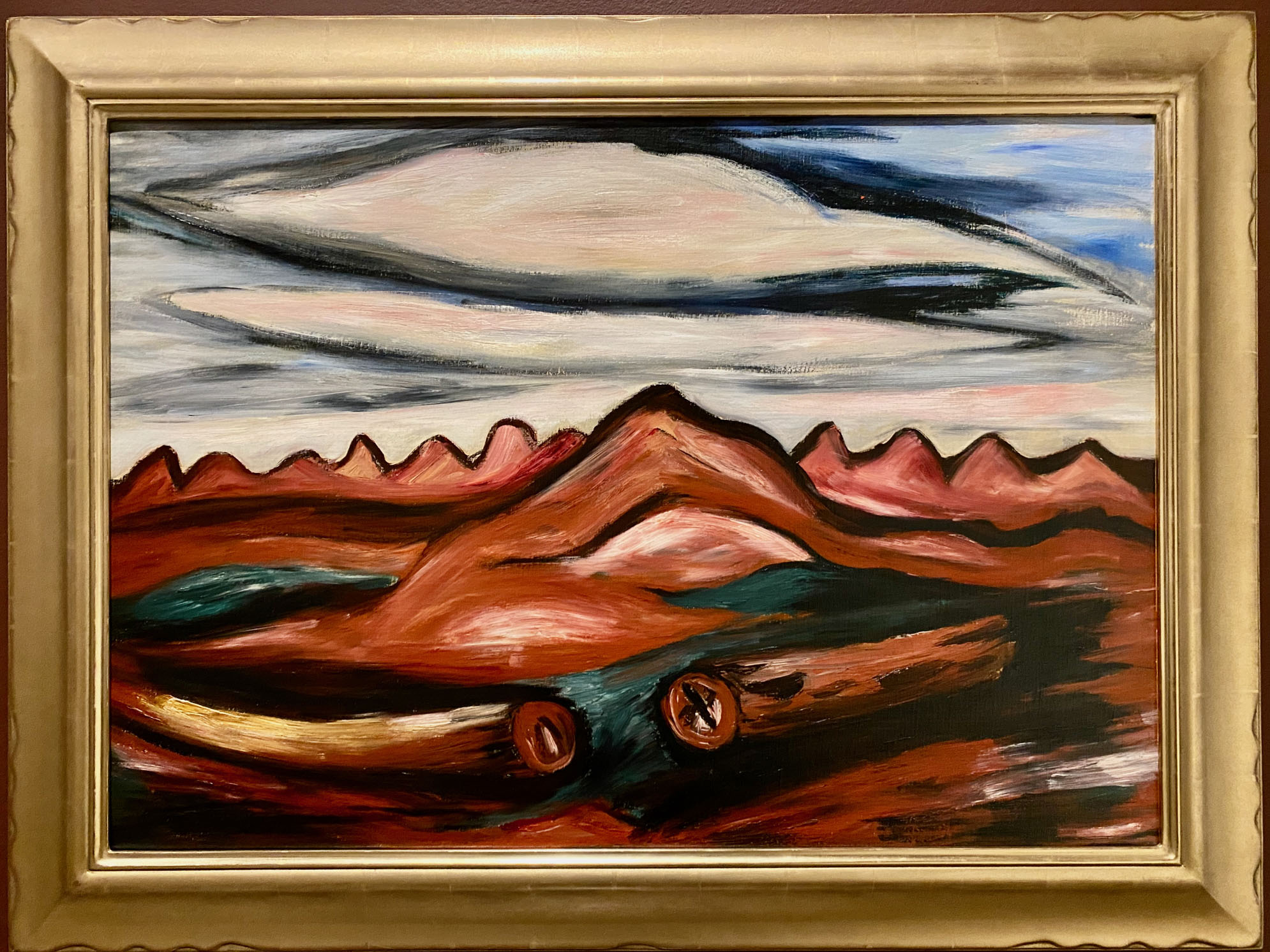
But it might be a surprise to learn that all of the Southwest landscapes were painted in Berlin in the 1920s – fittingly called his New Mexico “recollections” – or in Mexico in the 1930s.
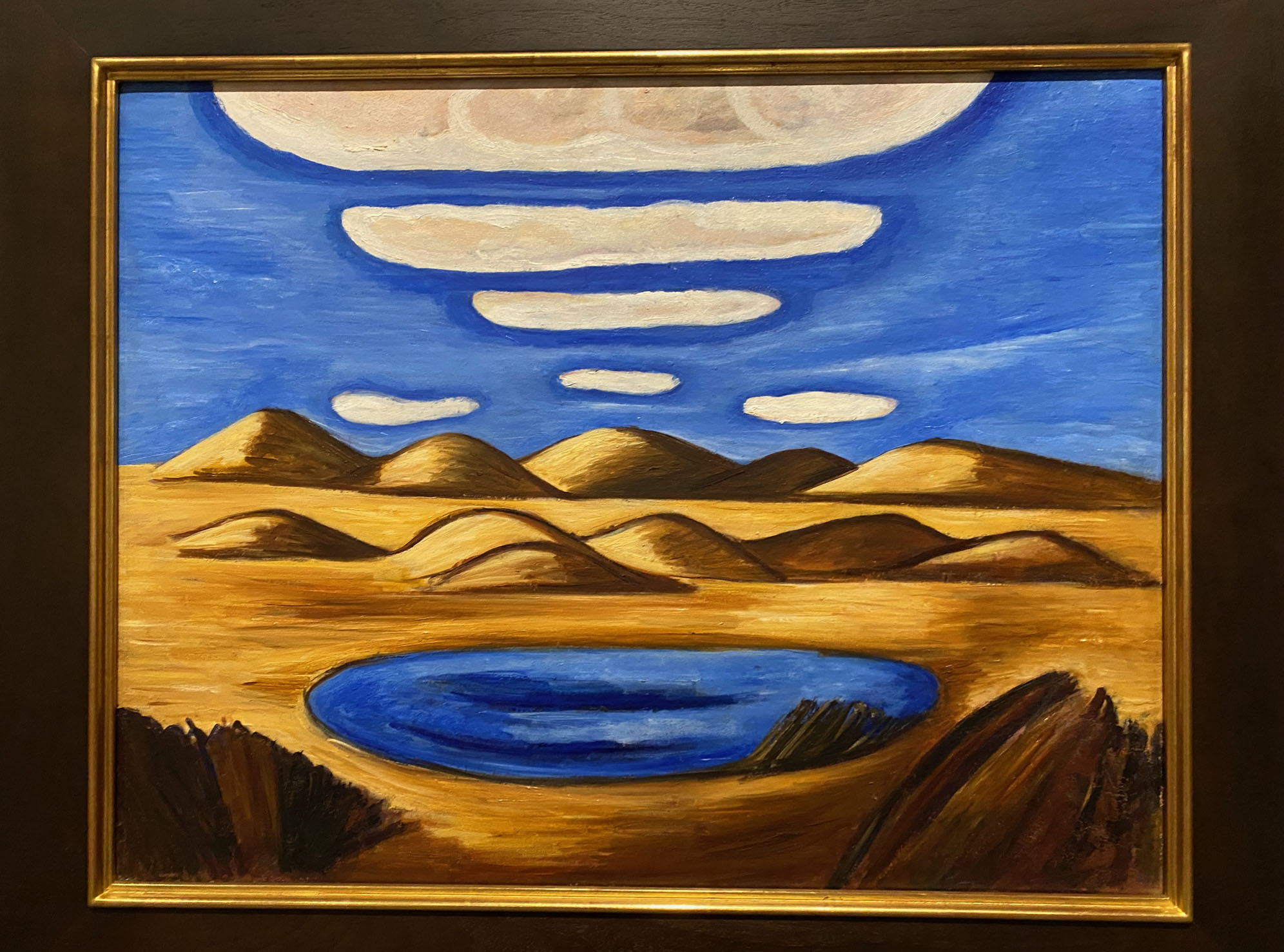
Floating clouds, expressive lines, and abstracted mountains – all from his vivid mind and recollections of spiritual and physical experiences long past. In the 21st century, increasing numbers of art historians and artists have looked to this phase of Hartley’s work for insight and inspiration – bold brushwork, expressive memory, and both a spiritual and emotional creative process.
Hartley’s 1923 oil New Mexico Recollection #14– painted in Berlin based upon memories of his year in the Southwest. Courtesy: Jan T. and Marica Vilcek Collection.
Hartley’s 1932 oil Lost Country – Petrified Sand Hills – a symbolic landscape inspired by mystical texts he discovered while painting in Mexico. Courtesy: Jan T. and Marica Vilcek Collection.
Toward the end of his life, the accolades, awards, honors, and retrospective exhibitions came his way, but Hartley remained the hardscrabble “painter of Maine,” barely interested in cashing the checks.
His niece, who preserved her uncle’s posessions and legacy after his death in 1943, took a train trip to New Mexico for the first time to see the landscapes that so inspired her uncle. Upon emerging from the train at the stop near Santa Fe, she looked up to take in the big, dramatic, cloud-filled sky. Thinking of all her uncle’s landscapes, she said, “Those clouds…I’d recognize them anywhere!”
If you see this show in Santa Fe, you will, too.
Louise Zelda Young’s 1943 photo Marsden Hartley’s Studio, Corea, Maine, where he worked in his final years. Courtesy: Bates College Museum of Art.
The artist stories and works presented in Out West: Gay and Lesbian Artists in the Southwest 1900-1969, at the New Mexico Museum of Art through September 2, 2023, shed light on artists who lived a bit more “under the radar” in the early 20th century, compared to the post-1969 era when loud and proud artists unleashed their voices in response to the Stonewall Riots.
The exhibition focuses on how early modernists used “coded” symbols in their work, explores the legacies of two-gendered Native American artists, and introduces mid-century work by mid-century contemporary artists working.
Marsden Hartley’s 1919 still life El Santo, featuring Hispanic Catholic objects of northern New Mexico.
Russel Cheney’s 1929 New Mexico/Penitente showing a bulto, axe, and flowers associated with the Penitente brotherhood.
The show opens with works by Marsden Hartley and Russell Cheney – painted 10 years apart (1919 and 1929) that feature items associated with rituals by Northern New Mexico’s Penitentes – Catholic men’s associations that kept faith alive during the 19th century when clergy were scarce in their remote mountain towns.
Hartley and Cheney were captivated by the religious rituals of these mysterious, faithful “brotherhoods” that persevered for centuries, despite periodic bans by New Mexico’s Catholic Church – not unlike the early 20th century gay men’s associations whose underground culture gave rise to “coded” rituals and language.
Hence, these works feature images of the suffering Christ, yucca plants used for self-mortification rituals, adobe churches, and props associated with processional death carts – symbols of religious brotherhood that represent the importance of brotherhood among the early 20th century gay community.
The second portion of the show introduces us to the many painters, photographers, and sculptors who not only drew artistic inspiration from the Southwest, but found communities that welcomed gay and lesbian artists. Works by artists, such as Agnes C. Sims and Cady Wells, are paired with portraits by a Southwestern who’s who of modern portraiture and photography – Will Shuster, Laura Gilpin, Ansel Adams, and Anne Noggle.
Modernist Deer Dance cedar sculptures carved in 1945 by Agnes C. Sims, a tribute to native cultures
Laura Gilpin’s 1942 photographic portrait of artist Agnes C. Sims
There’s even a “portrait” stitched by maverick Cady Wells of his very best friend, modernist Rebecca James. Well known for his expressionist paintings and his large collection of Northern New Mexican religious art, Wells subversively went all in on petit-point – an art form traditionally associated with “women’s work” and beloved by Ms. James.
Detail of 1953 petit-point stitchery “portrait” of Rebecca S. James by her friend, Cady Wells – his work in a traditional “feminine” genre of craft.
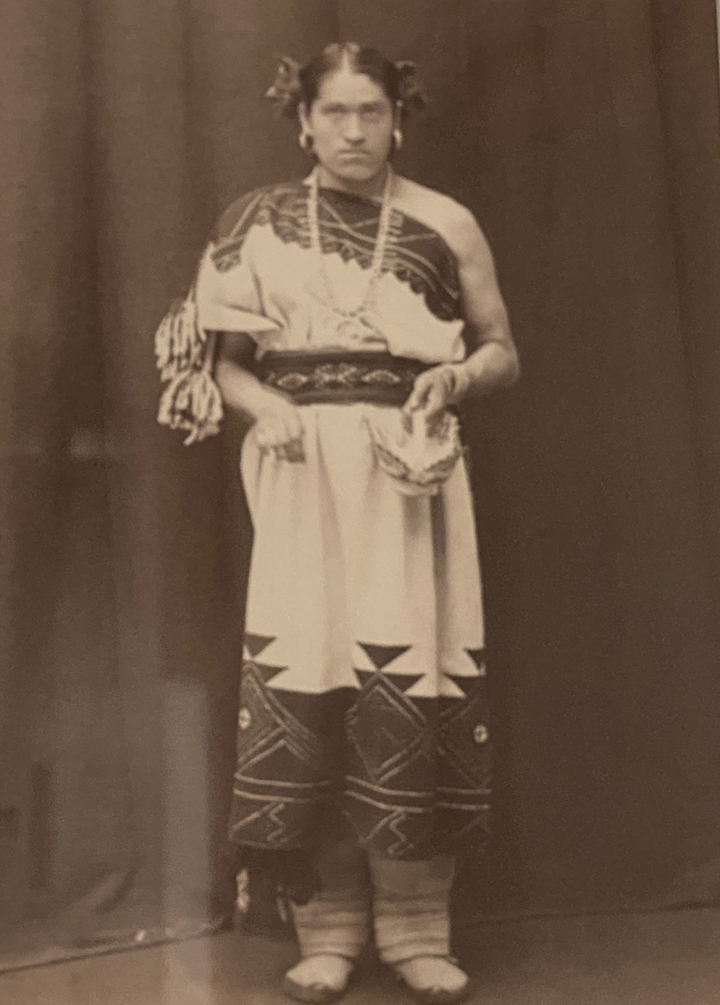
John K. Hillers’ 1879-1880 albumen portrait of Lahmana We’wha of Zuni Pueblo. Courtesy: Palace of the Governors Photo Archive.
This section also includes the stories of important two-spirit Native American artists – individuals who are born “male” but who take on spiritual and other tribal roles traditionally associated with women. The first is We’wha, a respected 19th-century expert in and advocate for Zuni arts and traditions– a favorite of Smithsonian anthropologists who demonstrated weaving in D.C. and even presented a special work directly to President Grover Cleveland as a wedding gift.
Another is R.C. Gorman’s portrait of Hosteen Klah, a Navajo two-spirit, one of the the Wheelwright Museum’s co-founders. Gorman, one of the best recognized and flamboyant 20th century contemporary Native artists, excelled in colorful mid-century works. Gorman made history in Taos by opening the first Native-owned gallery in the United States.
Navajo artist R.C. Gorman’s 1960 painting Night of the Yei – a celebration of Navajo spiritual traditions.
The final portion of the show includes two works by female rule-breakers. The first is a rare Agnes Martin 1954 abstract-expressionist work typical of her experimentation prior to her acclaimed grid series. It’s much more aligned to the biomorphic symbolism of early Pollack and Rothko – reflecting what was happening earlier in her New York career during the heyday of the Cedar Street Tavern crowd.
Agnes Martin’s untitled 1954 painting. Courtesy: University of New Mexico Art Museum.
Second ia a never-before-seen 1997 installation by feminist-art innovator Harmony Hammond, who was also represented in this year’s Whitney Biennial. Hammond, who curated one of Santa Fe’s first LGBTQ exhibitions back in 1999, used to travel backroads of the Southwest, finding abandoned towns and homesteads and collecting left behinds. In this show, she presents What Have You Done With Our Desire, a mixed-media piece using ancient kitchen linoleum – an allusion to circumstances leading to repression of gay women’s sexuality.
Harmony Hammond’s never-before-seen 1997 mixed-media installation What Have You Done with Our Desire. Courtesy: the artist.
For more about these and other artists, listen to curator Christian Waguespak’s talk about LGBTQ artists in the Southwest at the Harwood Museum in Taos.













 itsnewstoyou