Unknown's avatar

About MsSusanB

Arts and technology writer who is in the know about the latest and greatest that New York City – and other places in the country – have to offer and the fossils that are being dug up around the world

Pueblo Pots Speak in “Grounded in Clay”

Contemporary artists say they can hear their ancestors speak across generations. All they have to do is hold their community’s ancient pots – living beings that connect them to the Earth and the people from the past who made them.

You can hear these modern and ancient voices and see ceramic masterworks in Grounded in Clay: The Spirit of Pueblo Pottery, an exhibition on view the The Museum of Fine Arts, Houston through January 12, 2025; continuing at the St. Louis Art Museum March 7 to September 14, 2025; and on display at the Pueblo Cultural Center in Albuquerque from March 2026 to February 2027.

In video at Museum of Indian Arts and Culture, Clarence Cruz (Okay Owingeh) reflects on a pots’s personal meaning

Clay is central to Pueblo culture, and this show is special, because it’s the first major exhibition of Pueblo pots curated entirely by the indigenous community – artists, leaders, teachers, and museum professionals.
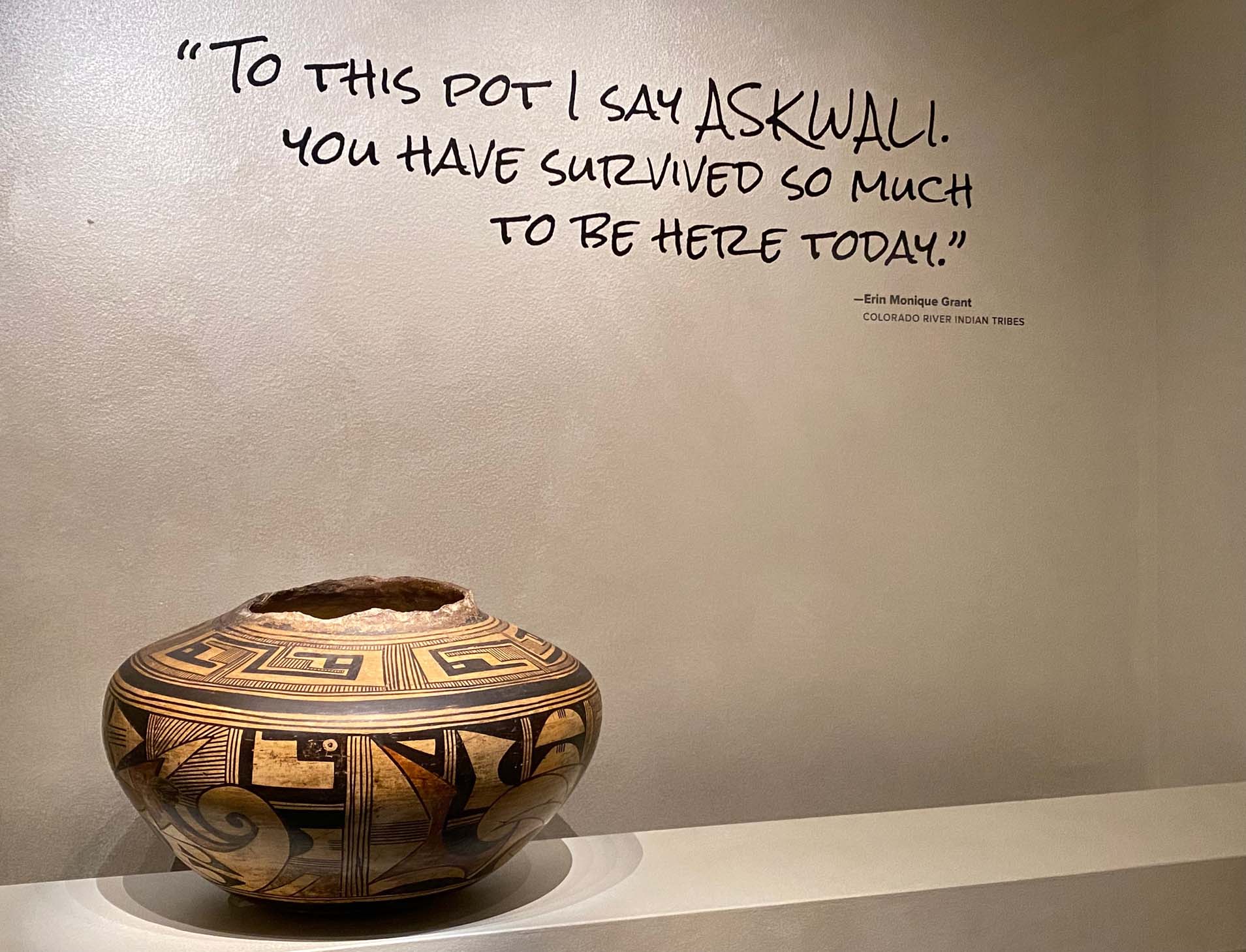
1900 Tewa-Hopi Hno jar selected by Erin Monique Grant (Colorado River Indian Tribes); it reminded her of her Hopi family. Courtesy: Vilcek Collection.

For the 100th birthday of the Indian Arts Research Center at School for Advanced Research (SAR), the exhibition debuted in 2023 at Santa Fe’s Museum of Indian Arts and Culture, and then traveled to New York to open at the Metropolitan Museum of Art.
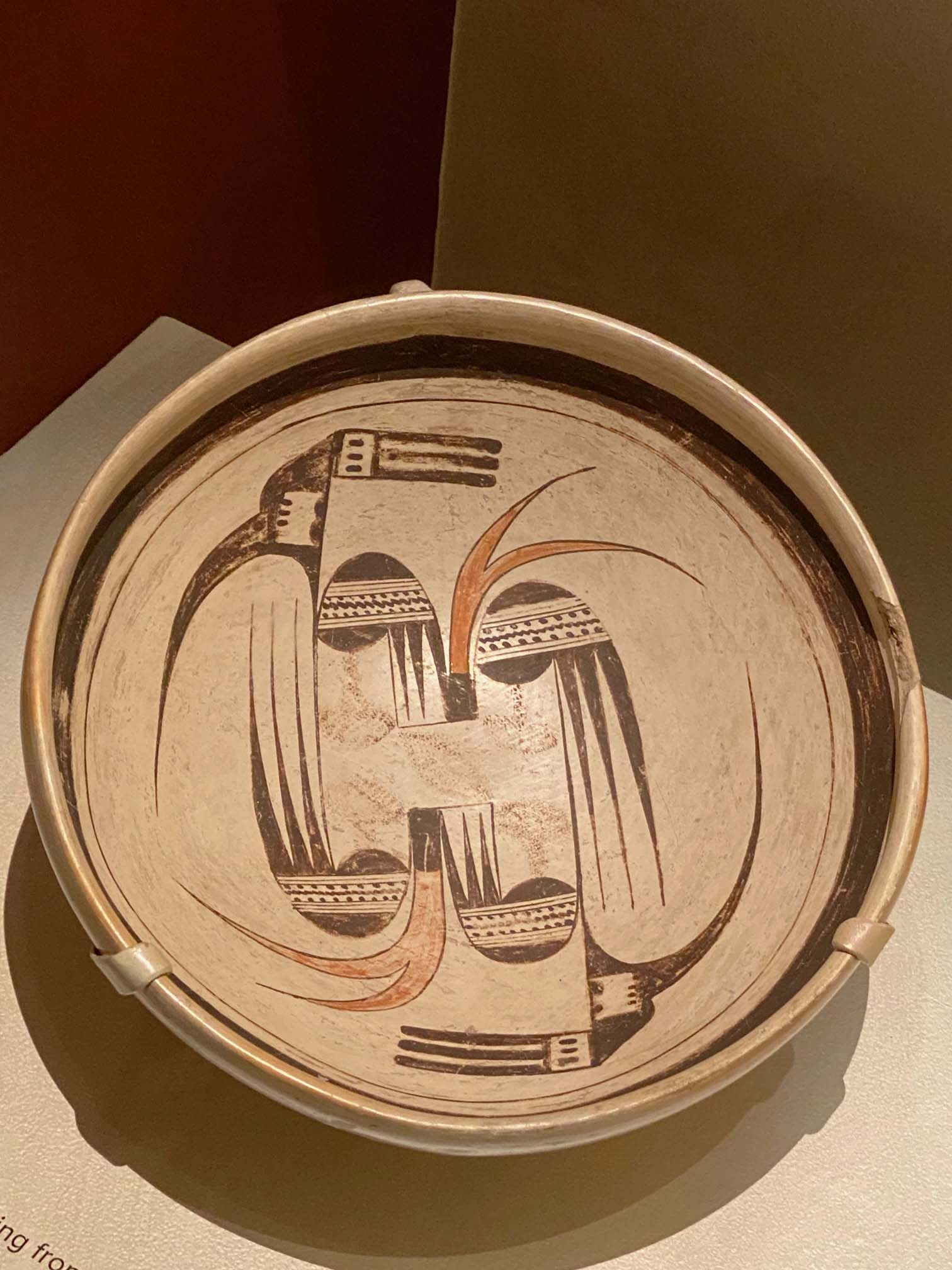
1907-1910 bowl by Nampeyo (Tewa/Hopi) selected by her great-great-grandson artist Dan Namingha. Courtesy: SAR

New York’s Vilcek Foundation co-sponsored the community-curation project, exhibition, and project website. The organizers consulted with sixty curators from 22 pueblo communities across the Southwest to select work from the IARC collection and write about the spirit of these works. Communications weren’t always easy, since Internet service (email) is still spotty on some tribal lands.  

But The Pueblo Collective’s inclusive approach to create the exhibition and catalog is now considered a template for major art institutions to work with tribal communities to convey their stories and culture to the public..

The IARC collection is legendary, spanning prehistoric to modern-day works. This video takes you inside IARC archive to meet a few of the Pueblo curators and the pots they selected:

Utilitarian vessels, ancient legacies, and intergenerational connections are themes explored in the 2023 installation at Santa Fe’s Museum of Indian Arts and Culture. The exhibition design artfully integrated the words and thoughts of the curators in, around, and above the spectacular selections. Take a look at some of our favorites in our Flickr album.

Two 19th-century Tesuque water jars: a jar chosen by artist Marita Hinds (Tesuque), who saw it on a 1980s class field trip; and one admired by potter Bernard Mora (Tesuque) for its personality and imperfections. Courtesy: SAR

In some cases, a curator chose an Ancestral Pueblo pot from the 1100s and reflected on how well it’s survived today. In other cases, a curator discovered their grandmother’s pot stored for decades within the IARC collection. What a joy to bring it out and let it breathe! Listen in….

This statement about Lonnie Vigil’s magnificent vessel by Nora Naranjo Morse says it all.  The MIAC gallery space recreated a Pueblo kitchen so we can experience the environment in which most Pueblo potters create their work.
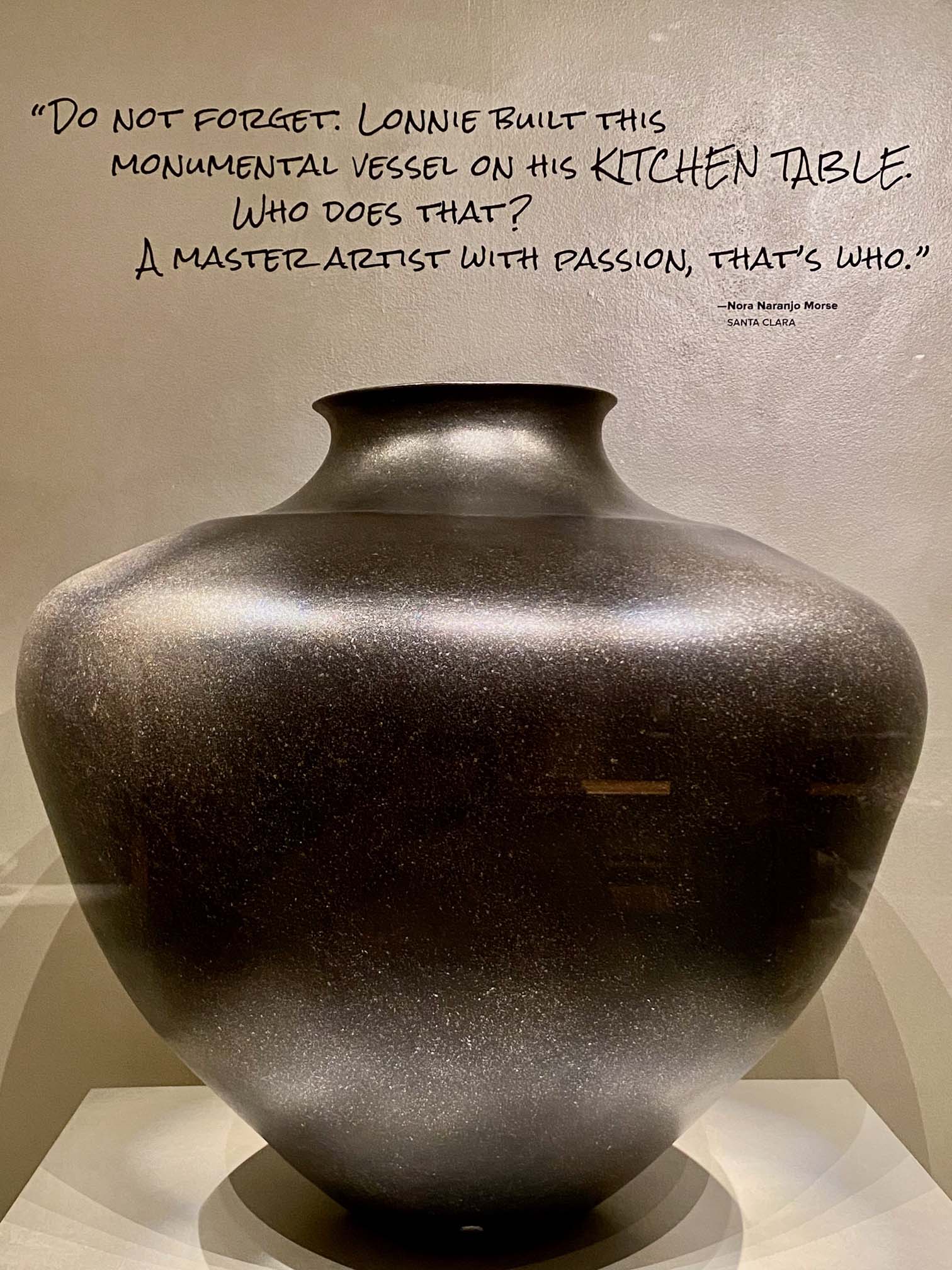
1995 micaceous clay jar made by Lonnie Vigil (Nambe) selected by Nora Naranjo Morse (Santa Clara) because it glitters like stars. Courtesy: SAR
Santa Fe’s Museum of Indian Arts and Culture’s replica of Pueblo kitchen where most pottery is created

And here’s how the Met featured Lonnie’s showstopping work – made on his kitchen table – prominently in the American Wing entrance!
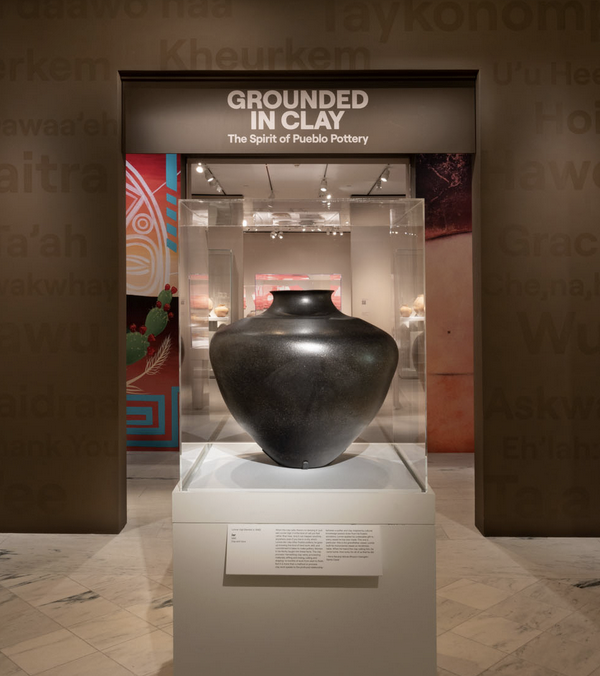
Micaceous clay jar by Lonnie Vigil (Nambe) in the show’s entrance at the Met’s American Wing. Photo by Richard Lee; courtesy: The Metropolitan Museum

The project website presents the curators’ biographies, their selections, and stories.

Listen to the Met’s 2023 panel with five curators behind this magnificent community-curated indigenous exhibition and find out why they believe understanding the vessels’ power is important:

Fernandez Curates Smithson at SITE Santa Fe

It’s not often you get to see Robert Smithson’s large-scale works inside gallery walls. Strolling through SITE Santa Fe’s magnificent Teresita Fernández/Robert Smithson exhibition, through October 28, provides an opportunity to see how a contemporary Brooklyn-based Cuban-American artist – inspired by landscape and societal histories of the Caribbean – positions her own work “in conversation” with Smithson’s 1960s-1970s geologic works, drawings, and photo installations.

SITE invited art-world superstar Teresita Fernández to curate this show with the Santa Fe-based Holt/Smithson Foundation. Prior to her deep dive into Smithson’s career, her primary knowledge centered around his 1970 epic Spiral Jetty – 6,650 tons of rock and earth jutting out from the shore of Utah’s Great Salt Lake.

Smithson’s 1969-1970 Mirrors and Shelly Sand and two by Fernández: 2009 Drawn Waters (Borrowdale) and 2024 Sfumato (Epic) 2. Courtesy: Dallas Museum of Art; the artist and Lehmann Maupin.
Still from Robert Smithson’s 1970 film Spiral Jetty, Great Salt Lake, Utah. Courtesy: Holt/Smithson Foundation.

But Fernández found a lot more from Smithson’s too-short career that she could couple with her own work to create SITE’s spectacular installation. Both artists use landscapes, deep time, ancient history, and travel.

Smithson’s 1968 installation A Nonsite (Franklin, New Jersey) with 2020 Archipelago charcoal work by Teresita Fernández. Courtesy: Museum of Contemporary Art Chicago; private collection

In the first gallery, Fernández selected a Smithson “nonsite” work – a minimalist series of boxes, each packed with rocks from the decidedly unromantic site of Franklin, New Jersey. Smithson’s “nonsite” includes a framed aerial photo that appears to document the site, but it’s a “readjusted” depiction of it. Not what it seems.

Next to the “nonsite,” Fernández hangs Archipelago, a charcoal wall sculpture., which appears to be a legit map, but it’s not. It’s an imagined map of separate Caribbean islands and continents linked together, making us reflect upon their shared socio-political colonial histories.

Viñales (Plateau) is a wall-sized “stacked landscape” depicting Cuba’s Viñales Valley, home of ancient karst caves once inhabited by Taino people and later where escaped plantation slaves sought refuge. At a distance, it evokes the valley’s ecological, social, and political legacies; up close, you see that the image is made up of thousands of tiny ceramic tiles. Something to get lost in.

2019 ceramic mosaic by Teresita Fernández Viñales (Plateau). Courtesy: the artist and Lehmann Maupin.

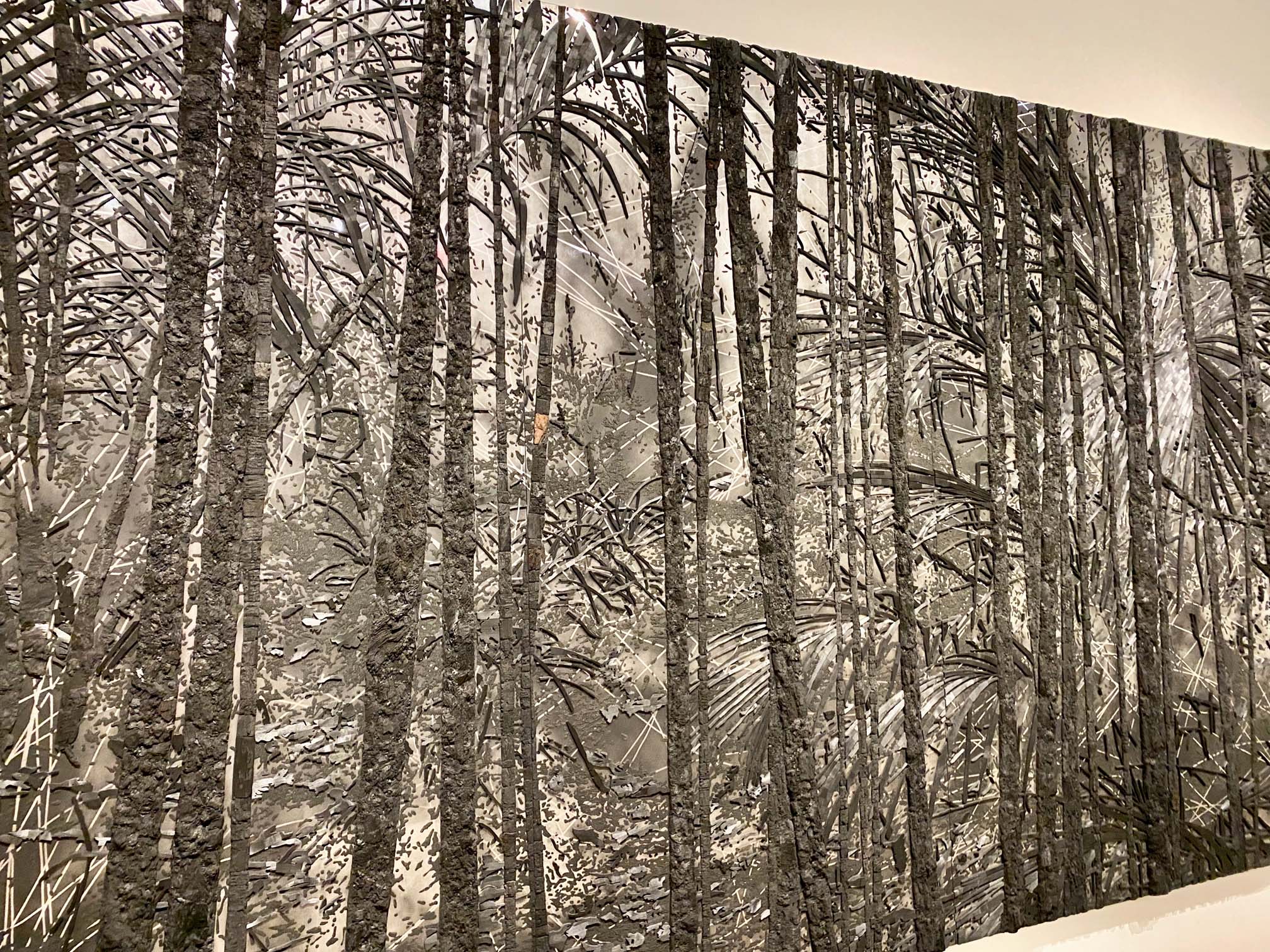
Both artists use reflection in their works. Manigual (Mirror) by Fernández– a tropical forest created from charcoal and sand – is affixed to a reflective surface, so you can “see yourself” in the charred thicket when you get right up to it. Smithson designed his earth-and-mirror Red Sandstone Corner Piece so that every gallery goer’s image is part of the visual experience – from close up, far back, and far away. You’re linked to the red sandstone.

Detail of 2023 Manigual (Mirror) by Teresita Fernández. Courtesy: Crystal Bridges Museum of American Art.

On the other hand, Smithson famous photographic series, Yucatán Mirror Displacements, documents his meticulously arranged mirrors set into Mexico’s coastal landscapes. Just reflections of landscape and sky in all the settings he documented his set of mirrors; no people.

Detail of Smithson’s 1969 Yucatán Mirror Displacements (1-9). Courtesy: Guggenheim Museum.

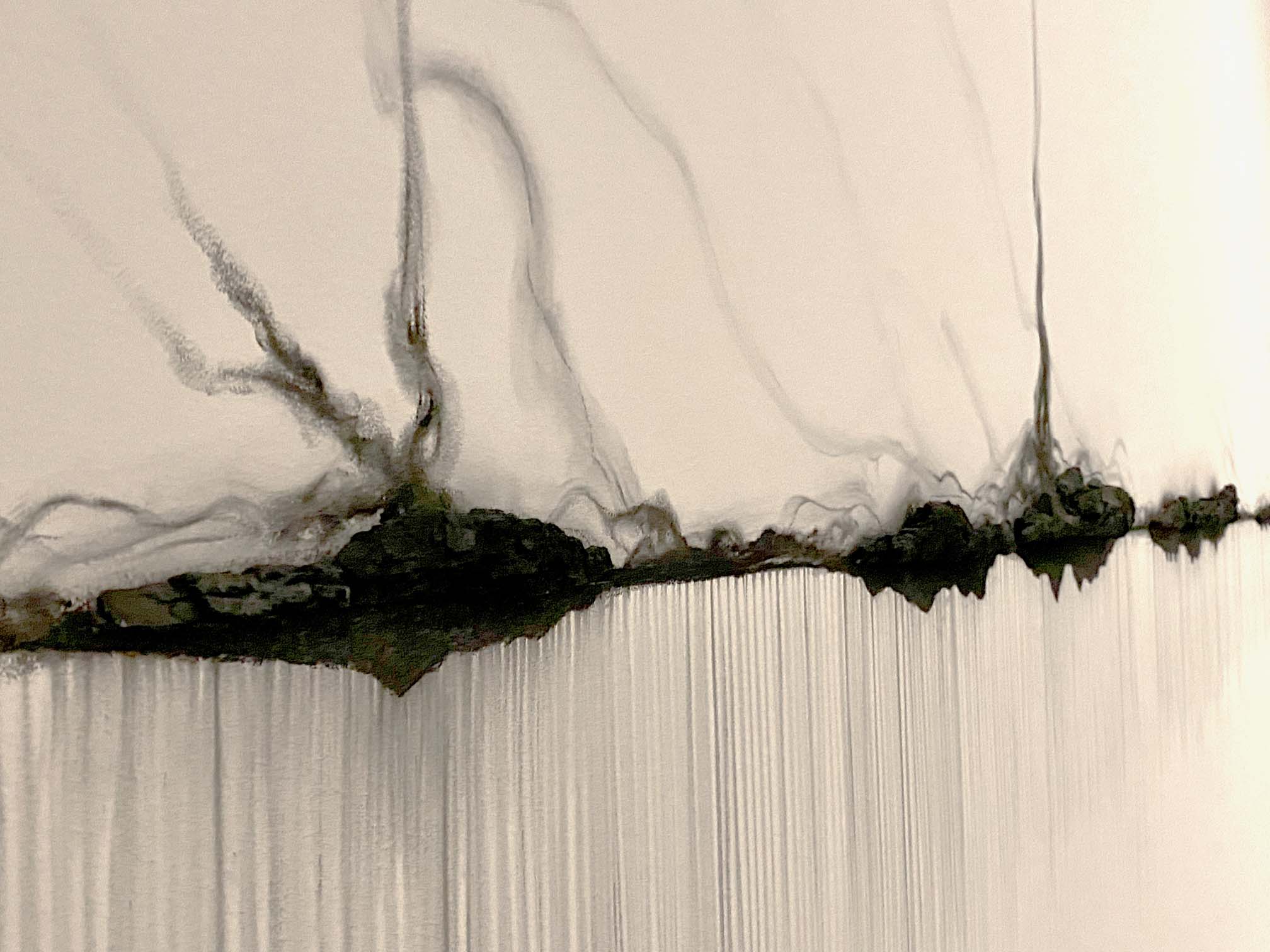
Nature’s continual ebb and flow, the Earth’s surface, ecosystems, and the cosmos ­are all subjects explored by both artists.What’s beneath the Earth’s surface, forces of nature, and human impact on it all pop up covertly in every room.  See more in our Flickr album.

Detail of 2017 charcoal work by Fernández Charred Landscape (America). Courtesy: the artist, Lehmann Maupin.
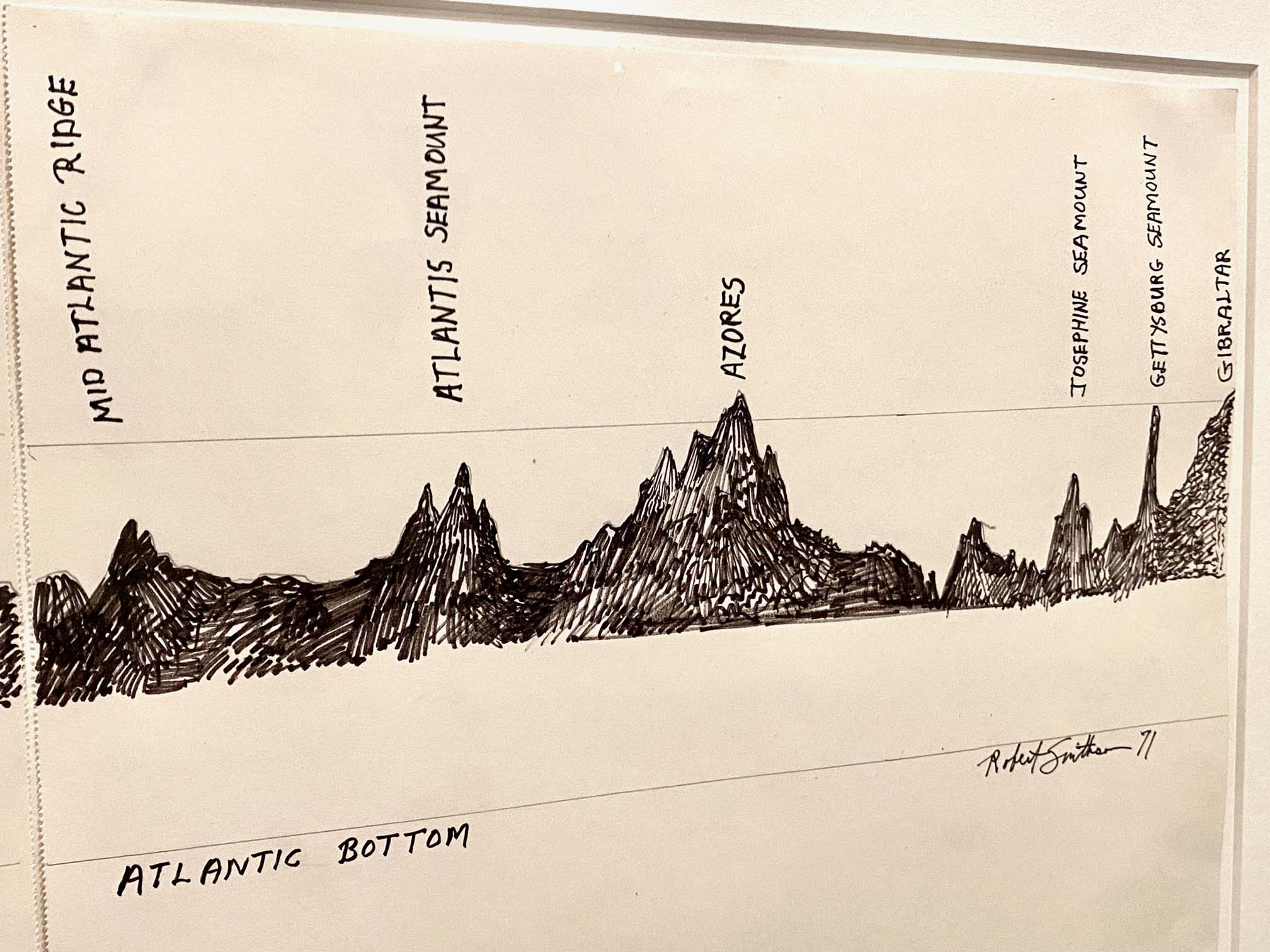
Detail of Smithson’s 1971 ink drawing A Profile of the Atlantic Bottom. Courtesy: private collection.

And learn more about the “conversations” that works by these artists are having in the curator lectures in SITE Santa Fe’s videos with Fernández herself and her co-curator from the Holt/Smithson Foundation.

Detail of Robert Smithson’s 1961-1963 paint and photo collage Algae, algae. Courtesy: Holt/Smithson Foundation and Marian Goodman Gallery.
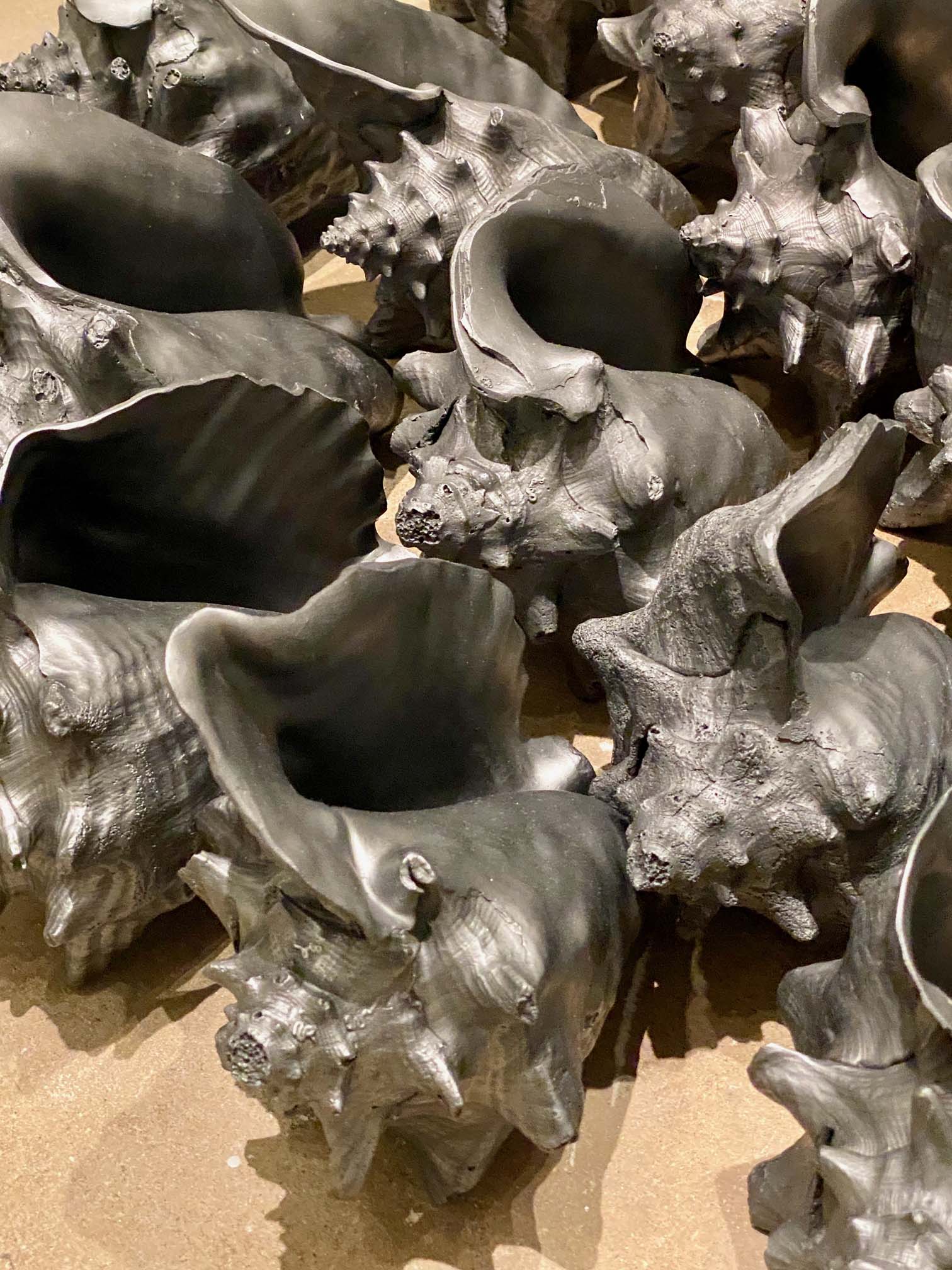
Detail of 2019 graphite-covered shell installation Chorus by Teresita Fernández. Courtesy: the artist and Lehmann Maupin.

National Gallery Celebrates 50 Contemporary Native Artists

If you want to take a trip across American land with 50 living Native artists, there’s still time to catch the ground-breaking exhibition, The Land Carries Our Ancestors: Contemporary Art by Native Americans, at Connecticut’s New Britain Museum of American Art through September 15, 2024.

The National Gallery of Art in Washington, D.C. asked Jaune Quick-to-See Smith (Citizen of the Confederated Salish and Kootenai Nation) to survey the United States and create an exhibition reflecting the diversity of the living Native American artists.

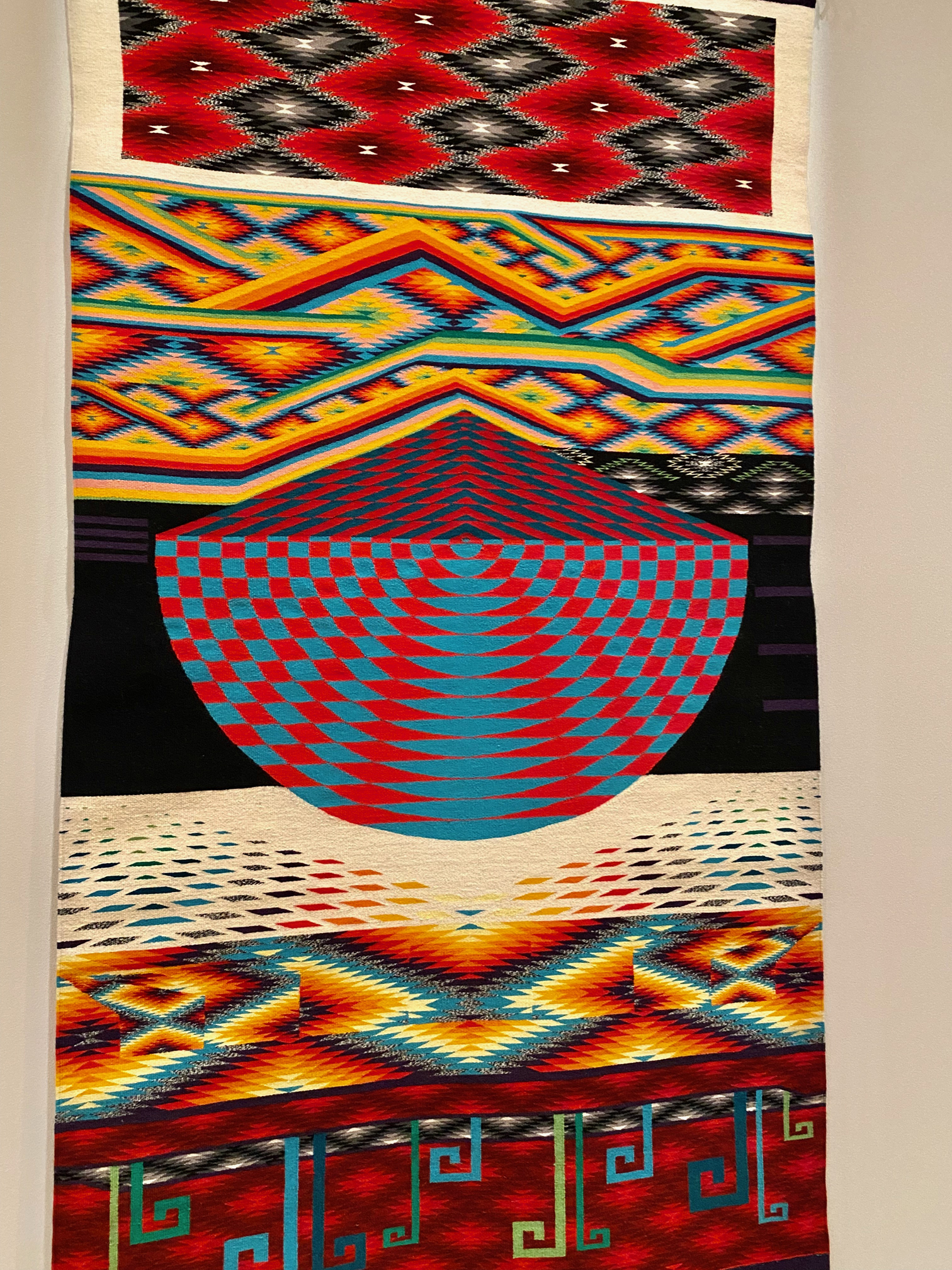
2014 wool weaving World Traveler by Melissa Cody (Navajo). Courtesy: Stark Museum of Art.

Smith, whose own artistic achievement was honored most recently in a three-museum retrospective in 2023-2024, became the first artist invited to curate a show at the National Gallery.

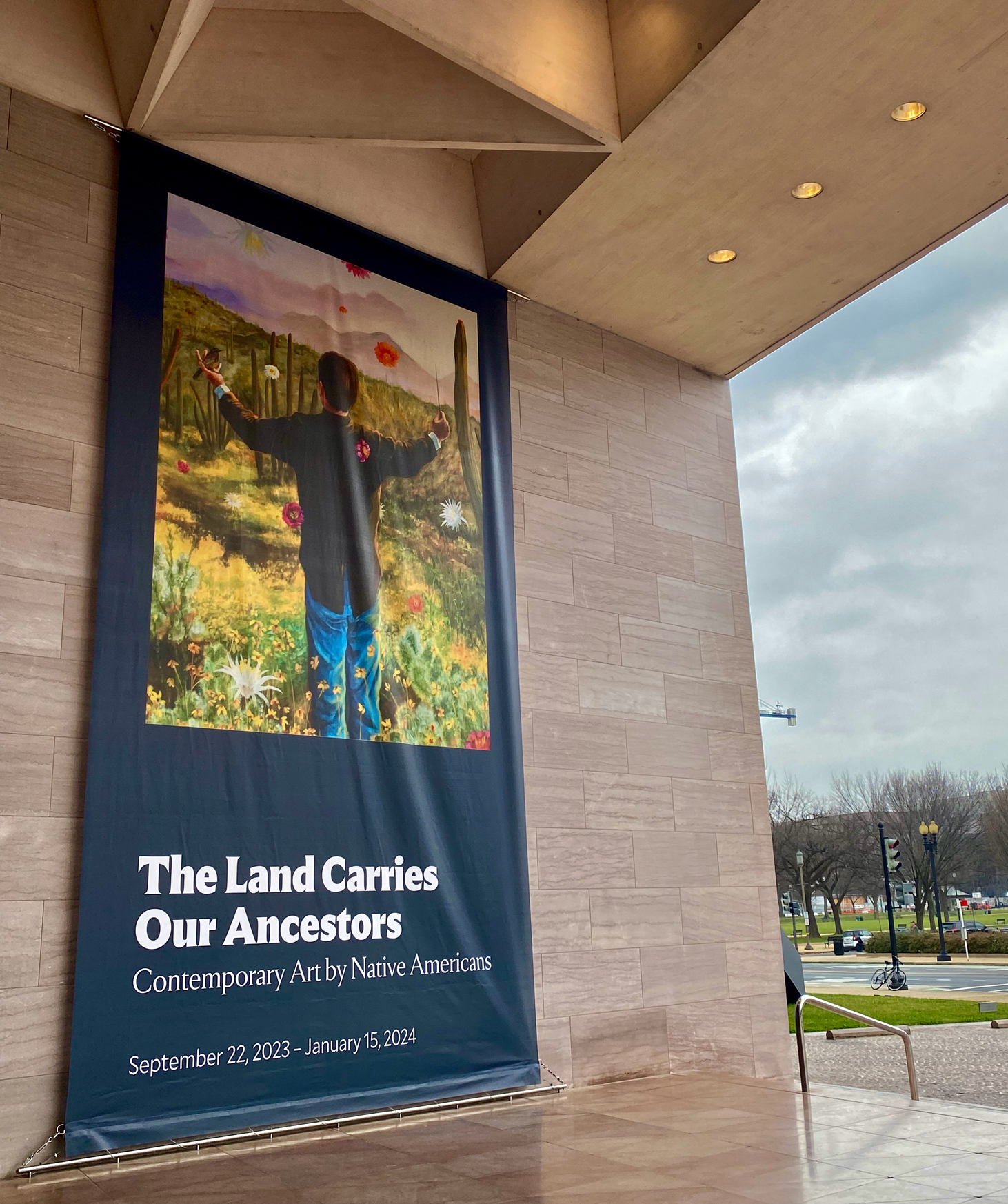
Entrance banner features Orchestrating a Blooming Desert by Steven Yazzie (Diné/Laguna Pueblo).

Smith has always done whatever possible to increase the visibilty of Native artists in the contemporary art world. For this exhibition, she chose 50 intergenerational artists from diverse regions, cultures, and artistic practices. Look at our Flickr album of the National Gallery installation to see some of our favorites.

All of the works reflect the artists’ deep connection to the land, especially Orchestrating a Blooming Desert by Steven Yazzie (Diné/Laguna Pueblo), a painting that reflects one man’s joyful encounter with a lush landscape.

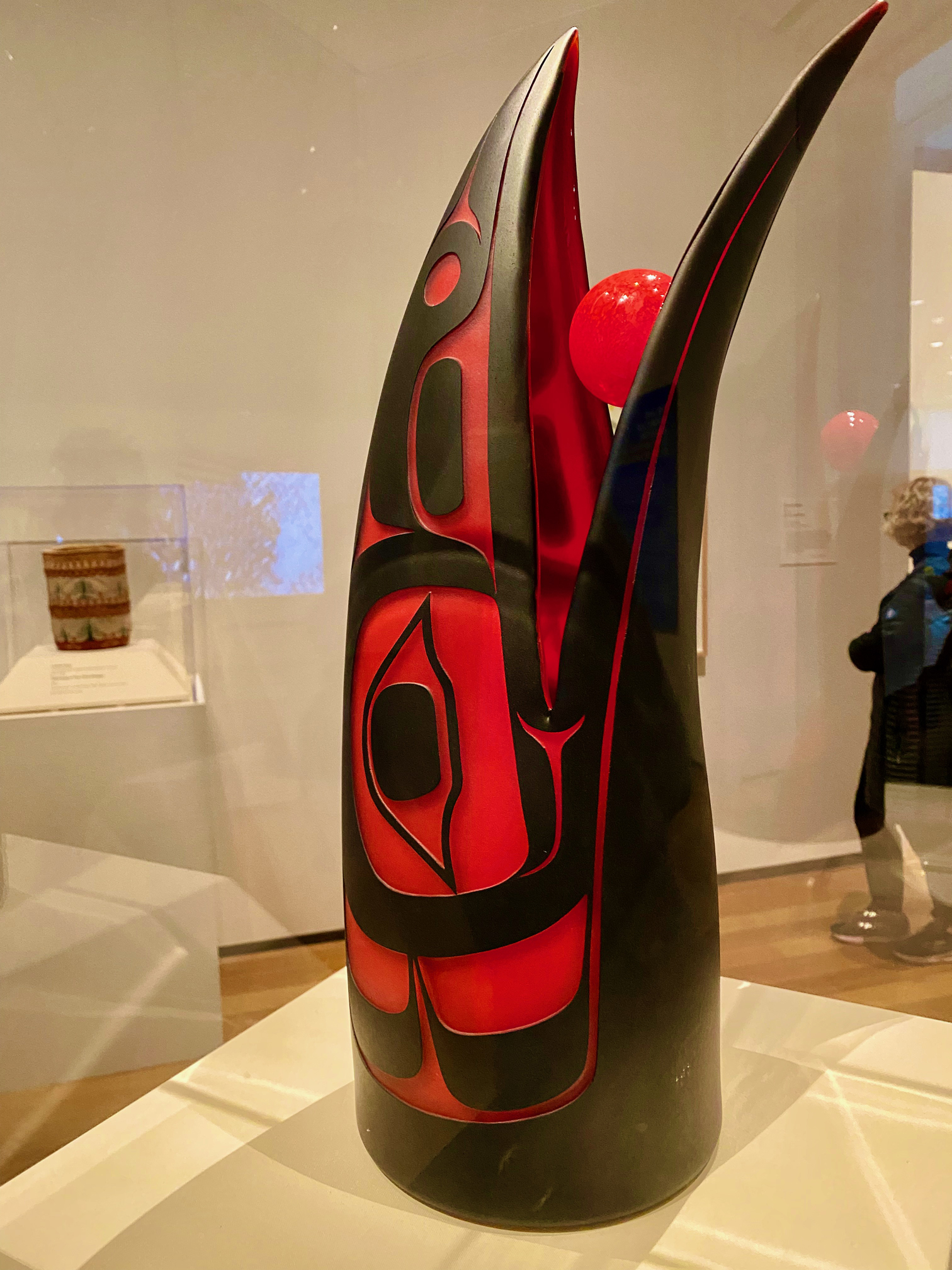
Some works depict a tribe’s link to the natural world through origin stories. Visitors are mesmerized by Preston Singletary’s exquisite sculpture of Tlingit creation-myth legend, Raven stealing the Sun. It’s glorious to admire this dramatic icon fully realized in a distinctly nontraditional medium – blown and sand-carved glass.

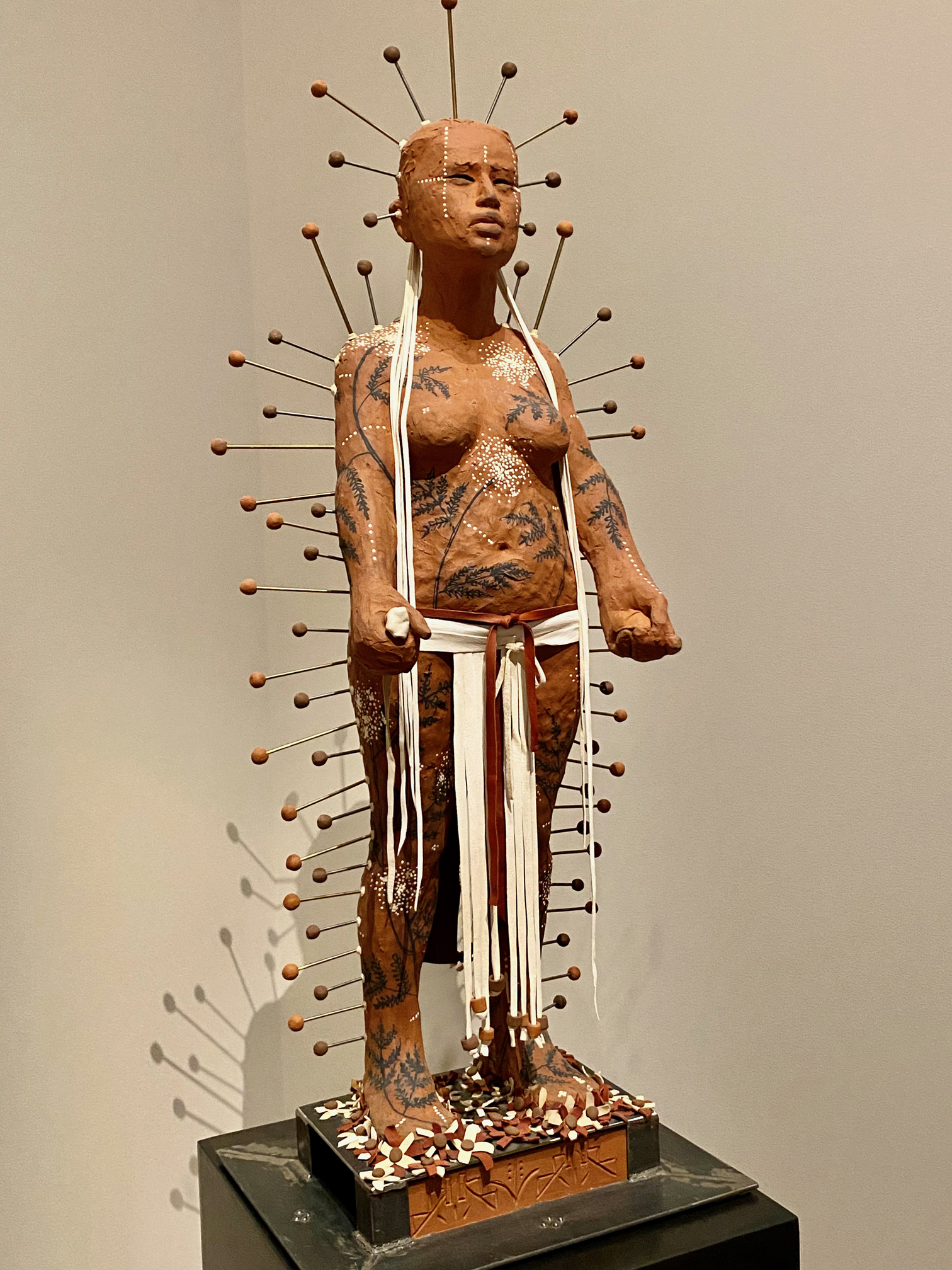
Experiencing the large, spiritual earth-colored ceramic figure by Rose B. Simpson (Santa Clara Pueblo) harkens back to eras when people had a more integral connection to the earth. Simpson calls her figure Tonantzin, an Aztec name for earth mothers, corn mothers, and even the Virgin of Guadalupe.

2017 blown and sand-carved glass Raven Steals the Sun by Preston Singletary (Tlingit). Courtesy: private collector.
2021 ceramic, steel, leather, and brass Tonantzin by Rose B. Simpson (Santa Clara Pueblo). Courtesy: Tia Collection.

Smith has chosen to hang many smaller two-dimensional works across a long wall in a checkerboard to suggest that visitors reflect on the impact of 1887 Dawes Act upon Native lands – a law that cut Native territory into “checkerboard” lots to facilitate private ownership.

At the National Gallery, Jeffrey Gibson’s punching bag (all made of found materials) was hung nearby, reminding us of the delicate balance that has to be struck by simultaneously caring for and taking gifts from the earth.

Next to checkerboard wall, the 2020 beaded punching bag To Feel Myself Loved On the Earth by Jeffrey Gibson (Mississippi Band of Choctaw Indians/Cherokee Nation). Courtesy: Hirschhorn Museum.

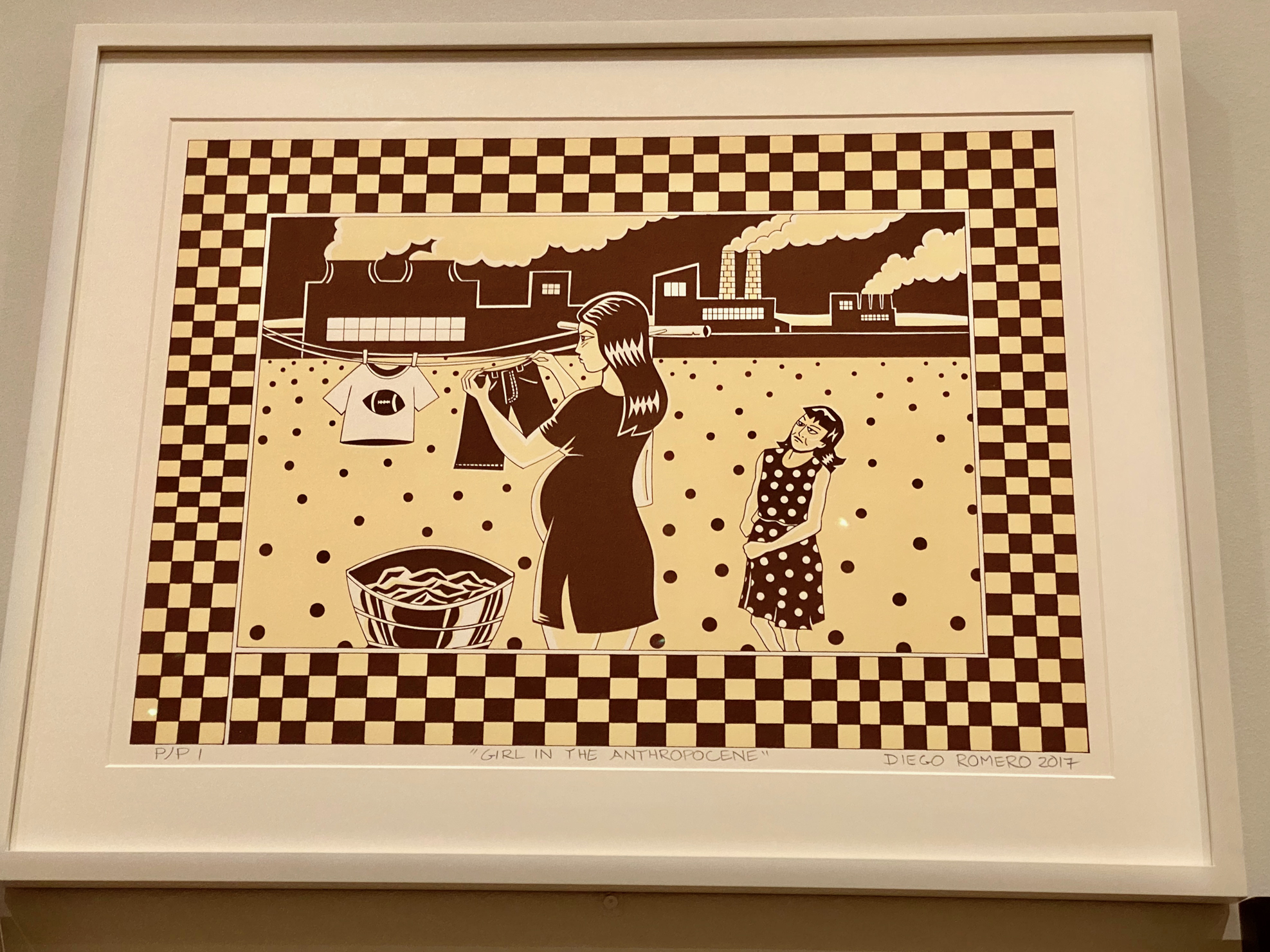
Some artists mix impressions of modern life with tribal lands, such as satiric works by Diego Romero (Cochiti Pueblo) and stylized symbols in a monoprint by Joe Fedderson (Colville Confederated Tribes).

2017 lithograph Girl in the Anthropocene by Diego Romero (Cochiti Pueblo). Private collection

In addition to sculptures, paintings, and photos, Smith has also included pieces made for fashion runways, live performances, and social protests.

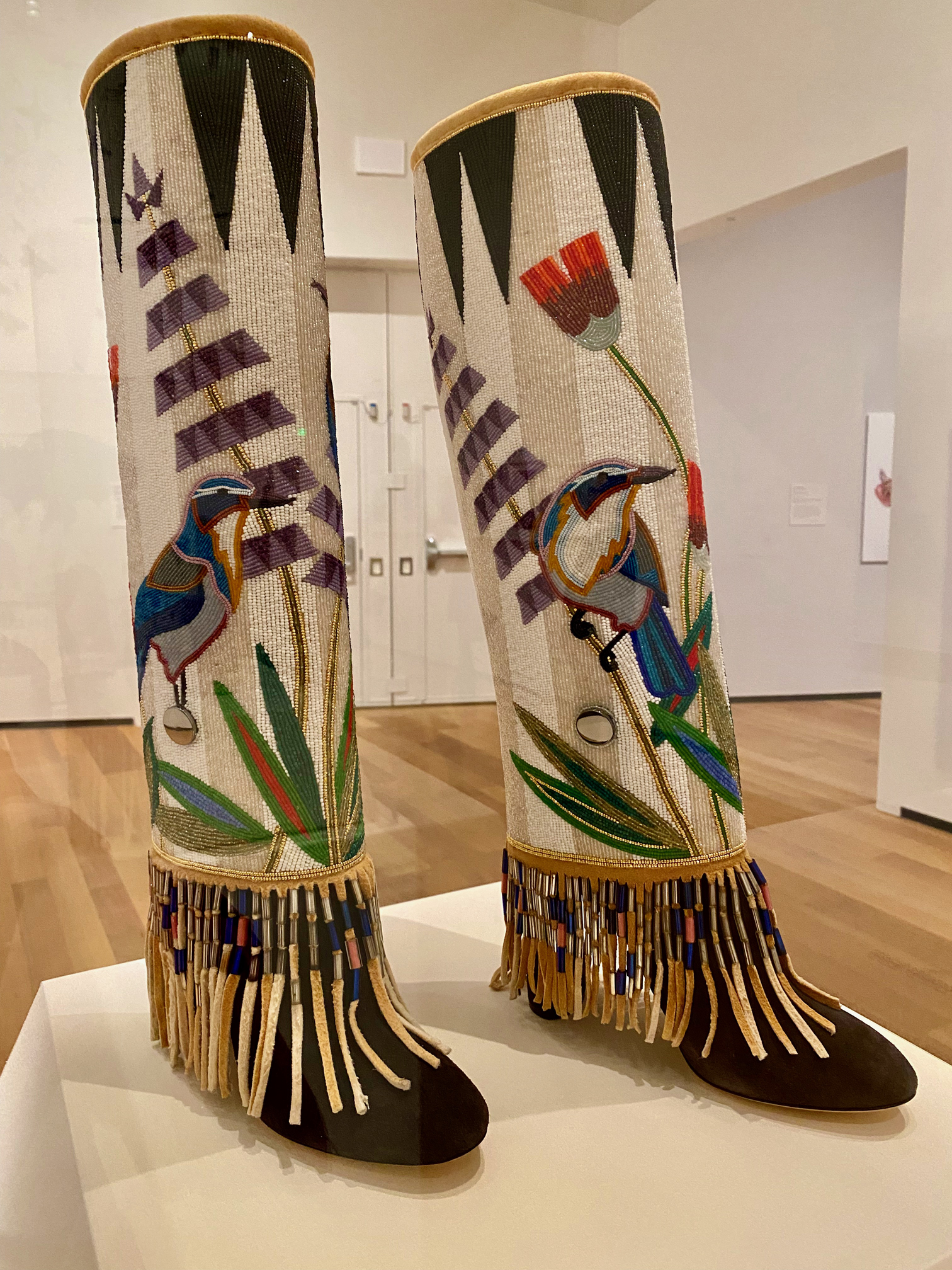
Fashion designer Jamie Okuma (La Jolla Band of Luiseno Indians) beaded her fringed fashion boots with a portrait of her family’s pet scrub jay.

Ten foot-long fiber seashell earrings designed for an interactive video and gallery performance by fiber and performance artist Eric-Paul Riege (Diné) are a reminder of the ancient trade networks that brought trade items from the ocean to the interior deserts.

2021 beaded and fringed Casedei boots by Jaime Okuma (La Jolla Band of Luiseno Indians). Courtesy: Dartmouth College’s Hood Museum
2020 mixed-fiber installation jaatloh4Ye’iitosoh [3-4] by Eric-Paul Riege (Diné). Courtesy: Tia Collection.

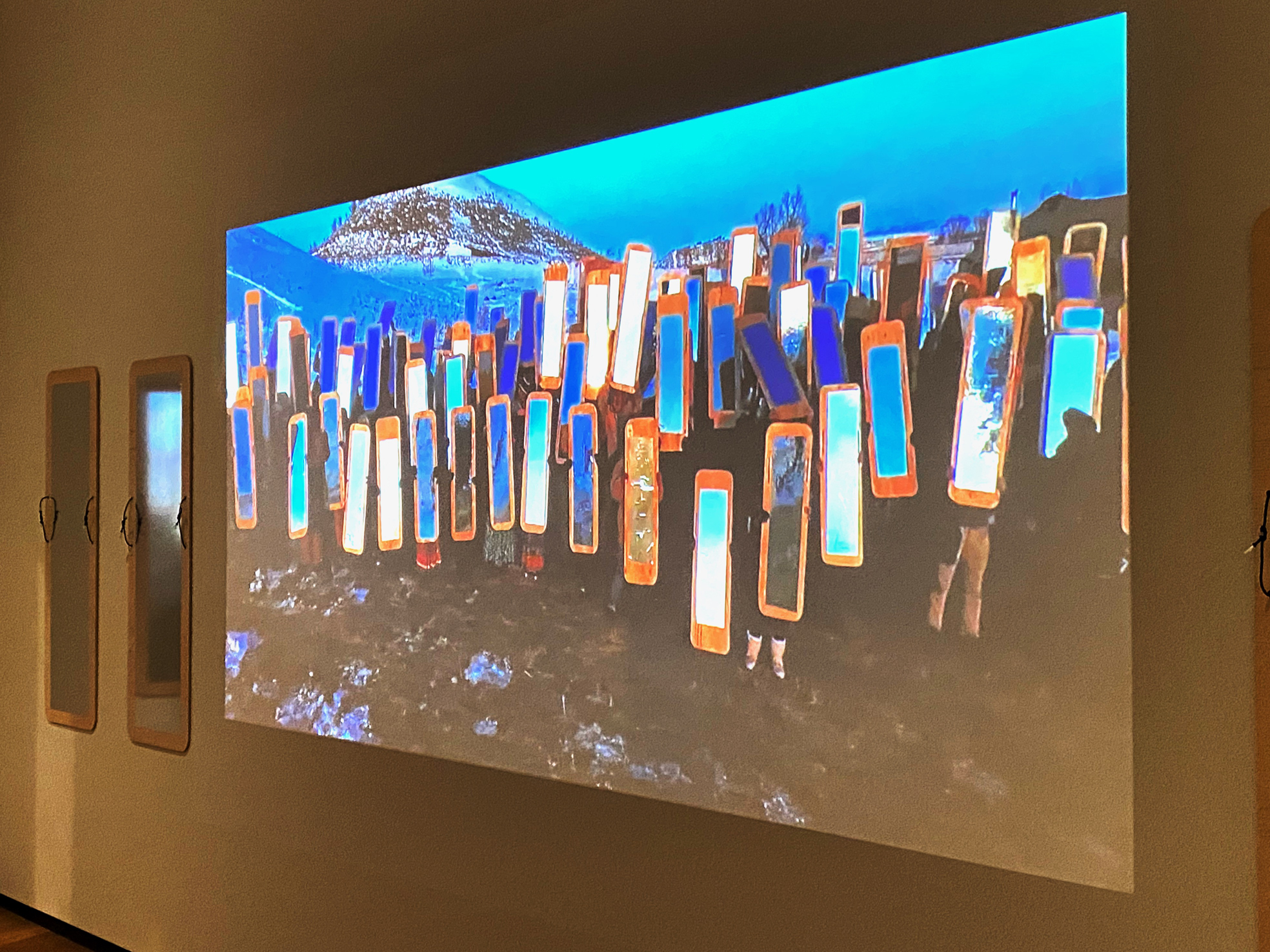
A wall of “mirror shields” were mounted by artist-activist Cannupa Hanska Luger (Mandan/Hidatsa/Arikara/Lakota), showing just a small sample of the 1,000 protective and reflective shields made by people to help water protectors during thre 2016 pipeline intervention at Standing Rock Sioux Tribe Reservation, Luger’s childhood home. Take a look at Luger’s instruction video here.

The shields served to protect the peaceful protesters from rubber bullets and water cannons, and reflected images of the security forces back to them. The crowd-sourced shields were also used in a social-action performance piece at Standing Rock.

2016 mirror shields and video for Mirror Shield Project – River (The Water Spirit) by Cannupa Hanska Luger (Mandan/Hidatsa/Arikara/Lakota). Courtesy: the artist, Garth Greenan Gallery.

Textiles and vinyl drawings also pack a punch in this show. Take a look at the dazzler woven by Melissa Cody (Diné), who draws inspiration from video gaming and the matriarchs of Navajo Nation. Watch her interview from her recent exhibition at MoMA PS1.

Here, John Hitchcock explains how his room-sized drawing, Impact vs. Influence, incorporates his influences – nature, family, Native beadwork, and the next-door military base:

Take a look the National Gallery’s trailer and meet the 50 contemporary artists whose work and relationship to the land is celebrated in the show:

Out West in New Mexico

The artist stories and works presented in Out West: Gay and Lesbian Artists in the Southwest 1900-1969, at the New Mexico Museum of Art through September 2, 2023, shed light on artists who lived a bit more “under the radar” in the early 20th century, compared to the post-1969 era when loud and proud artists unleashed their voices in response to the Stonewall Riots.

The exhibition focuses on how early modernists used “coded” symbols in their work, explores the legacies of two-gendered Native American artists, and introduces mid-century work by mid-century contemporary artists working.

Marsden Hartley’s 1919 still life El Santo, featuring Hispanic Catholic objects of northern New Mexico.
Russel Cheney’s 1929 New Mexico/Penitente showing a bulto, axe, and flowers associated with the Penitente brotherhood.

Take a look at our favorites in our Flickr album.

The show opens with works by Marsden Hartley and Russell Cheney – painted 10 years apart (1919 and 1929) that feature items associated with rituals by Northern New Mexico’s Penitentes – Catholic men’s associations that kept faith alive during the 19th century when clergy were scarce in their remote mountain towns.

Hartley and Cheney were captivated by the religious rituals of these mysterious, faithful “brotherhoods” that persevered for centuries, despite periodic bans by New Mexico’s Catholic Church – not unlike the early 20th century gay men’s associations whose underground culture gave rise to “coded” rituals and language.

Hence, these works feature images of the suffering Christ, yucca plants used for self-mortification rituals, adobe churches, and props associated with processional death carts – symbols of religious brotherhood that represent the importance of brotherhood among the early 20th century gay community.

The second portion of the show introduces us to the many painters, photographers, and sculptors who not only drew artistic inspiration from the Southwest, but found communities that welcomed gay and lesbian artists. Works by artists, such as Agnes C. Sims and Cady Wells, are paired with portraits by a Southwestern who’s who of modern portraiture and photography – Will Shuster, Laura Gilpin, Ansel Adams, and Anne Noggle.

Modernist Deer Dance cedar sculptures carved in 1945 by Agnes C. Sims, a tribute to native cultures
Laura Gilpin’s 1942 photographic portrait of artist Agnes C. Sims

There’s even a “portrait” stitched by maverick Cady Wells of his very best friend, modernist Rebecca James. Well known for his expressionist paintings and his large collection of Northern New Mexican religious art, Wells subversively went all in on petit-point – an art form traditionally associated with “women’s work” and beloved by Ms. James.

Detail of 1953 petit-point stitchery “portrait” of Rebecca S. James by her friend, Cady Wells – his work in a traditional “feminine” genre of craft.
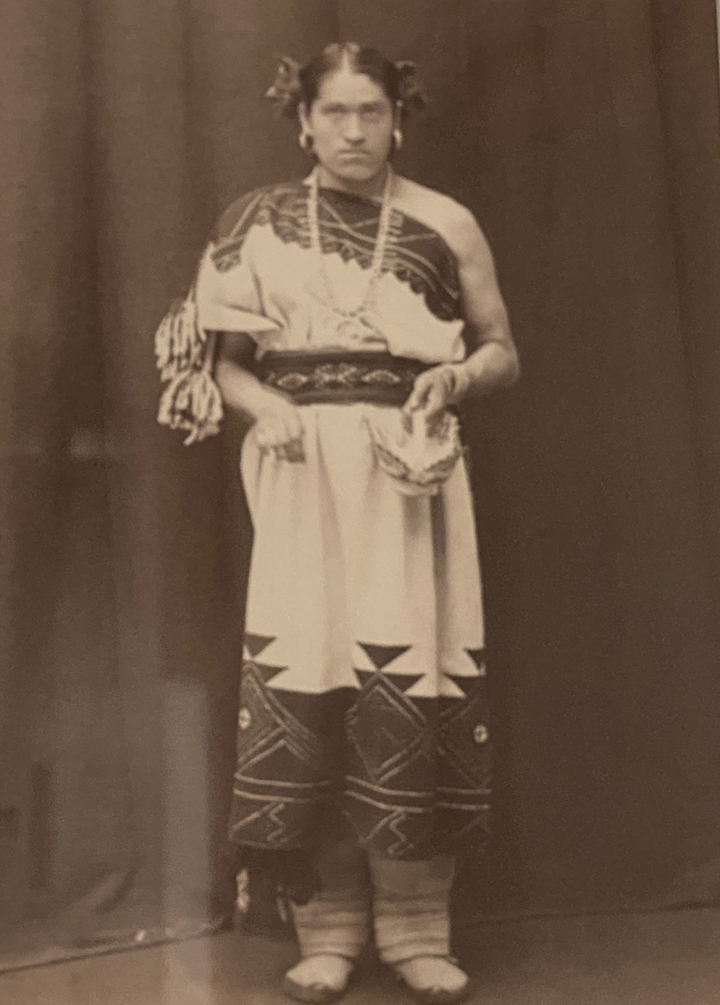
John K. Hillers’ 1879-1880 albumen portrait of Lahmana We’wha of Zuni Pueblo. Courtesy: Palace of the Governors Photo Archive.

This section also includes the stories of important two-spirit Native American artists – individuals who are born “male” but who take on spiritual and other tribal roles traditionally associated with women. The first is We’wha, a respected 19th-century expert in and advocate for Zuni arts and traditions– a favorite of Smithsonian anthropologists who demonstrated weaving in D.C. and even presented a special work directly to President Grover Cleveland as a wedding gift.

Another is R.C. Gorman’s portrait of Hosteen Klah, a Navajo two-spirit, one of the the Wheelwright Museum’s co-founders. Gorman, one of the best recognized and flamboyant 20th century contemporary Native artists, excelled in colorful mid-century works. Gorman made history in Taos by opening the first Native-owned gallery in the United States.

Navajo artist R.C. Gorman’s 1960 painting Night of the Yei – a celebration of Navajo spiritual traditions.

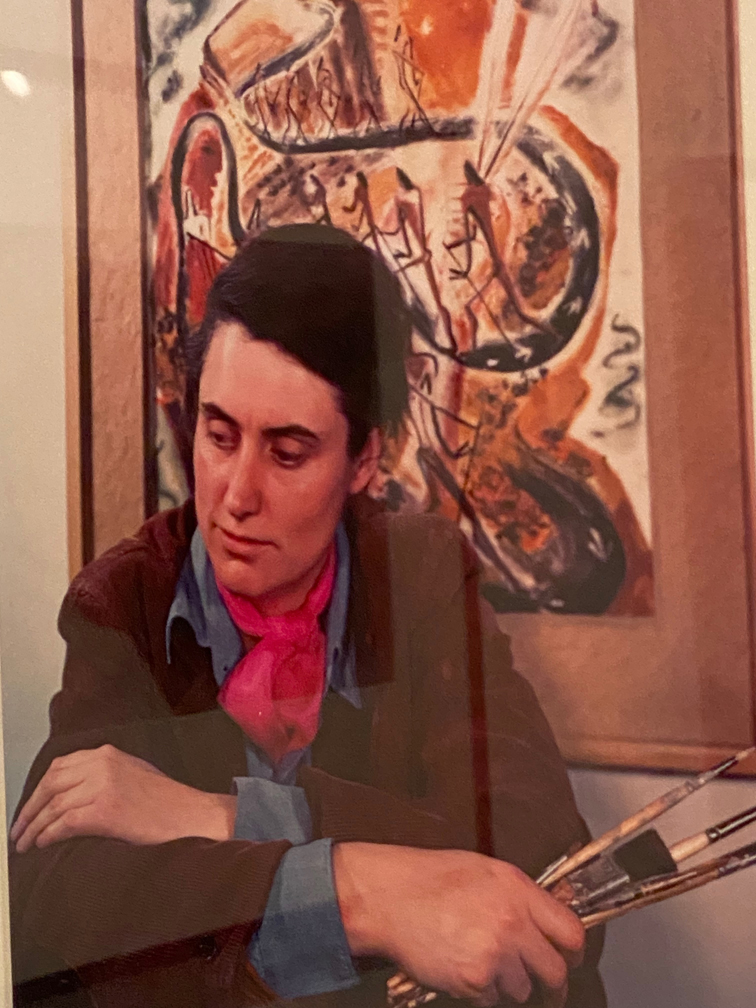
The final portion of the show includes two works by female rule-breakers. The first is a rare Agnes Martin 1954 abstract-expressionist work typical of her experimentation prior to her acclaimed grid series. It’s much more aligned to the biomorphic symbolism of early Pollack and Rothko – reflecting what was happening earlier in her New York career during the heyday of the Cedar Street Tavern crowd.

Agnes Martin’s untitled 1954 painting. Courtesy: University of New Mexico Art Museum.

Second ia a never-before-seen 1997 installation by feminist-art innovator Harmony Hammond, who was also represented in this year’s Whitney Biennial. Hammond, who curated one of Santa Fe’s first LGBTQ exhibitions back in 1999, used to travel backroads of the Southwest, finding abandoned towns and homesteads and collecting left behinds. In this show, she presents What Have You Done With Our Desire, a mixed-media piece using ancient kitchen linoleum – an allusion to circumstances leading to repression of gay women’s sexuality.

Harmony Hammond’s never-before-seen 1997 mixed-media installation What Have You Done with Our Desire. Courtesy: the artist.

For more about these and other artists, listen to curator Christian Waguespak’s talk about LGBTQ artists in the Southwest at the Harwood Museum in Taos.

Why Do People Like Folk Art So Much?

It wasn’t a scientific survey, but Santa Fe’s Museum of International Folk Art asked each museum staff member to select a favorite piece from the collection, explain why, and then mounted an entire exhibition about the love of folk art – Staff Picks: Favorites from the Collection at MoIFA through August 18.

Everyone knows about the 10,000 objects displayed in the museum’s Girard wing, but MoIFS houses over 150,000 additional works from over 100 countries. Given the vast scope of the collection, how did everyone choose one special item to be featured in the show?

2010 Alligator with Ice Cream carved by Joe Ortega of Tesuque, New Mexico welcomes everyone to the exhibition.

Some of the security staff remembered works from past shows that they loved, and some working in the collections had favorites hidden in the archives. To make it a little easier, the exhibitions team divided the task up into different regions of the world (to give a sense of the global extent of the collection), and asked some colleagues to pick a specific region, including the folk-art rich environs of Northern New Mexico.

1960 Noah’s Ark by Chimayo, New Mexico carver Jose Mandragon – an inspiration to take an adventure.

So why did different staff members choose what they did? The exhibition (and our Flickr album) states the reason that each was selected.

Sometimes a painting, sculpture, or necklace reminded them of places they’ve visited or cultures they loved – like the painting that evoked the tropical vibe of rural Cuba by Joe Ortega, or the cart direct from a colorful folk festival in Sicily, or intricate, bejeweled work from artists of Nepal in the high Himalayas.

2014 painting San Lazaro by Cuban artist Luis Rodriguez Ricardo.

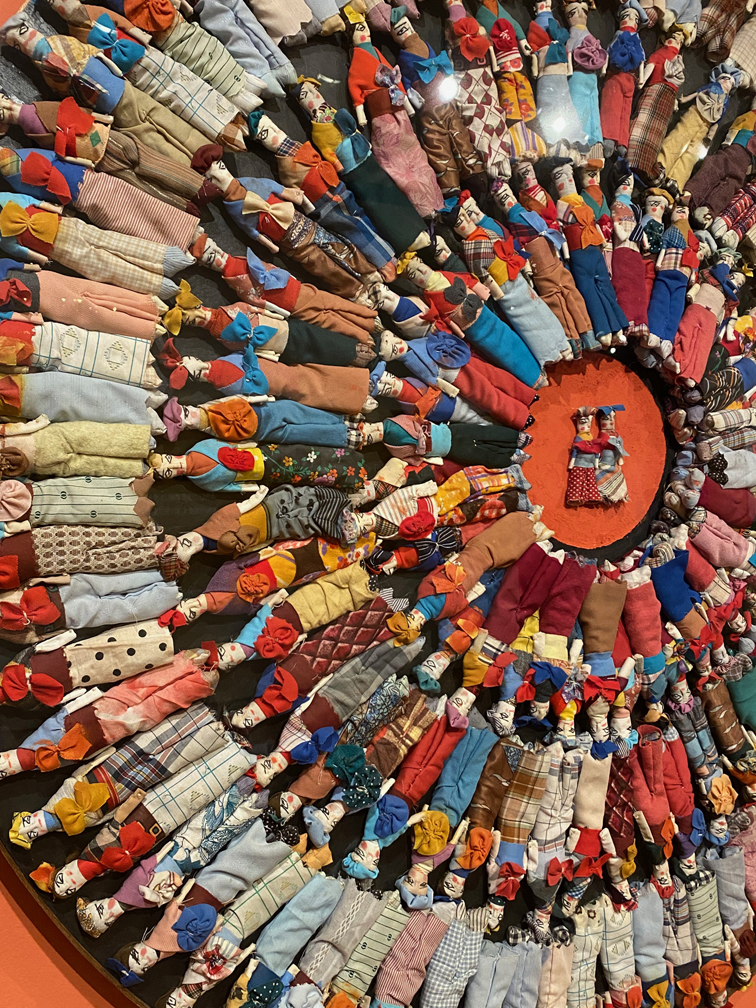
And who doesn’t love work that is pure whimsey and telegraphs sheer joy? Several staff members said they couldn’t resist works that just made them smile – the whimsical alligator sitting above the entry with his huge tri-color ice-cream cone, the recycled robot from California relaxing in his lounge chair with a drink in hand (summer fun!), and a super-happy circle of tiny Ecuadorian dolls, dolls, dolls!

Close-up of Ecuadorian artist Osvaldo Viteri’s 1980 doll sculpture Se Nos Cayo La Luna Para Amar La Tierra (The Moon Fell So We Could Love the Earth).
BoBo bu Ko, a 1994 recycled materials sculpture by Alameda, California artist James Bauer

Sometimes you just have to stand back and admire the sheer determination, precision, and willpower of a particular artist. How did Rhode Island artist Henry Patrick Neugent collect and take apart all those cigar boxes and create two intricate tramp art cabinets with secret compartments?

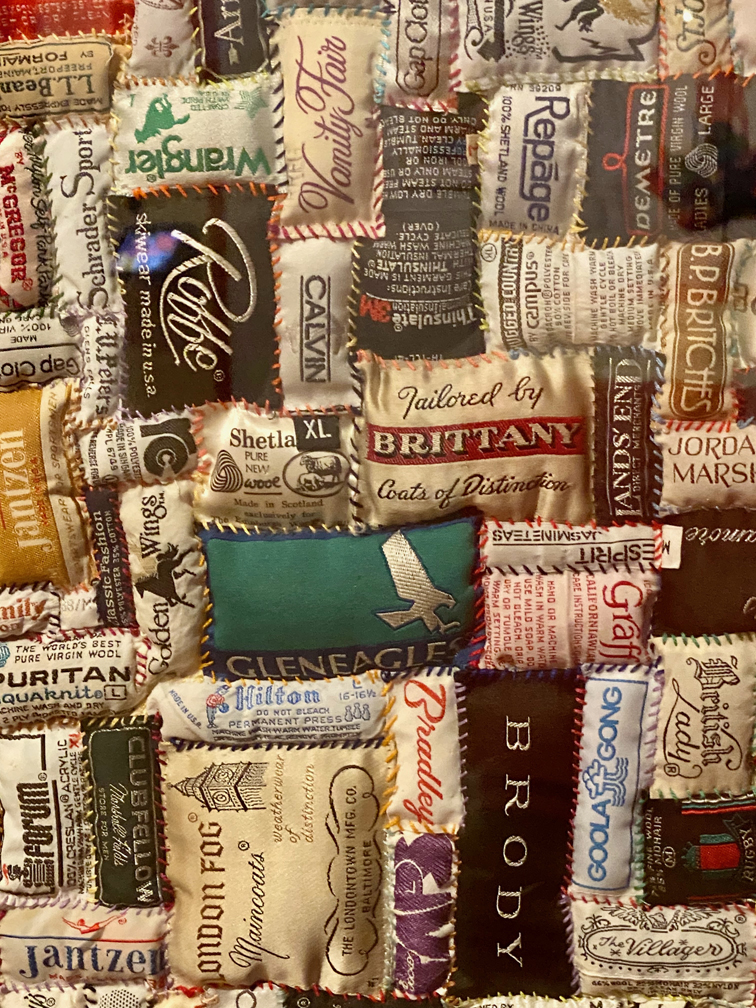
And what about the gigantic quilt made by New York textile artist Susie Brandt – she removed zillions of tiny tags from vintage shirt collars and jacket breast pockets and worked them into a log-cabin sort-of pattern. You could spend hours just reading and reflecting on the memories behind those tags – Jordan Marsh, B.P. Britches, and old Wrangler or L.L. Bean tags.

Top of early 20th century tramp art whimsey table from cigar boxes by Portsmouth, Rhode Island artist Henry Patrick Neugent
Detail of large quilt Sleep Product made of garment labels collected by New York artist Susie Brandt in 1986-1989.

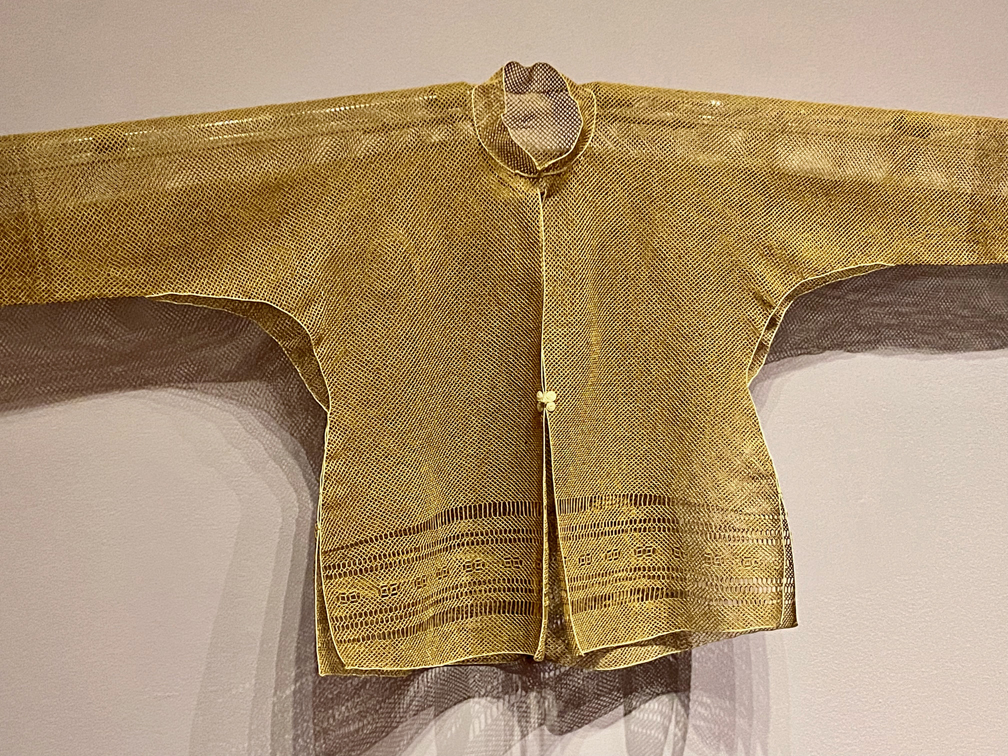
One collections manager picked hers for the sheer technical genius.  Check out the 19th century Chinese undershirt designed to keep you cool under the heavier, decorated silk robes. It’s woven in a clever, open diamond pattern from bamboo and cotton!

Innovative “cooling” 19th century Chinese bamboo and cotton undershirt.

An anthropologist on the team paid tribute to craft excellence is carried on generation to generation in North Carolina’s historic ceramic-making communities. She selected two pots by a father and son – Matt Luck’s corncob-stopper jug and a show-stopping double-faced jug created by his dad, Sid Luck (a fifth generation Seagrove potter), to commemorate the experience of living through Hurricane Fran.

The museum’s director selected a Zimbabwe thumb piano sheerly for its beautiful sound!

Two generations of Seagrove NC potters – Matt Luck’s 2012 pot with corncob stopper and Sid Luck’s 1996 double-faced jug
1992 thumb piano (mbira of the ancestors) made by a Shona artist from Zimbabwe.

The show is a tribute to the teamwork it takes to welcome the world to a popular folk-art destination and a delight to behold. A selection of these works will be on display at New Mexico’s Roundhouse in the Governor’s Gallery through April 25, 2025.

Take a Google walk through MoIFA’s massive Girard Wing here.

How Philadelphia Made American Artists

How does it feel to have the eyes of 200 years of art history upon you, peering out from portraits, history paintings, and scenes of everyday people? What stories do they have to tell you? And who gets to tell the history and make the story?

Find out by contemplating works by over 100 artists nurtured and celebrated by PAFA in Making American Artists: Stories from the Pennsylvania Academy of Fine Arts, 1777-1976, currently on view at the Albuquerque Museum through August 11, 2024…but coming soon to a museum near you (see below)!

Charles Willson Peale’s 1779 George Washington at Princeton, painted during the War of Independence. Courtesy: PAFA

While renovations are happening at the Academy in Philadelphia, the curators have chosen some of PAFA’s most iconic works to be shipped cross-country and installed “in conversation” with works by PAFA artists who may not be household names but were nonetheless ahead of their time.

It’s all a tribute to legacies preserved in the oldest art museum + art school in the United States, founded in 1805 by the dynamic duo of William Rush and Charles Willson Peale, both Continental Army militia (and artists!) during the American Revolution.

1810 painted pine sculpture Eagle by PAFA co-founder and Revolutionary War veteran William Rush.

Mr. Rush carved the bow figures on most of the ships for America’s first Naval fleet. All of those ships are now long gone, so it’s nice to see that we can admire his majestic Eagle in this exhibit.

Mr. Peale, one of the Sons of Liberty who served under and painted General Washington, later founded America’s first natural history museum on the second floor of Independence Hall. He also passed his talent on to the next generation through his very large family of artistic prodigies.

These two artists of the Revolution walked the walk and talked the talk and passionately felt the young nation needed an art academy.

PAFA’s first hundred years had some ground-breaking firsts – the first exhibition that included both male and female artists (1811), admission for Black artists (1857), and first female instructor (1878).

Charles Willson Peale’s 1822 self portrait (painted at age 81), The Artist in His Museum proudly showing his collection, turkey, and mastodon. Courtesy: PAFA

The show kicks off with a masterful history painting by Benjamin West, a Pennsylvania painting genius who landed in England in 1763, helped to found the Royal Academy, and somehow remained best friends with both King George III and Benjamin Franklin at the same time. He revolutionized history painting by depicting contemporary subjects and taught (in London) a who’s who of Americans artists – Peale, Stuart, Sully, Morse (who invented the telegraph and code), and Fulton (who invented steamships).

Benjamin West’s 1771-1772 Penn’s Treaty with the Indians, an imaginary scene painted to rehabilitate Penn’s image at the time, although it does feature Lenape chief Tamanend;. Courtesy: PAFA

In addition to masterworks by West and Gilbert Stuart, the exhibition showcases many works by female and African-African artists associated with PAFA – Patience Wright (America’s first professional sculptor), Cecilia Beaux (first female teacher), Henry O. Tanner (first successful African-American painter), and superstar Mary Cassatt.

1784-1786 wax relief portrait of George Washington by Patience Wright, the oldest American sculpture in the PAFA collection
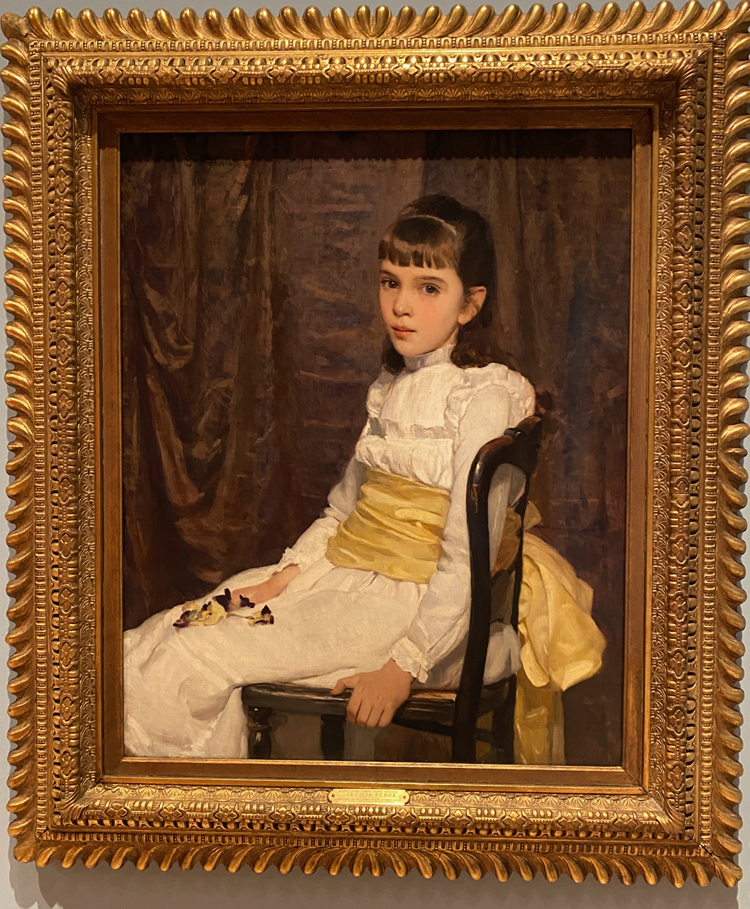
1887 A Little Girl by Cecilia Beaux, an acclaimed female portraitist known for her insightful psychological depictions of young women. Courtesy: PAFA

In the day, grand history paintings were primarily the work of men, but the exhibition emphasizes that many enterprising 19th century women still found ways to make it in the art world. They specialized in “lesser genres,” like portraits, still lifes, and scenes of everyday life. Check out our favorites in our Flickr album.

Making American Artists really comes alive by adding 20th century works on the walls. Alongside the Founding Fathers, the portrait section features liberated women, bohemian artists, and proud Black artists with attitude.

Margaret Foster Richardson’s 1912 A Motion Picture – an honest self-portrait reflecting society’s changing views of professional women. Courtesy: PAFA
Barkley L. Hendricks’ 1968 J.S.B III, a fashionable, life-sized, postmodern portrait of his PAFA classmate James Brantley. Courtesy: PAFA

The section of the exhibition on still life focuses on early female painters who made decent incomes from their work, as well as modernist superheroes O’Keeffe and Nevelson. The history painting section presents 20th century show-it-like-it-is artists, like Horace Pippin and Alice Neel.

Georgia O’Keeffe’s 1923 Red Cana, an early abstracted floral still life. Courtesy: PAFA
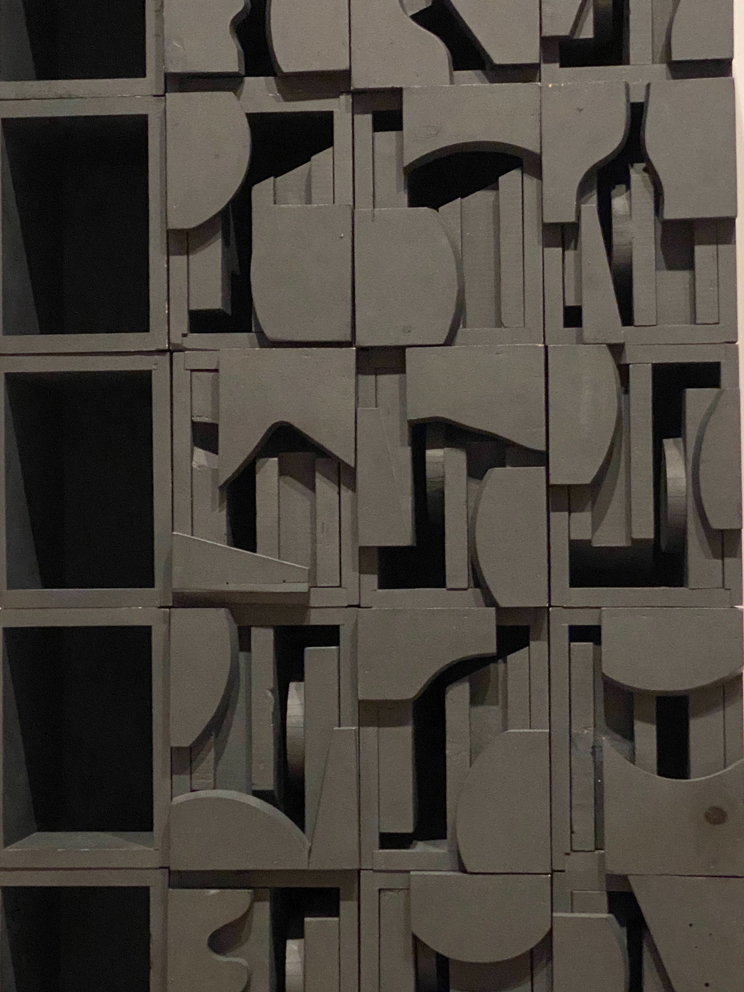
Detail of Louise Nevelson’s 1972 South Floral. Still life section. Courtesy: PAFA

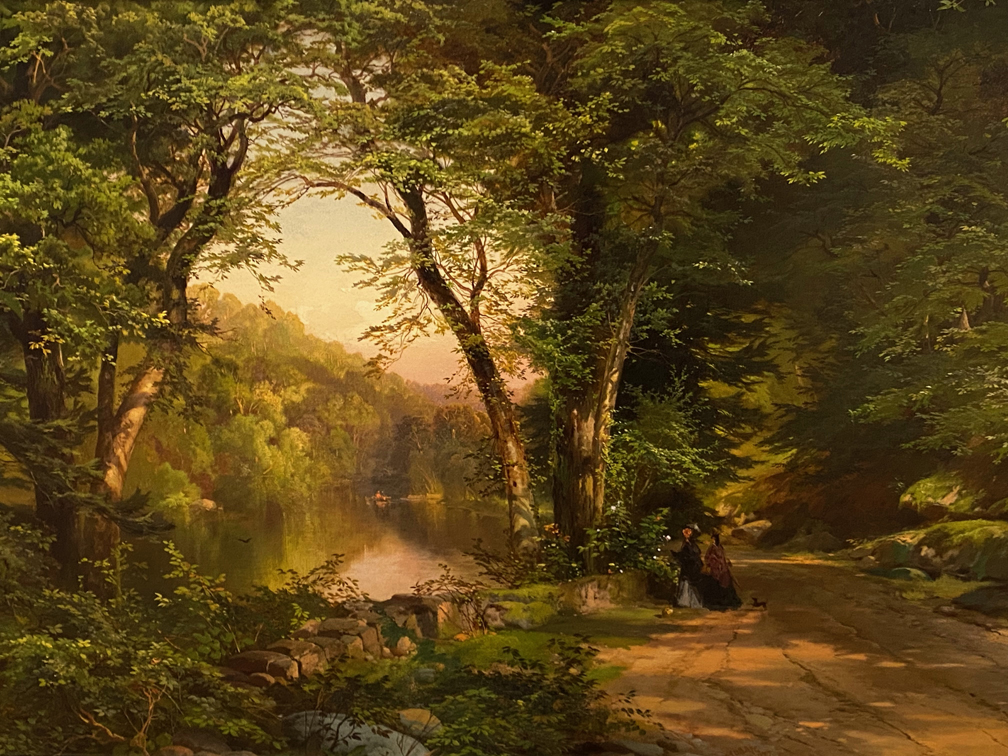
We’re reminded that many of the great masters of American landscape, like Thomas Moran, got their starts by painting bucolic views of Philadelphia’s Wissahickon and Schulkyll Rivers. Painting Philadelphia’s river landscapes may have even inspired the rise of the Hudson River School.

Thomas Moran’s 1870 Two Women in the Woods enjoying the green along the Wissahickon in Philadelphia. Courtesy: PAFA

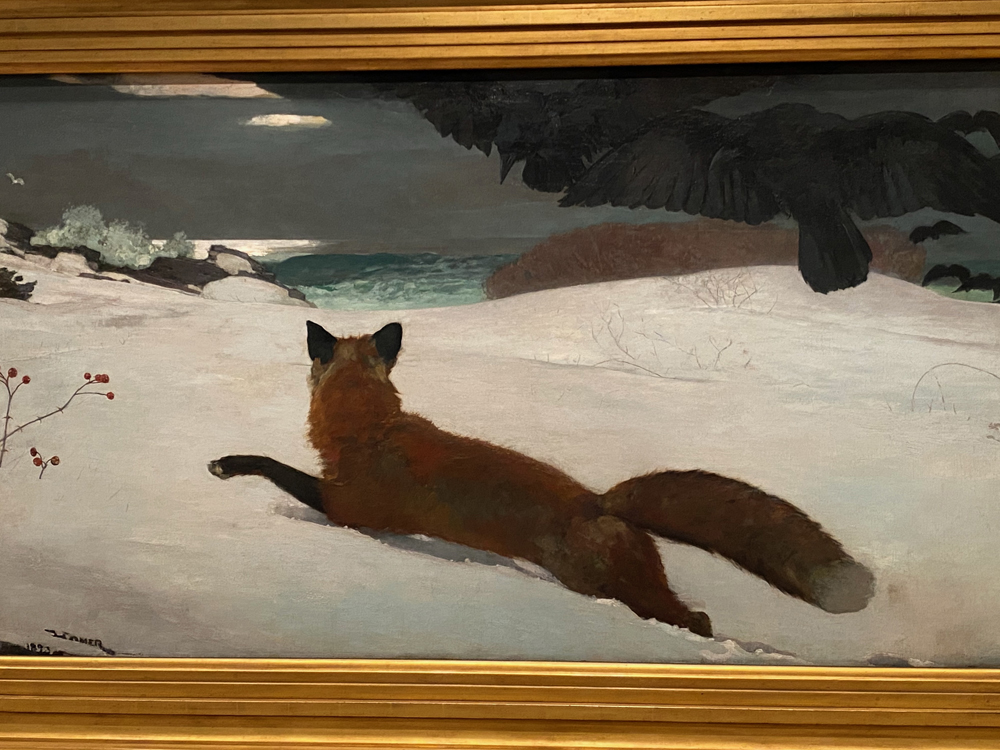
And it was PAFA that gave Winslow Homer his professional start.

Winslow Homer’s 1893 Fox Hunt, where predator becomes the prey; Homer’s first painting to enter a museum collection. Landscape section. Courtesy: PAFA

The entire exhibition is a fresh look at American masters who created an astonishing legacy at one of our oldest art institutions ­and upstarts who never quite got their due. There’s so much to appreciate from this fresh, 21st century perspective!

Earlier this year, Making American Artists was at the Wichita Art Museum. Its next stop is the Philbrook Museum of Art in Tulsa, Oklahoma (September 25, 2024), followed by a spectacular road show: Everson Museum of Art in Syracuse (February 2025), the Peabody-Essex in Springfield, Massachusetts (June 2025), and the Taubman Museum of Art in Roanoke, Virginia (October 2025).

Don’t miss it. While you’re waiting, listen in to curator Anna O. Marley’s May talk at the Albuquerque Museum:

How O’Keeffe Saw Trees

Whether she contemplated her surroundings among the greenery at Lake George or the multicolord rocks at Ghost Ranch, Georgia O’Keefe often started by sketching the trees around her.

in Rooted in Place, a special exhibit at the Georgia O’Keeffe Museum in Santa Fe through November 3, 2024, you are surrounded by Georgia’s watercolors, oils, and sketches interpreting (and abstracting) trees she encountered on her walks and international travels.

Take a look at our favorites in our Flickr album.

Georgia’s 1937 painting Gerald’s Tree I, a tree enjoyed by her friend, science historian Gerald Heard

The curators have selected works from the full span of Georgia’s life. The earliest are from her trips to Lake George, such as the glorious autumn maples surrounding the Stieglitz home.

The show’s curators leverage Georgia’s habit of collecting inspirational bits and pieces of nature from her Ghost Ranch walks, showing the twisted juniper she brought home alongside the dramatic oil painting in which it stars.

Piece of juniper that Georgia collected from the land surrounding her Ghost Ranch home.
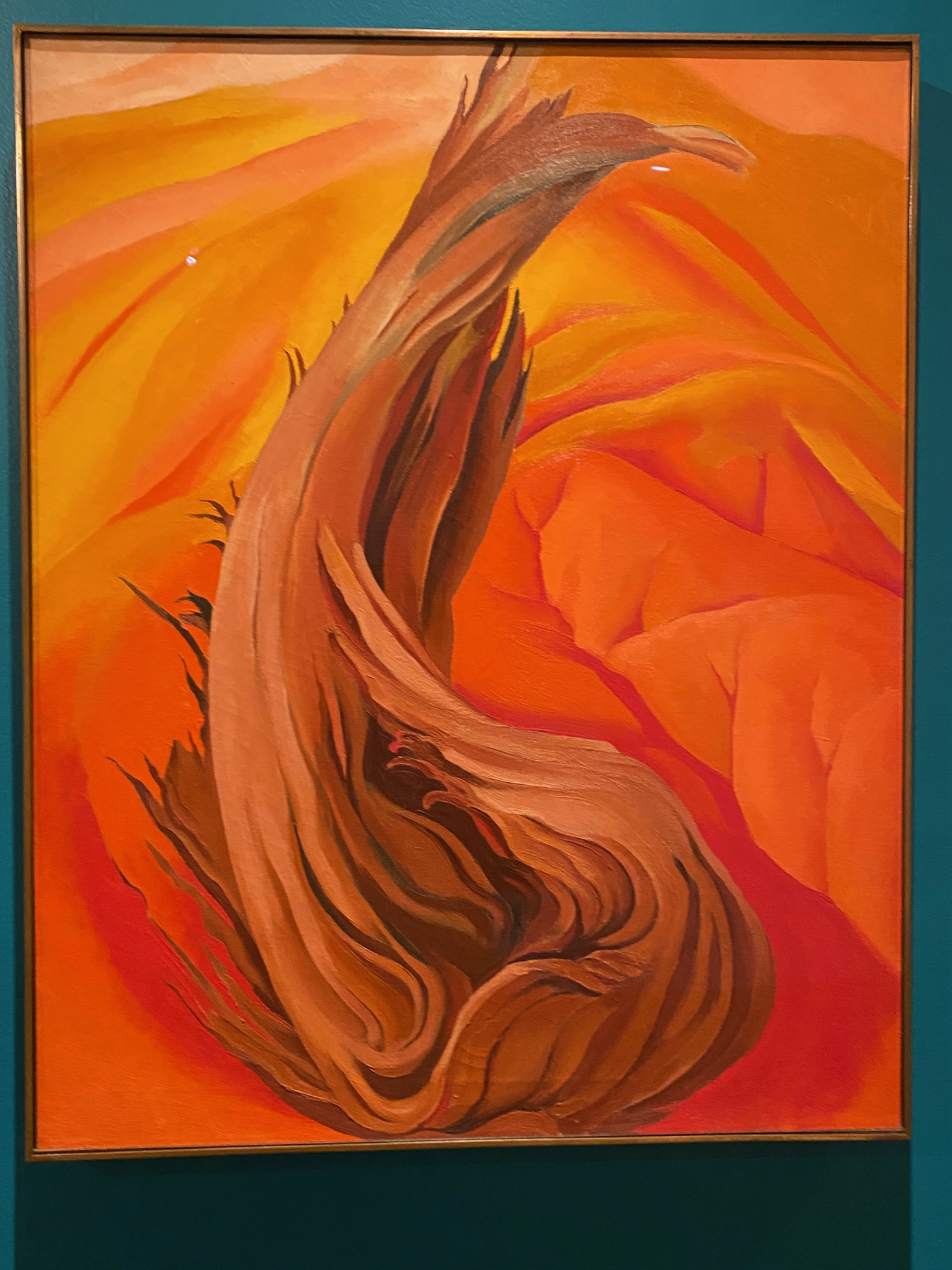
Georgia’s 1940 painting Stump in Red Hills

The museum’s collaboration with the Santa Fe Botanical Garden adds scientific insights about the three cornerstone species of New Mexico wilderness that from which Ms. O’Keeffe drew inspiration – pinons and junipers next to the red rock, and wide, leafy cottonwoods along the river.

Georgia’s 1930 Cottonwoods Near Abiquiu showing the breeze catching the wide branches

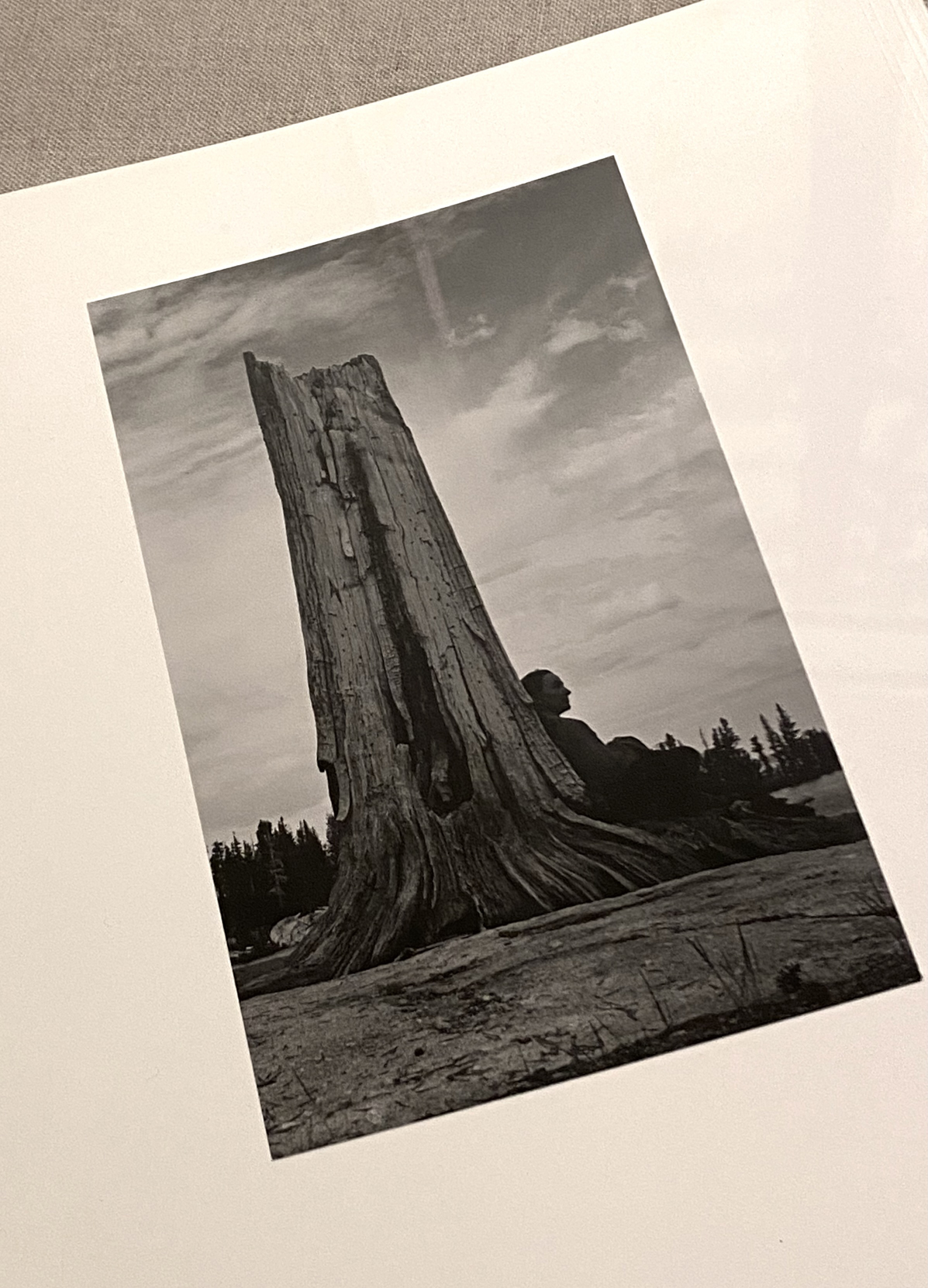
A gorgeous photo by Ansel Adams shows Georgia nestled up against one of her favorites nearby in the desert. She loved the fruit trees she planted near her home garden, but she never painted them.

When Georgia was a young student at the Art Institute of Chicago in 1905-1906, she studied with John Vanderpoel, well known for being a master educator in figure drawing. Looking at her drawing of a banyon tree from her trip to the Bahamas over thirty years later, it’s clear she employed those early lessons – bringing trees to life as living beings in her work ­– throughout her life.

Ansel Adams’1938 portrait of George O’Keeffe resting against a dramatic tree stump in northern New Mexico
Georgia’s 1934 figure-like drawing Banyon Tree created on her trip to Bermuda

Listen to the museum’s panel about Georgia’s approach to painting her favorite trees and the role they play in the ecosystem of northern New Mexico:

Past and Future of Santa Fe’s Indian Market

There’s no better way to see the best of the best at the Santa Fe Indian Market than to visit the remarkable retrospective assembled at the New Mexico History Museum in their honorary centennial exhibition, Honoring Tradition and Innovation: 100 Years of Santa Fe’s Indian Market, 1922-2022, on view through August 31.

The curators have gathered loans from private collections, museums, individual artists, and big-name galleries to give visitors a decade-by-decade chronicle of the people, families, maker innovations, and contemporary-art trends that converged to showcase works from one the most exciting confluences of creativity in the United States.

Santa Clara artist Nancy Youngblood’s 2018 polished pottery jar (best of pottery category award), granddaughter of Margaret Tafoya. Courtesy: private collection.

The items in the show – traditional pots, dazzling Navajo weavings, whimsical figurines, elaborately embroidered accessories and clothing, social-commentary photos and paintings – are so compelling that it takes two or three visits to actually focus on the thoughtful, illuminating text that accompanies each portion of the show.

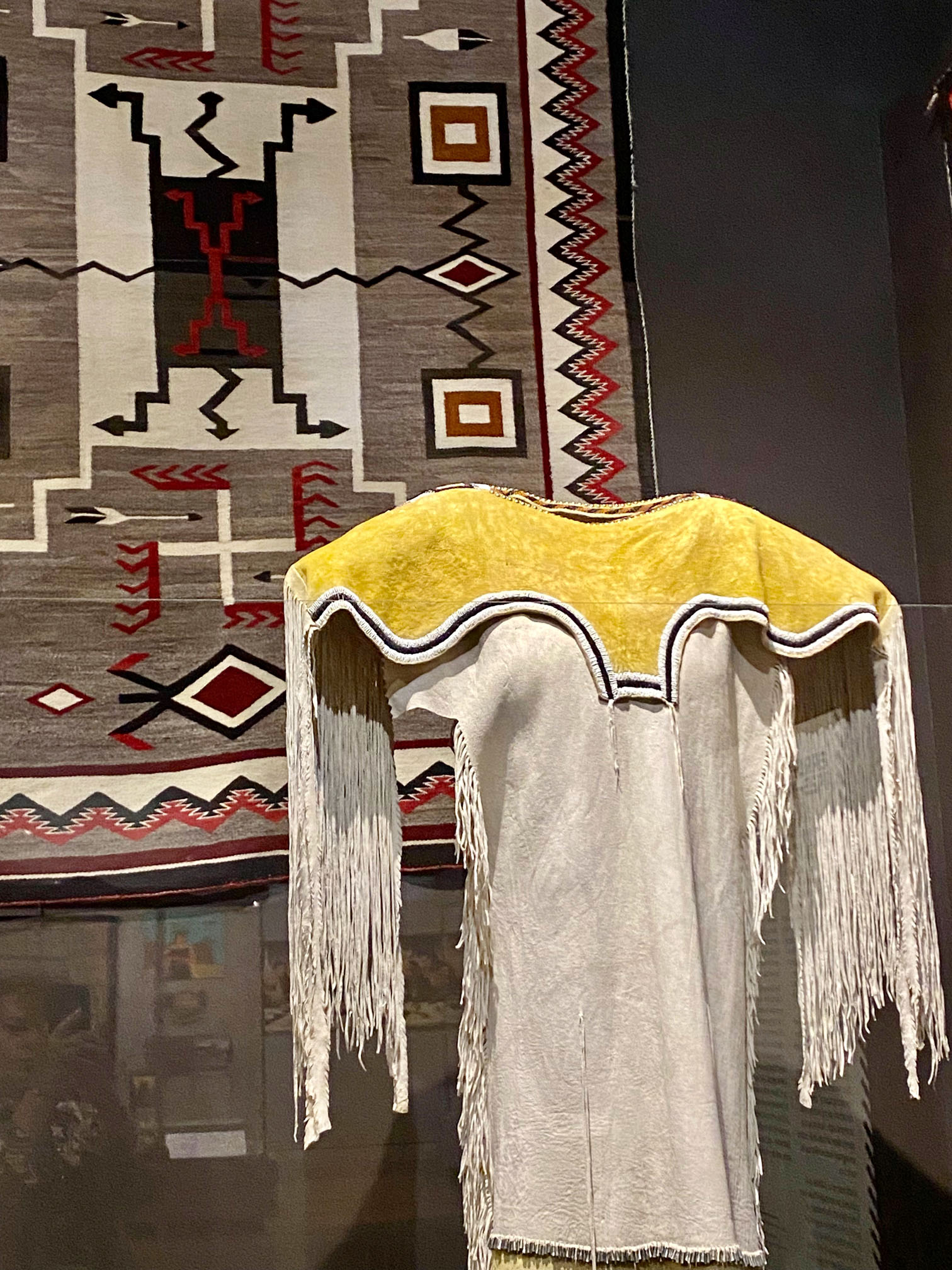
Embellished 1890 buckskin Apache/Ute dress; behind, a 1925-1930 Navajo rug. Courtesy: Cowboys and Indians Antiques, Historic Toadlena Trading Post Museum.

The organizers have provided a revealing chronology of the politics, economics, and social context of each decade of the arts festival, noting changes in the people, processes, power, and patronage over time.

The first gallery brings you back to the earliest days of the market – a time when there were no Indian curators or judges (unlike today!) and when Native makers were not even allowed to sell their own work or interface directly with non-Native buyers. 

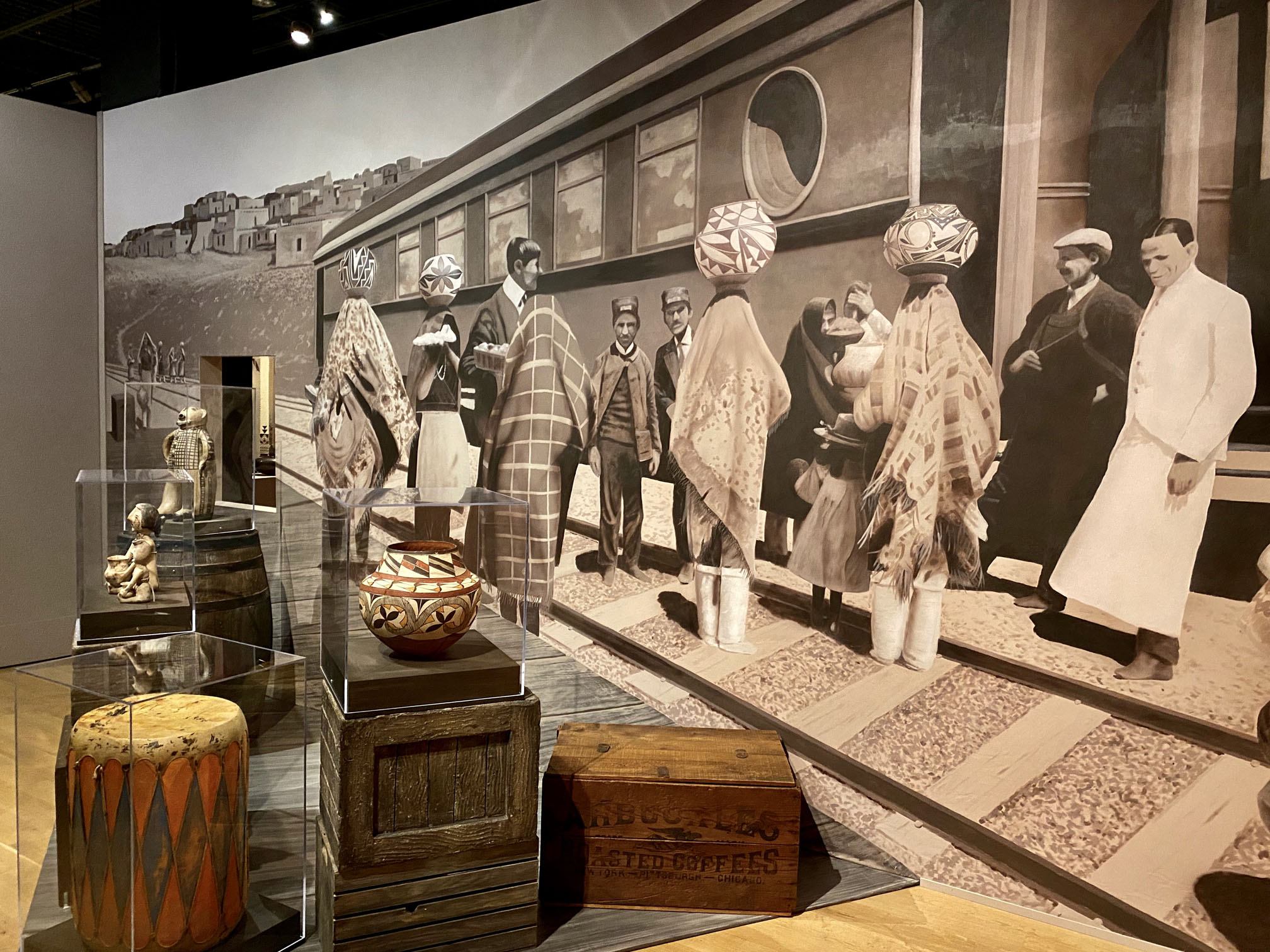
The wall mural harkens back to the days when Pueblo people sold their pots and creations to tourists along the railroad, which in the late 1890s and early 1900s brought curious travelers, East Coast dandies, and traveling showpeople out to the Western badlands.

David Rock’s mural with early Native-made collectibles – early 1900s pottery and 1920s drum.

Turn-of-the-century tom-toms, curios, and older pots are displayed near the rail-top mural; Navajo rugs and beaded moccasins from the period are arrayed across the way. It’s an arrangement that evokes what might be displayed in an old trading post, or at least in the early 1920s Santa Fe markets.

Many of these makers in New Mexico were still living on their ancestral lands, but across the United States, the majority of Indigenous populations had either been relocated to reservations or boarding schools.

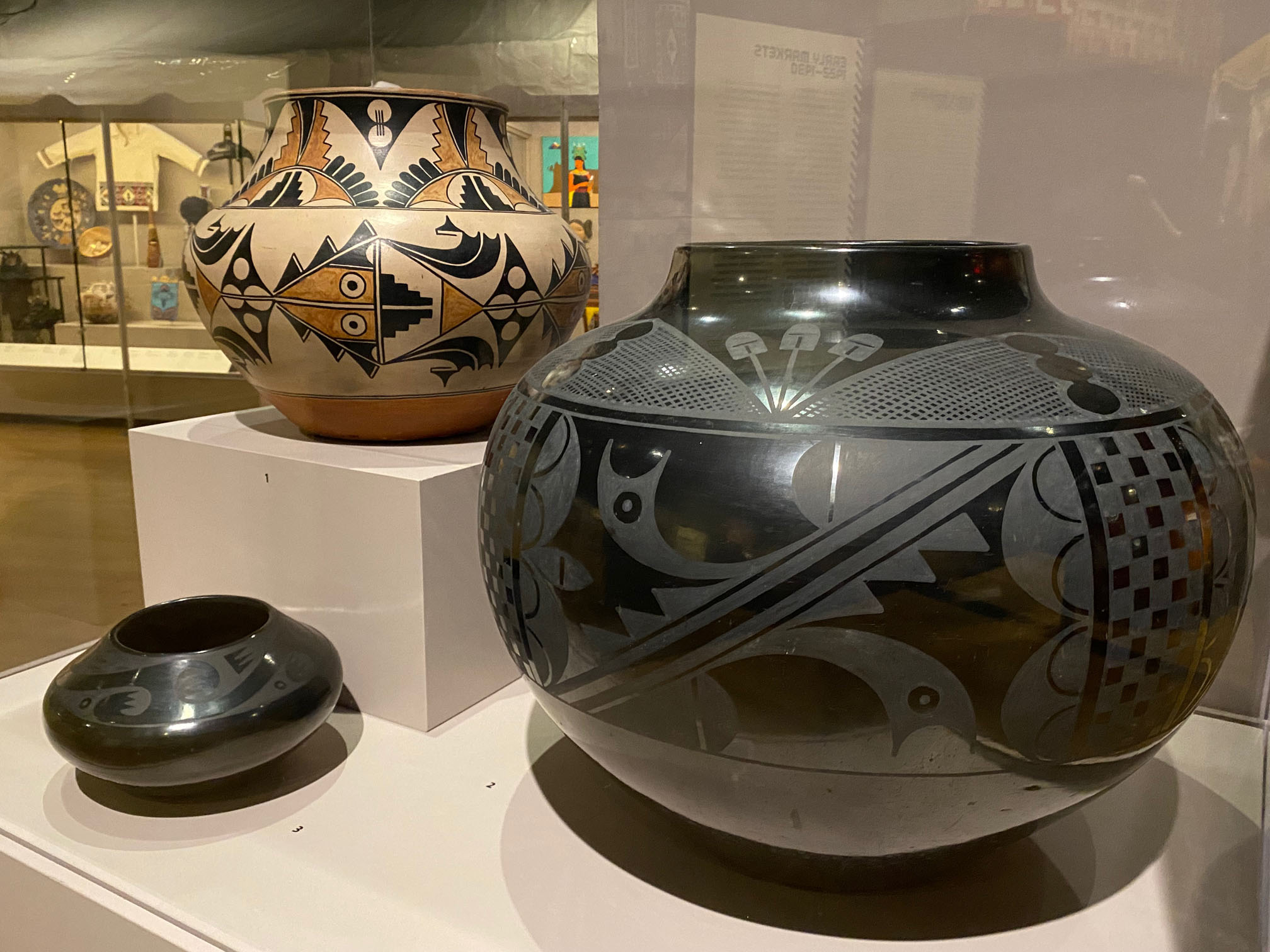
The inter-generational mastery of New Mexico’s Pueblo artists is featured in several vitrines holding examples of black-on-black (and other) masterworks by the Martinez family at San Ildefonso (go, Maria!) and the Tafoyas of Santa Clara, with Margaret’s famous bear-paw imprints.

Work by famed San Ildefonso artist Maria Martinez: 1922 polychrome, large 1942 black pot (award-winner painted by Julian Martinez); and 1928 jar. Courtesy: MICA, SAR

The surrounding gallery features dazzling painted pottery works by Zuni and Acoma from the 1920s – all drawn from the School for Advanced Research (SAR) collection, which began in 1922 to preserve classic works, SAR is the source of the acclaimed exhibition now at the Metropolitan Museum, Grounded in Clay: The Spirit of Pueblo Pottery. Sometimes the artists who made the pot is known; but often the maker is lost to history.

1928 Acoma jar. Courtesy: SAR

In the 1930s and 1940s across the United States, tribal mortality rates increased and their other economic lifelines decreased. But these conditions in the Southwest made the Market an even more important source of family revenue. Throughout the 1940s, the Santa Fe Market boomed.

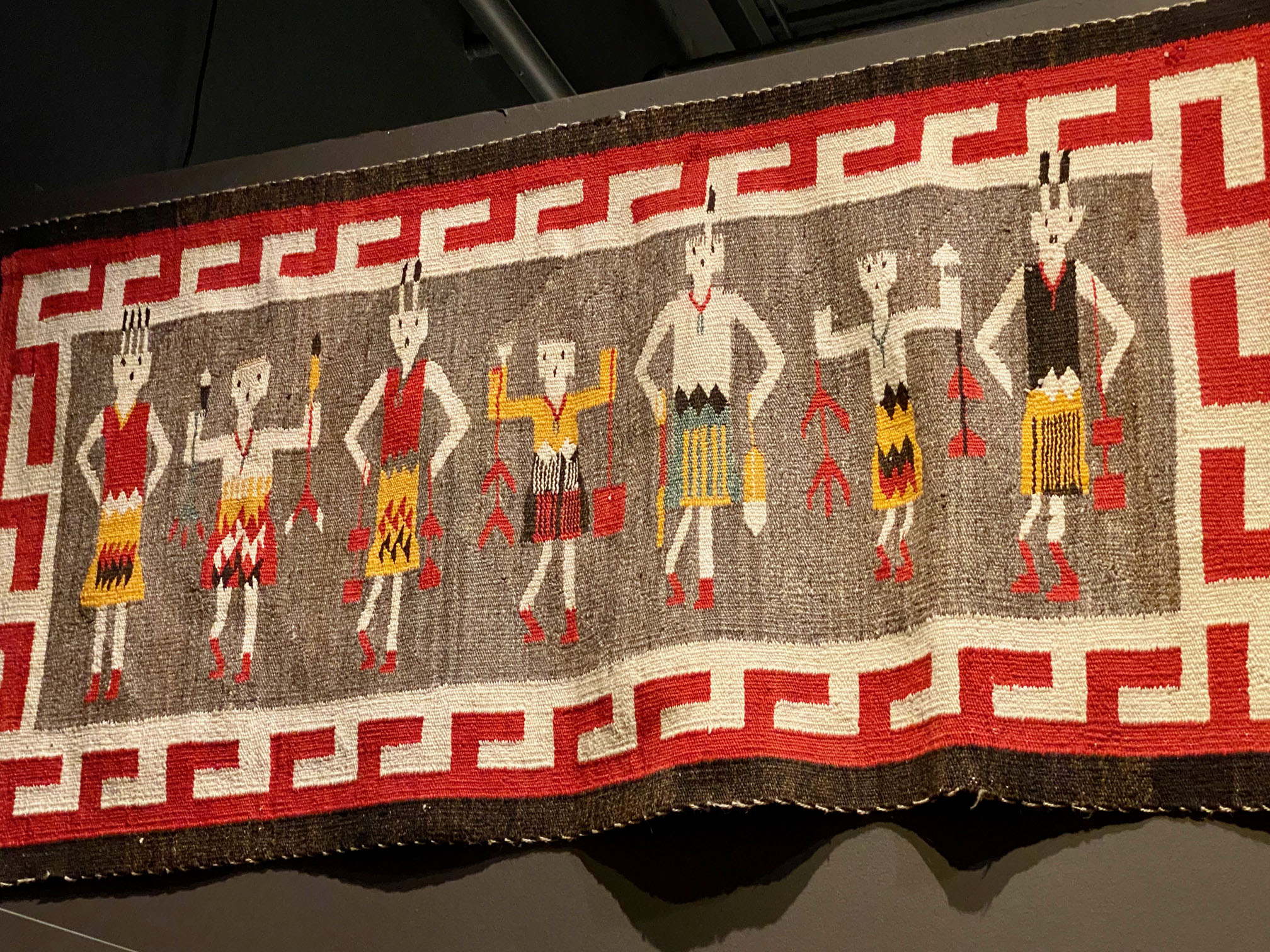
1920-1930 Navajo hand-spun wool rug with figures representing the fire dance. Courtesy: Historic Toadlena Trading Post Museum.

By the 1950s, Federal government instituted policies to encourage Indians to leave their land and move into cities. Unfortunately, Santa Fe Indian Market policies had the same depressing effect – the organizers reduced both the number of artists allowed to show and amount of prize money that could be won.

By 1959, the SF Indian Market was on life support, with a few private donors stepping in with funding just to let it survive.

But during the 1960s, changes were afoot. The Institute for American Indian Arts began in Santa Fe, where Lloyd Kiva New gave Native artists “permission” to throw off traditional conventions and make contemporary art. Across the United States, social-justice movements focused on indigenous people’s rights demanded policy changes to reverse the impact of oppression. By 1968, Congress had passed the Indian Civil Rights Act.

What did that mean for the Market? The majority of works on display in the museum gallery are from the post-1970s period, when the scope, range, voice, virtuosity, and experimentation reflected the times.

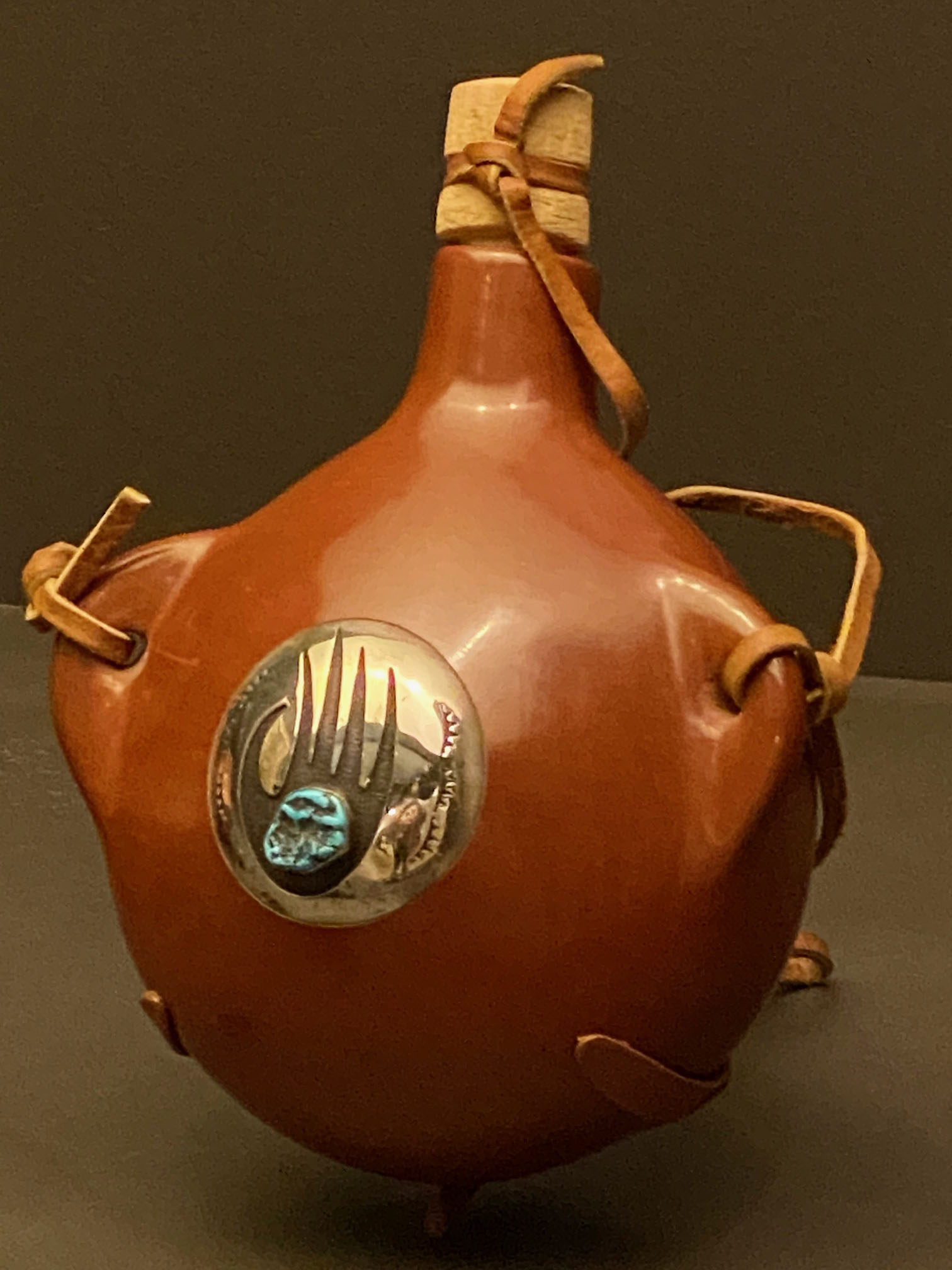
1974 pottery canteen with turquoise and silver by San Ildefonso artists Rose Gonzales and Tse Pe. Courtesy: private collection.

Here are some examples – the glorious, gleaming, turquoise-inlaied 1980s vessel by by Zia/Jemez/San Ildefonso artist Dora Tse Pe and the virtuoso painting on a jar by by Acoma artist Dorothy Toriio.

1980s pottery jar by Zia/Jemez/San Ildefonso artist Dora Tse Pe. Courtesy: private collection.
1990 pottery jar by Acoma artist Dorothy Toriio. Courtesy: King Galleries.

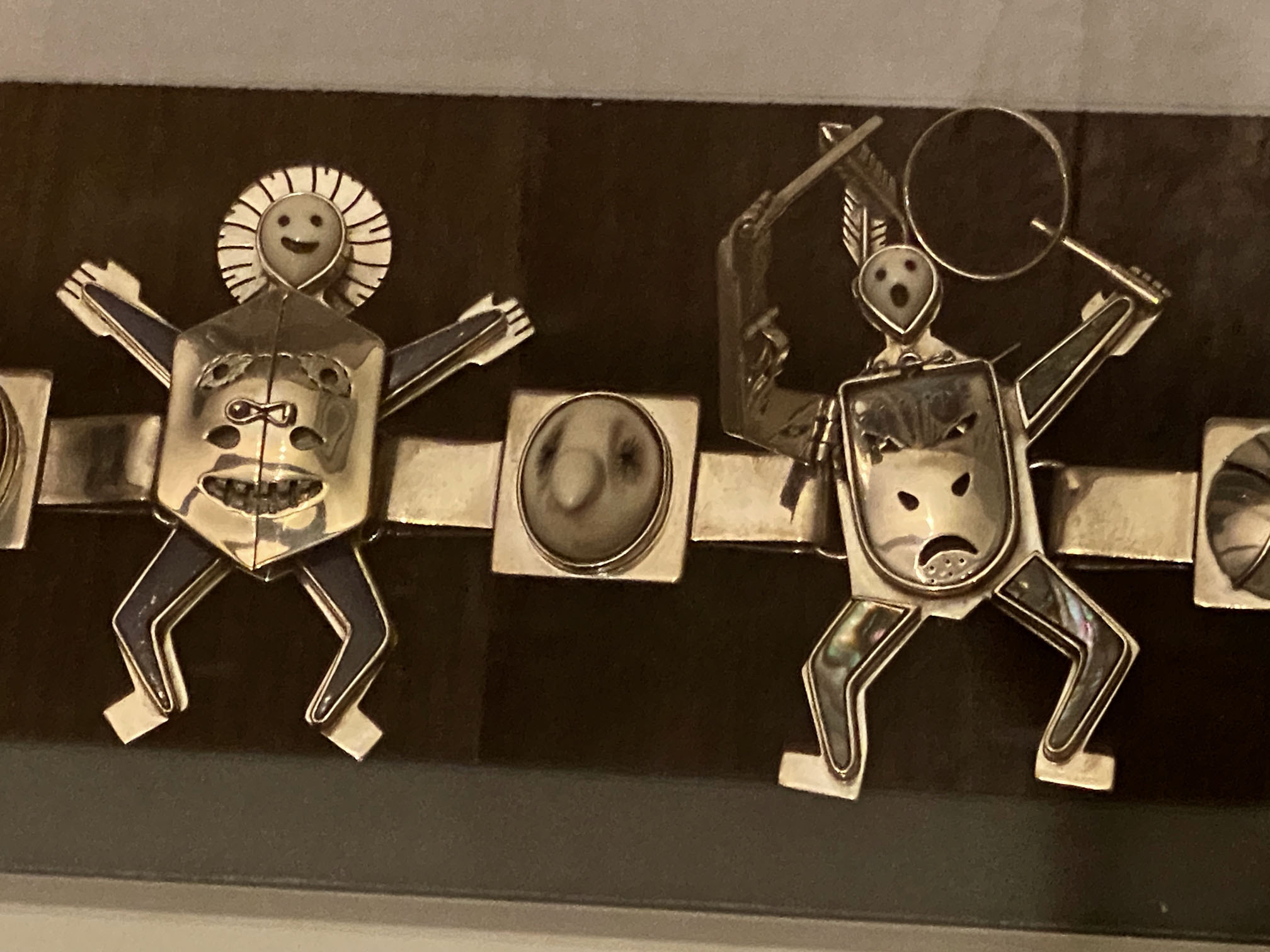
Or, consider the virtuoso silverwork and inlaid belt by Aleutian master Denise Wallace; edgy, theatrical 1990s Cochiti figurines by Virgil Ortiz; and a 1999 horsehair basket woven by Tohono O’odham artist Leona Antone. See more in our Flickr album.

Silver 1986 “Aleut Dancer Belt” by Aleut artist Denise Wallace with abalone, fossil ivory, and lapis; Best in Non-traditional Jewelry Award. Courtesy: private collection.

The show’s finale catapults the story of Indian Market into the future.  First, there’s a cluster of sculptural and video works by Virgil Ortiz, featuring his sci-fi, super-powered, time-traveling warriors from the future who travel back to 1680 to fortify the success of the Pueblo Revolt and save Pueblo culture.

“Kootz (Runner-twin brother of Tahu)” 2018 high-fire clay sculpture with “warning” LED lights by Cochiti artist Virgil Ortiz. – a character from his sci-fi 2180 ReVOltage Series. Courtesy: the artist
“Tahu (Blind Archer)” 2018 sculpture with LED lights by Cochiti artist Virgil Ortiz.. Courtesy: the artist

Second, there’s a photo wall of families and their young children, who create work to enter in to the children’s division. It leaves visitors with the strong feeling that not only will forward-looking artists keep innovating and creating, but that the kids will be all right.

Still of 2022 “Made in Native America” video by Cochiti artist Virgil Ortiz, featuring sci-fi costumes. Courtesy: the artist

Pedro Reyes Takes Direct Action in Santa Fe

You first see a group of anonymous protestors – statues that appear to be taking it to the streets with placards and bullhorns. Elevated at different levels, they present a monument to non-violent protest – a fitting opening to Pedro Reyes: DIRECT ACTION, on view at SITE Santa Fe through May 1.

Reyes believes in participatory art projects that transform art-making into social action.

The Protesters, Reyes’ 2016-2017 monument to unified voices that bring about change from non-violent protest. Courtesy: the artist, private collectors.
Memento, 2022 – vases made from gun parts by Albuquerque and Santa Fe students. All for sale.

The products of his 2022 Memento are right behind you – an array of fun flowers popping out of tall vases. Look closer.

The airy containers are transformed guns from a New Mexico buyback program that incentivized people to exchange their guns for grocery or home-store gift cards. The vases, made by welding-class students from Albuquerque and Santa Fe, are all for sale, with proceeds going to fund activities by New Mexicans to Prevent Gun Violence.

Turning the corner into the next installation, you encounter a wall of videos and shovels in a similar transformation – Palas por Pistoles – that Reyes organized in a particularly violence-prone community in western Mexico.

Reyes’ Palas por Pistoles (2006-present) – shovels made from melted-down gun parts, which were used by schools and museums to plant trees.

Reyes asked people to donate guns to be melted down for an art project promoting environmental peace. He received 1,527 weapons, crushed them in a public-art event, and commissioned a foundry to make shovels. Schools and museums used the shovels to plant 1,527 trees.

Every turn in the gallery reveals a different type of installation and project – libraries for “the people,” sculptures referencing language systems, posters protesting nuclear arms, and musical instruments and contraptions created from weapons.

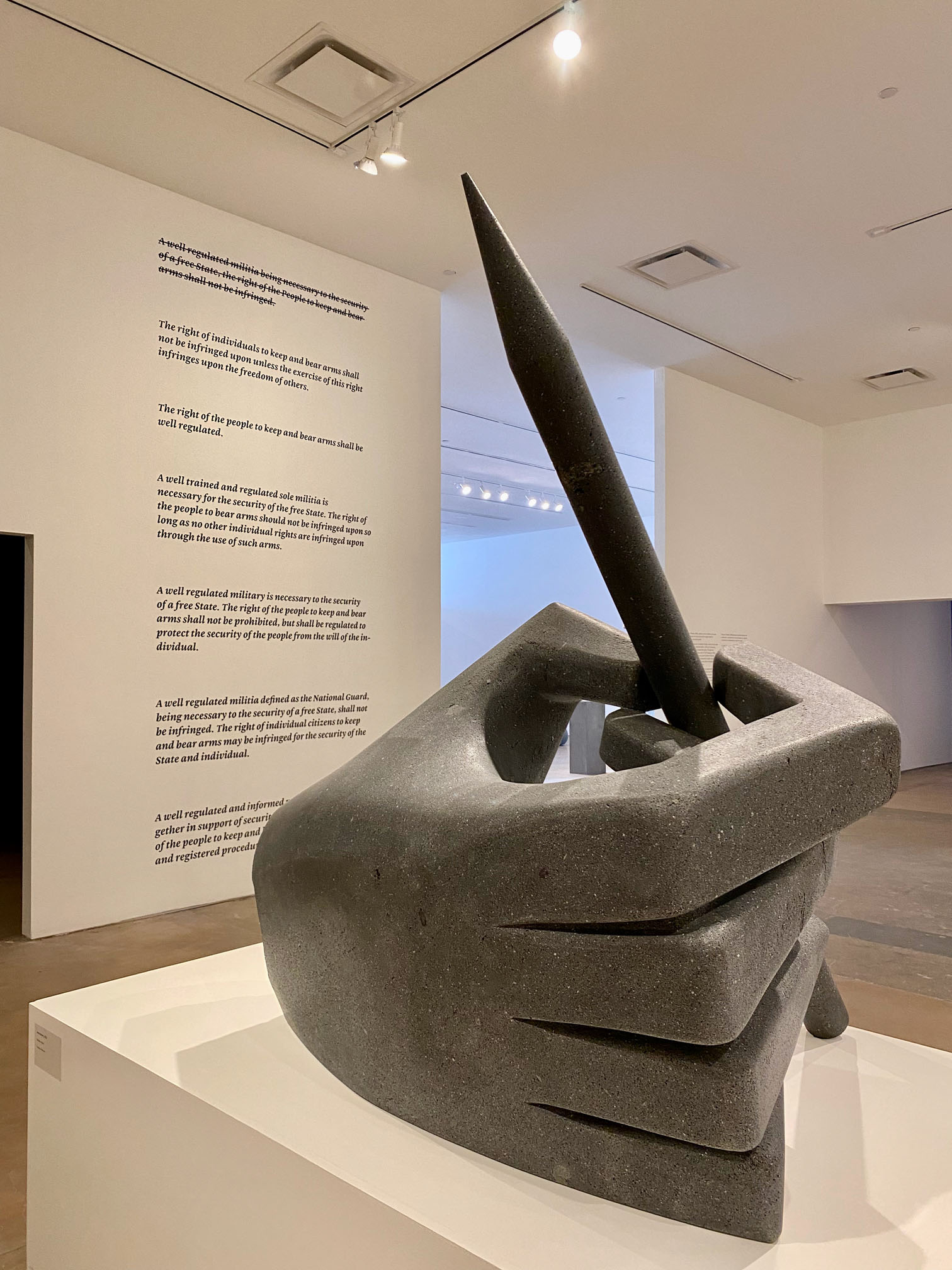
You can’t miss the artist’s large volcanic-rock hand with pencil – an emblem of Reyes’ Amendment project that held community meetings where rewrites to the Second Amendment were proposed and discussed. The idea is that with so much discussion on policies these days, it’s better to write down the “amendments to the Amendment” in pencil! A list of suggestions is prominently posted nearby.

2002 Amendment volcanic stone hand writes the Second Amendment in pencil to facilitate changes in wording as necessary. On wall, multiple drafts of the Second Amendment generated in a Tampa, Florida community project.
Reyes’ 2022 marble sculpture, Colloquium (Parafrasis) depicting the architecture of speech; in background, icons of solutions to social problems from The People’s United Nations (pUN) project – food insecurity, population, gun control, mass incarceration.

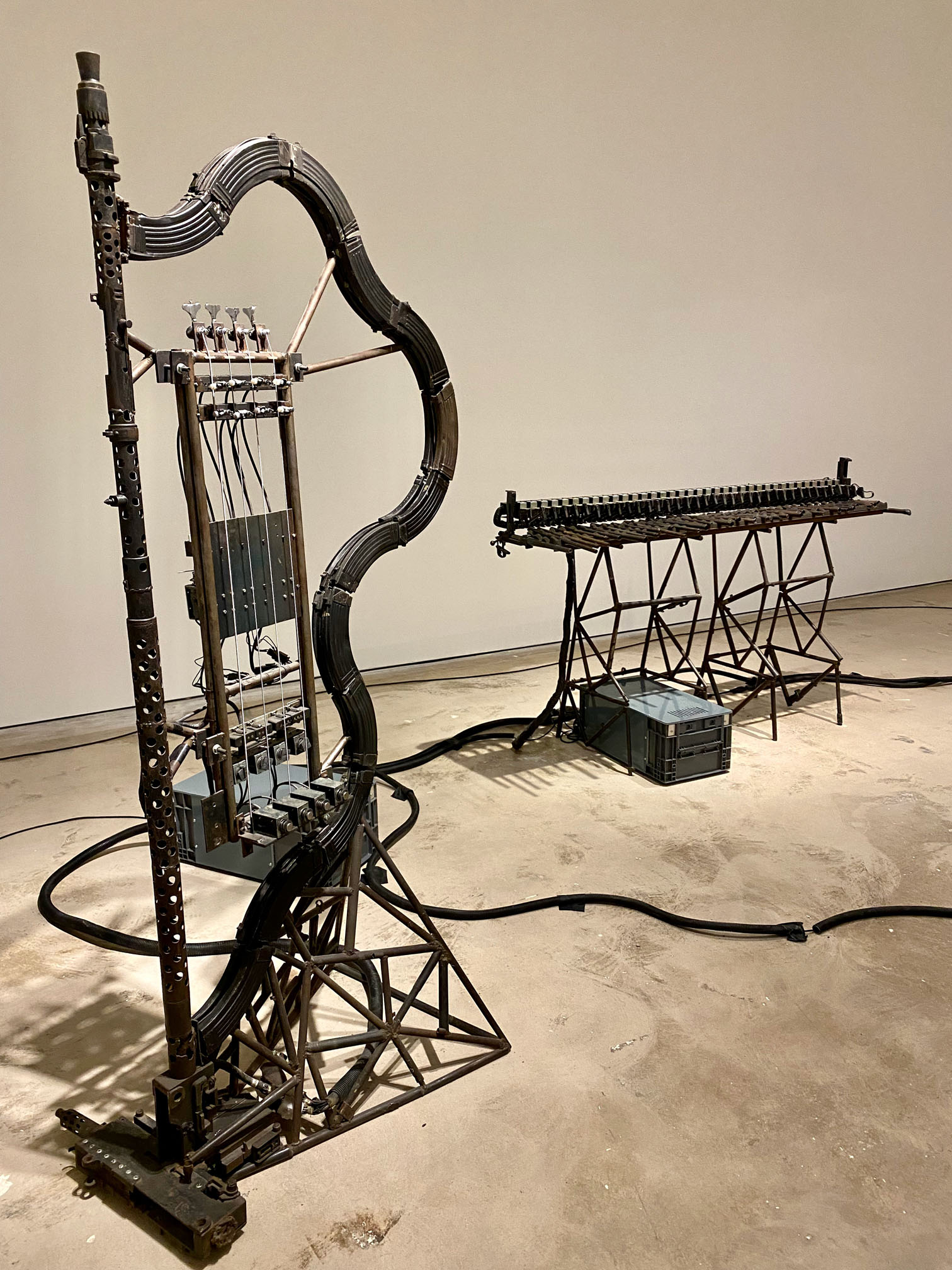
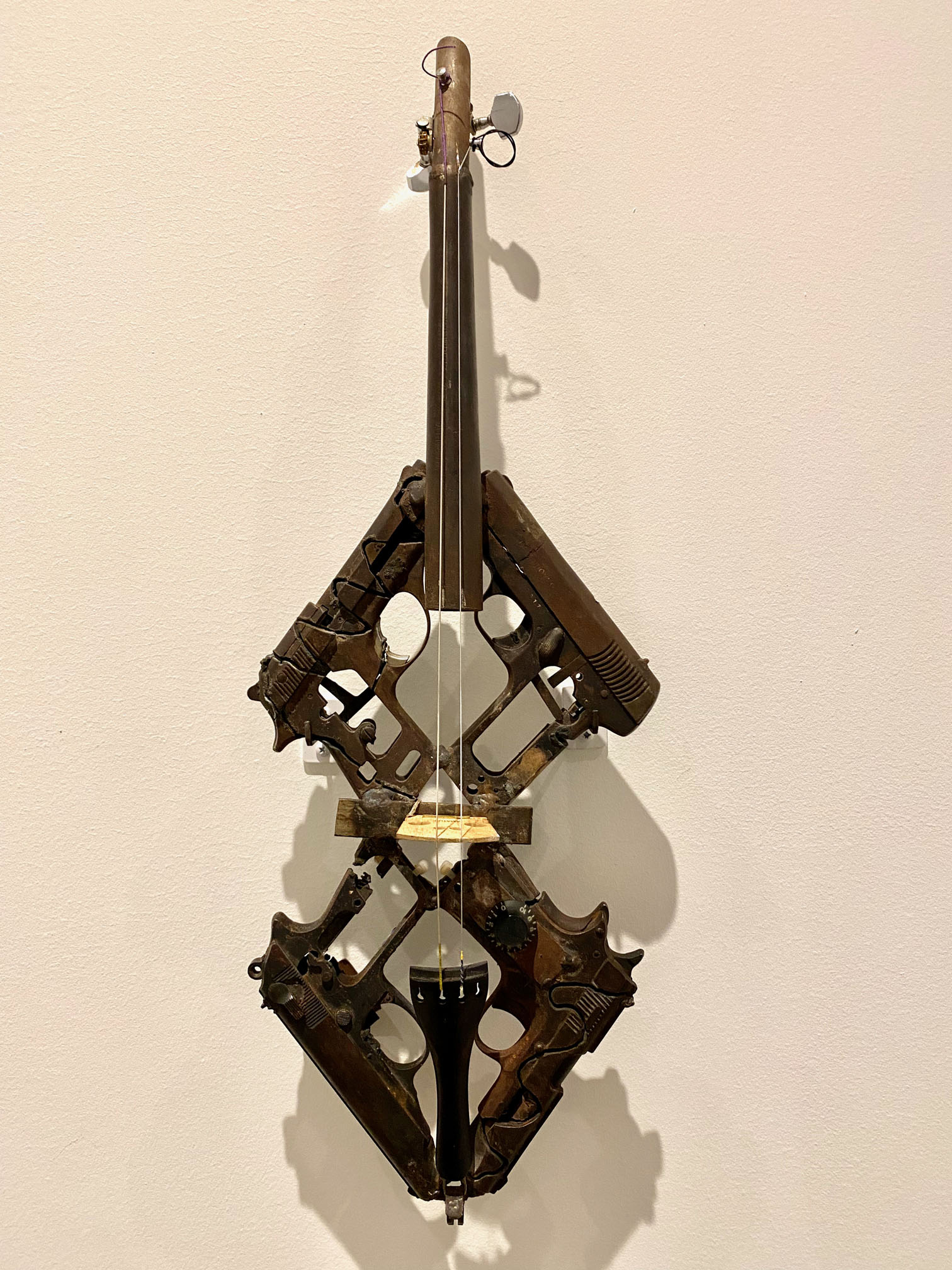
Visitors tend to linger in the Disarm gallery, closely examining the various automated musical instruments created from firearms. Every few minutes, one of the pieces awakens to pluck a string or tap out a slow sequence. It’s a bit startling, not knowing which of the seven is going to activate next.

Harpanet and Cañonófono in Disarm Mechanized, mechanized instruments made from recycled gun and rifle parts. Courtesy: Enrique Rojas.
Reyes’ 2012 Disarm (Violin) from destroyed weapons, played in SITE Santa Fe concerts in 2023. Courtesy: the artist.

Take a look at our Flickr album to see more of the exhibition and to hear the sounds made by the Disarm instruments.

SITE Santa Fe provides “activators” for Reyes’ Music Machine installation – an experience that demonstrates how one artist’s imagination can make you stop and think, even if it’s toward the end of a deep, contemplative show.  Reyes features iconic firearms from three European countries – Austrian Glocks, Swiss Carbines, and Italian Barettas – that have been transformed into classy music boxes. When activated, each plays a musical composition by a famous composer from that country.

Gallery educator Red Hart about to activate Reyes’ Machine Music – crank-operated music boxes made of Swiss Carbine rifles, Italian Barettas, and Austrian Glock pistols.

Hear the artist talk about each of these works in the SITE Santa Fe audio guide, and take time to ponder taking direct action as you visit this beautifully installed, socially relevant, and thought-provoking show.

No Nukes installation with series of 2022 hand-painted Zero Nukes posters in different languages, representing many countries. Courtesy: the artist.

Fronteras del Futuro in the Southwest

Pow! Wham! What? It’s superheroes, avatars, and mixed-media channeling sci-fi social consciousness in an engaging, colorful, thought-provoking mix in the super-fun Fronteras del Futuro: Art in New Mexico and Beyond exhibition at Albuquerque’s National Hispanic Cultural Center through March 12.

These artists love mixing pop culture images, found objects, and historic iconography to question where we’ve been and where we’re going. Take a look at our favorites in our Flickr album.

Some artists use pop culture to get our attention on deeper issues. The back-to-the-future B-movie poster series by Angel Cabrales prompts reflection on societal attitudes about immigrants and border issues.

2016 B-movie poster by Angel Cabrales to spur discussion on immigration and border issues. Courtesy: the artist.

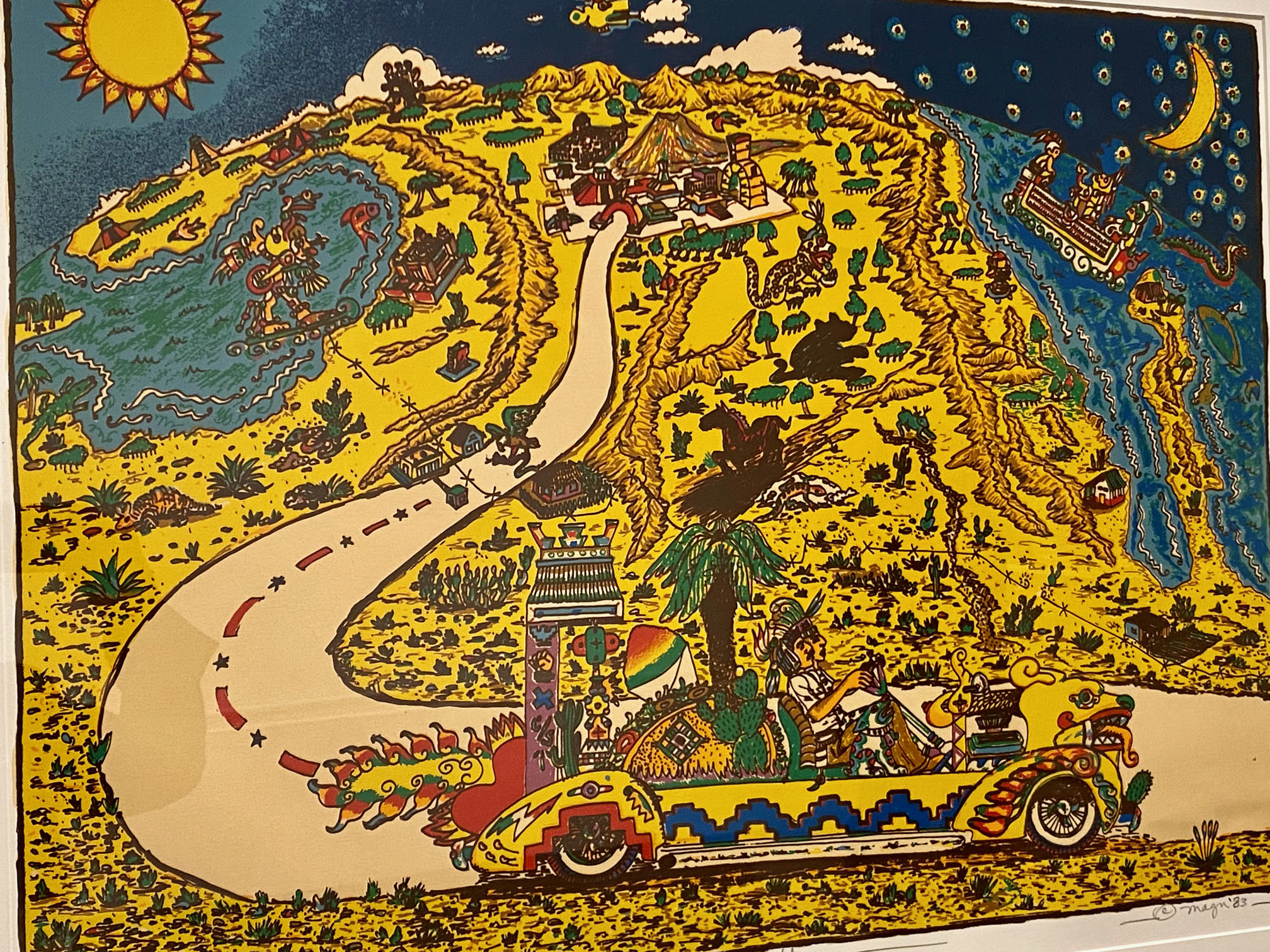
Gilbert “Magú” Luján’s silkscreen merges the epic scope of Mesoamerican history into a contemporary context. A stylish Aztec couple takes a cross-border journey from Aztlán to Texas in a pre-Columbian-styled low rider.

1983 silkscreen Return to Aztlán by Gilbert “Magú” Luján; a cross-border journey and reflection on pre-Columbian roots and heritage.

One of the most epic achievements is a wall-length, accordian-folded letterpress codex – a collaboration by Enrique Chagoya, Guillermo Gómez-Peña, and Felicia Rice. Codex Espangliensis features pop-culture superheroes, pre-Columbian imagery, comics, and social declarations to explore New World history from 1492 to the present.

Designed to be read right to left: cover and first pages of Codex Espangliensis from Columbus to the Border Patrol, a hand-colored letterpress accordian-folded book.
Pages from 1999 Codex Espangliensis from Columbus to the Border Patrol, a hand-colored letterpress book by Enrique Chagoya, Guillermo Gómez-Peña, and Felicia Rice.

Another set of artists rummages around to find tossed-off computer parts, circuit boards, skateboard parts, and other found items to create their works.

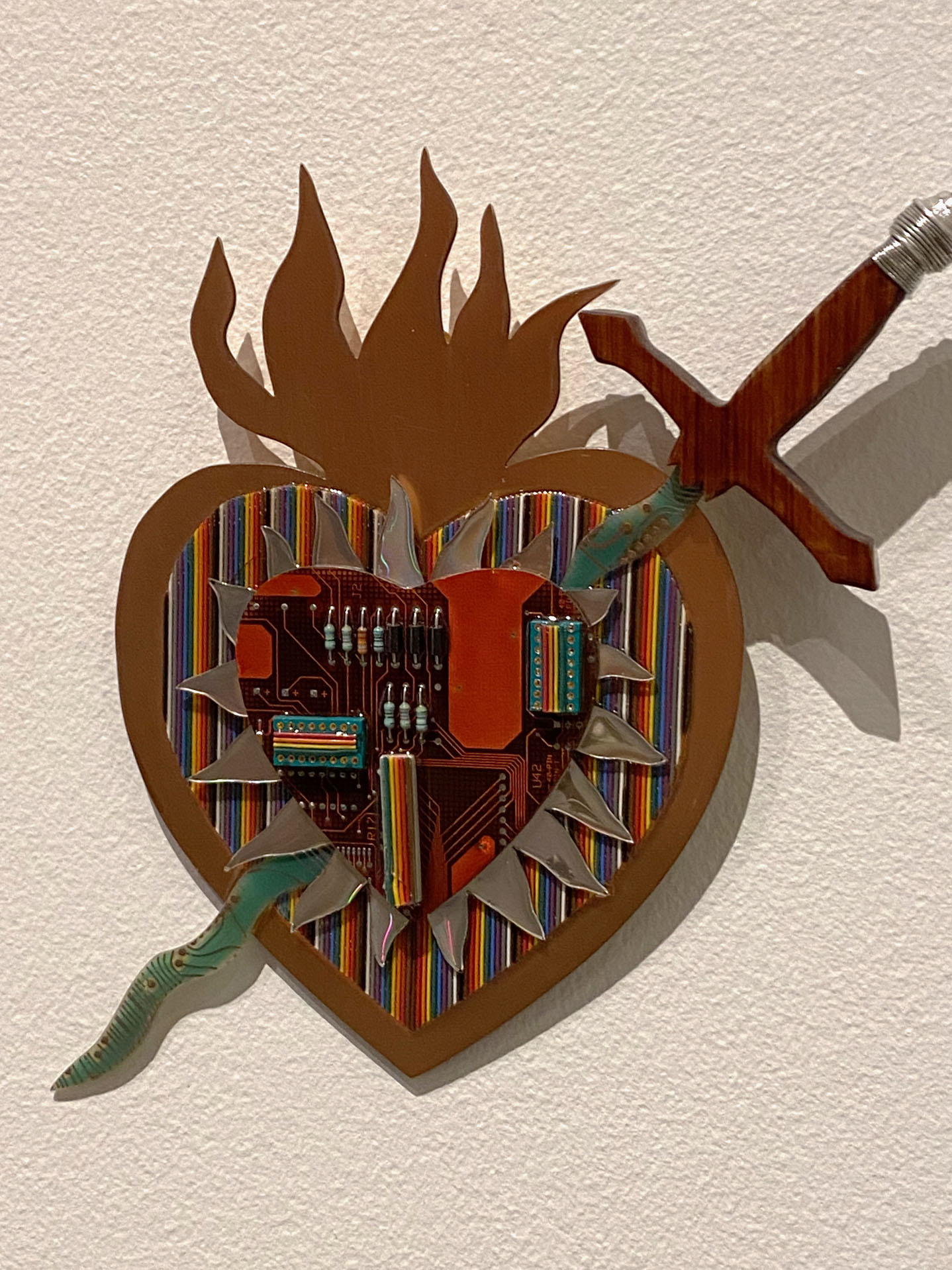
Marion Martinez’s 2002 Pierced Heart/Milagro; circuit boards and wood. Courtesy: the artist
Esteban Borjorquez’s 2018 Zena of Urion – a sci-fi creation from discarded items. Courtesy: the artist.

Marion Martinez grew up near Los Alamos National Laboratory, and started visiting its salvage area to find components from which to assemble her artworks – transforming discarded tech into beautiful icons of Northern New Mexican heritage.

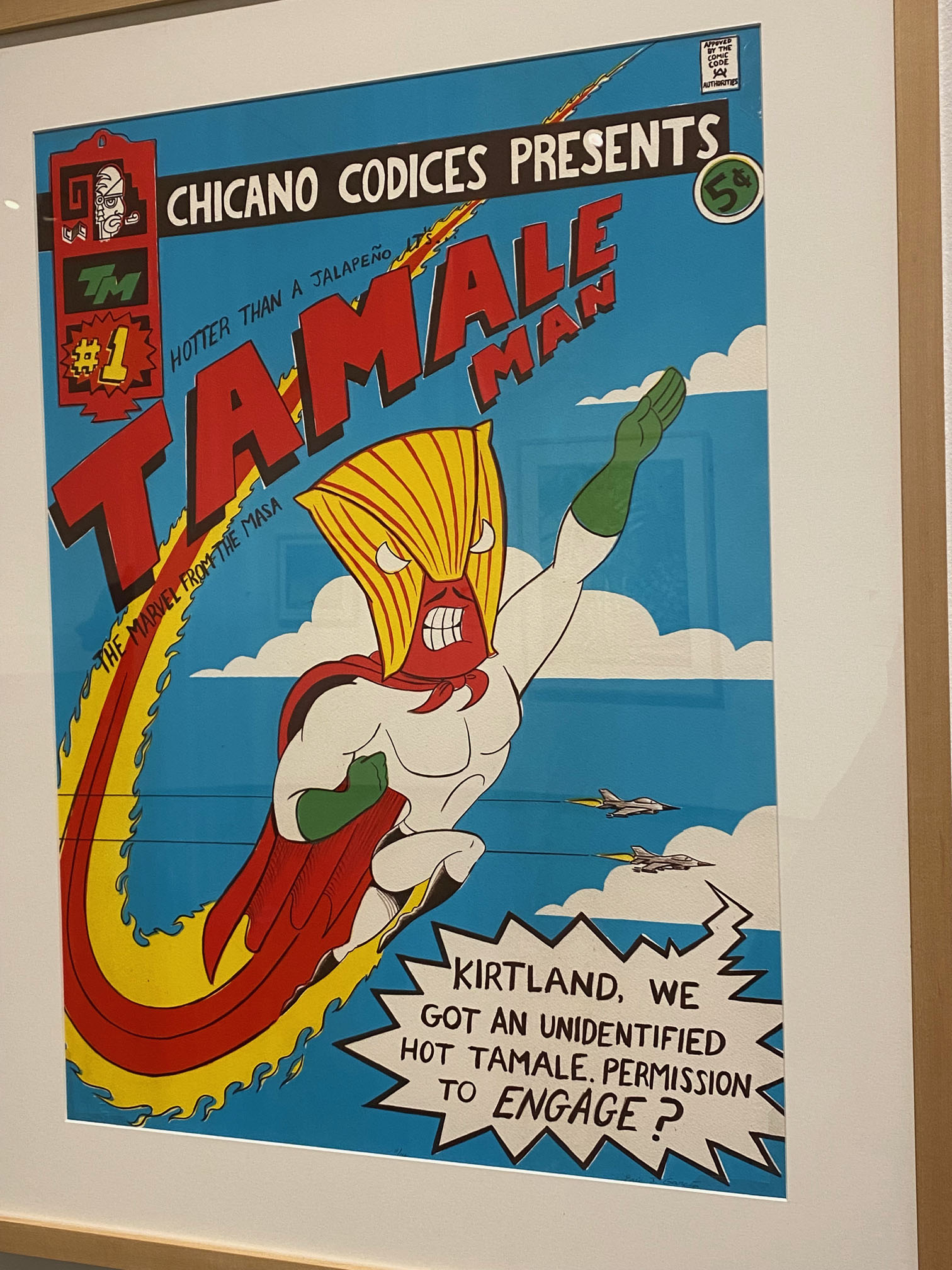
Eric J. Garcia’s 2005 lithograph Tamale Man.

Roswell political cartoonist Eric J. Garcia takes another angle on mixing New Mexico’s cultural, culinary, and nuclear history. His Tamale Man series features the transformation of a guy munching a tamale at the first blast at the Trinity Site into a radioactive superhero.

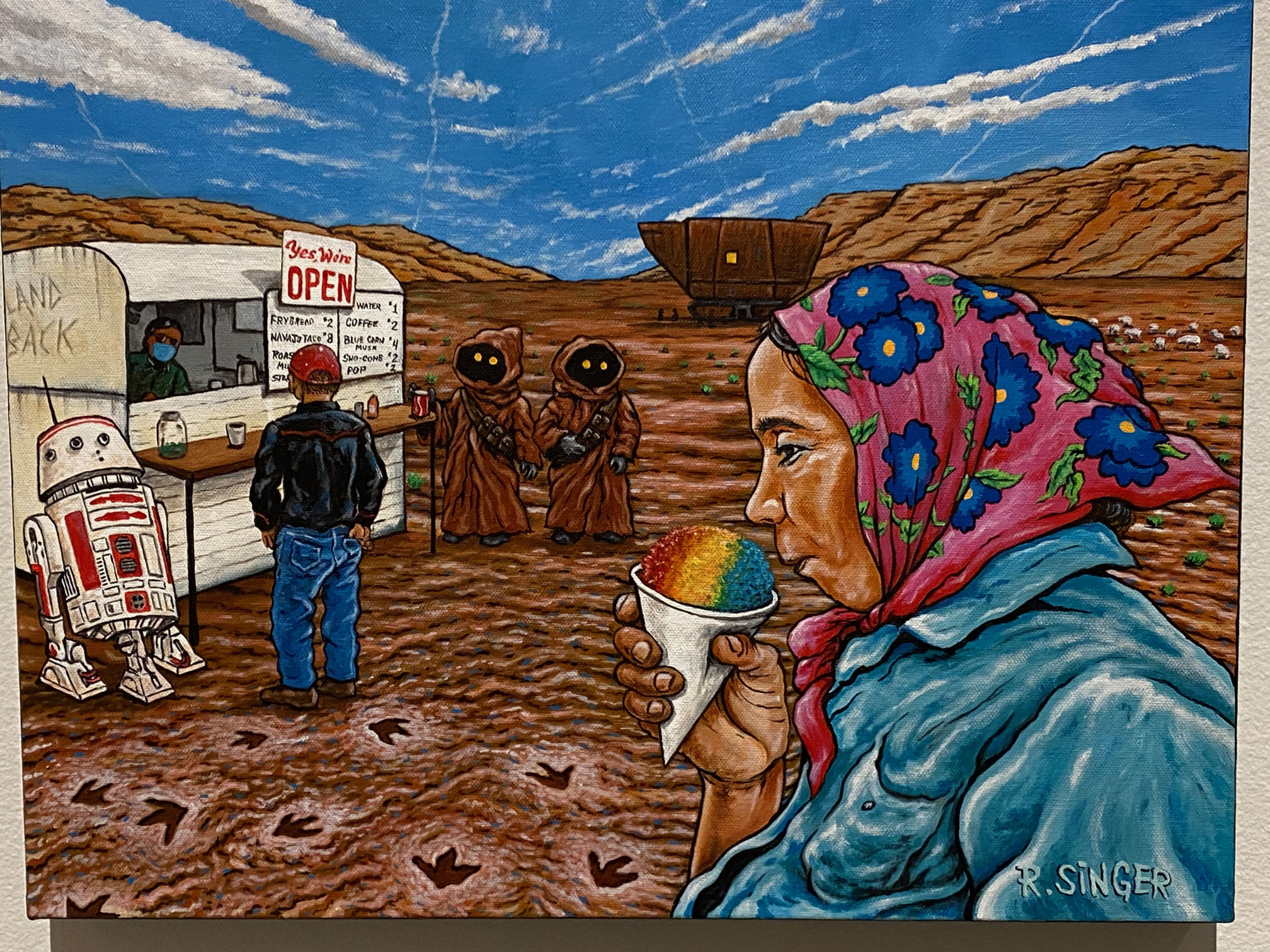
Ryan Singer’s painting series blends his childhood fascination with Star Wars and other futuristic sagas with his Navajo heritage and upbringing.

Ryan Singer’s 2021 acrylic, Rainbow Flavor.

Meet Ehren Kee Natay, a Diné artist, whose work opens the exhibition with a loving tribute to his grandfather, the first Native American to release a commercial record: